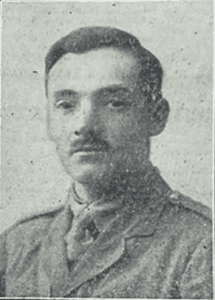
2nd Lieutenant Allan Harrison Hudson

Allan Harrison Hudson was born on December 1, 1894 at Tiviot Dale, Stockport, Cheshire. His father, Jervis Tarbuck Hudson, was a publican and married Ann Harrison on August 2, 1893.  A daughter, Kathleen Louise Hudson, was born on June 19, 1896.

Allan was educated at Denstone College, Staffordshire, where he obtained his colours for both cricket and football, and where he was in the Officers Training Corps (O.T.C.) for two years. Afterwards he was articled to Messrs. Brown, Briggs and Symonds, solicitors, Stockport, and passed his intermediate examination in March 1914. He was a member of Hyde Golf Club. On the outbreak of the war he joined the Manchester University O.T.C., and was given his commission in the 9th Manchester Battalion on November 14, 1914.

2/Lt. Allan Harrison Hudson

He proceeded with the 2/9th Manchesters to Southport for training, and later he volunteered with 2nd Lieut. A.W.F. CONNERY and 2nd Lieut. JOHN M. ROBSON, for active service with the 1/9th Battalion. On April 1, 1915 the three officers were sent  to Egypt, where they joined the Battalion around April 13th. He landed with the 1/9th in Gallipoli on May 9, 1915 as a platoon commander in “B” Company.

The following is excerpted from the personal diary of 2/Lt. Charles Earsham Cooke:

June 13. Sunday. HUDSON, poor fellow, went down to base early and was climbing over parapet to get 2 men who were over gathering-up equipment and got badly hit in left side; died a few hours later.

2/Lt. Allan Harrison Hudson died of wounds on Sunday June 13, 1915. He was 20 years old. He was buried at the Lancashire Landing Cemetery and is commemorated at the following places:

  1. Ashton-Under-Lyne Civic Memorial.
  2. St. Stephen’s Church, Flowery Field, Hyde.

The brass plaque at St. Stephen’s read: To the glory of God and in loving memory of their only son, Allan Harrison Hudson, 2nd Lieutenant 1/9th Manchester Regiment, who was killed in action in Gallipoli, June 13th 1915 aged 20 years. The East Window is erected by his devoted father and mother.

Lancashire Landing Cemetery

2nd Lieutenant Fred Jones

Fred Jones was born in Openshaw in June 1894.  His father, Arthur Jones, was a plumber and married Emily Rogers on 29 May, 1880. In 1901 Fred was six years old and living in Openshaw with his parents and siblings Bertha, Eva and Arthur.

By 1911 Fred was at school and living with his parents in Droylsden, his older sisters and brother having left home. He studied at University in London and Manchester and initially took a position as assistant master at Birley Street School, Manchester later becoming an assistant master at the West End Council School in Ashton-under-Lyne. He was getting ready to take his final University exams when war broke out.

Private 1551 Fred Jones joined the 9th Battalion Manchester Regiment on December 15, 1913 when he was 19 years and six months old. He passed a class of Instruction for promotion on April 11, 1914 and was subsequently promoted to Corporal on May 14, 1914. He was promoted to Sergeant on August 4, 1914 when the 1/9th were mobilised. On leaving Bury with the Battalion in September for Egypt he was still officially a Sergeant but he was commissioned as a 2nd Lieutenant and gazetted on September 30, 1914 a week after the battalion’s arrival in Egypt.

2/Lt. Fred Jones

He served with the Battalion in Egypt throughout their training and preparations for action and subsequently landed with the 1/9th in Gallipoli on May 9, 1915.

Cpl. 243 Thomas Valentine, a 26 year veteran of the 9th Manchesters, stated that he was stood behind Lt. Jones in shrapnel gully. He was at the top of the gully talking to two other officers when he suddenly fell, one of the officers asked, “have you fell over Jones?”, but when he looked he realised he was dead. He was dead before he hit the floor. We carried him away on a stretcher and buried him in the gully.

Second Lieutenant Fred Jones was killed in action on May 24, 1915. He is buried in the Redoubt Cemetery, Helles and commemorated on the Ashton-Under-Lyne Civic Memorial.

Redoubt Cemetery

2nd Lieutenant John Broadbent

John Broadbent was born in Ashton-under-Lyne on September 4, 1872.  His father, Timothy Broadbent, was a Pawnbroker and died when John was just 2 years old.

Lt.-Col. D.H. Wade T.D., J.P., Col. Sir Walter de Frece M.P., Lt.-Col. J. Broadbent T.D., J.P. and Major Ralph Lees T.D.
Sunday November 12, 1922. (Copyright Imperial War Museum)

His mother, Mary Henshaw Broadbent (née Wright) took over the Pawnbroker business when his father died and John lived with his mother and his uncle’s family at 243 Stamford St, Ashton-under-Lyne. He was educated at Stamford Academy, Ashton-under-Lyne and enlisted in the 3rd Volunteer Battalion, the Manchester Regiment on February 8, 1892. Three years later he was awarded a commission as a Second Lieutenant, on May 22, 1895.

On December 22, 1897 he married Mary Hannah Marland and they lived in Ashton. He was promoted to Lieutenant on December 16, 1896 and served with the detachment the Battalion sent to South Africa in the Second Boer War being promoted to Captain on June 13, 1900. He was promoted to Major on July 18, 1907 and was subsequently appointed to the 9th Battalion Manchester Regiment when it was formed  on April 1, 1908.

By 1911 he and his wife had moved to Bella Vista, Castleton, where he was a large land owner,  and were living there with a servant.  Major John Broadbent resigned his commission with the 9th Battalion on April 20, 1912, retaining the rank of Major.

When war broke out he re-enlisted with the 1/9th and was awarded a commission as Second Lieutenant, dated September 5, 1914 while the Battalion were at camp at Bury. This must have been quite a difficult decision for him as he was by now 42 years old and his wife was about to give birth which she did on September 13th when Mary Henshaw Broadbent was born, (named after his mother who had died in 1912).

Nevertheless, he joined the Battalion at Chesham Fold Camp, Bury in September 1914 sailing with them to Egypt later that month.  He served with them there throughout their training and preparations for action. He landed with the 1/9th in Gallipoli on May 10, 1915 as Transport Officer arriving one day after the main force.

Regimental records note that he was assigned for special duty in Alexandria for 16 days from September 11, 1915 and the Brigade war diary reports that 2/Lt. J Broadbent was sent sick to hospital on October 7, 1915. Two weeks later he was invalided to the UK on October 21, 1915.

In England, he rejoined the 3/9th Battalion at Codford, Salisbury Plain in January 1916 and on April 26, 1916 rejoined the 1/9th Battalion in Egypt.  The London Gazette in 1917 notes that he was promoted to Lieutenant with precedence from June 1, 1916. He managed to take 4 days leave in Cairo from October 22-26, 1916 and took another 2 days, again in Cairo, from February 18-20.

He sailed with the Battalion from Egypt landing in France on March 11, 1917. He took two weeks home leave in the UK from May 6-21, 1917 and again from October 4 – 18th, 1917. Six weeks later he was sent to hospital sick and remained there from November 27 to December 28, 1917. He left the battalion in the field for the last time on January 10, 1918, reporting to the War Office in the UK. The January 18, 1918 London Gazette announced his promotion to Captain, with precedence from Aug 5, 1917. In England he was transferred to the Territorial Reserve as Captain on March 19, 1918.

After the war, orders to reform the regiment were received in October 1920 and Lt-Col D. H. Wade was appointed Commanding Officer. Captain John Broadbent was appointed Major, (antedated to August 5, 1917), and rejoined the 9th Battalion on August 3, 1921. When Col. Wade retired from the Territorial Force on January 27, 1922 having reached the age limit, Major Broadbent was appointed as the new Commanding Officer and promoted to Lieutenant Colonel the following day. Lt-Col. Broadbent remained in command of the battalion until he completed his tenure on January 27, 1926 retiring with the rank of Brevet Colonel.

Away from the battalion, he became involved in politics and served as Mayor of Ashton-under-Lyne from 1923 to 1925. As a consequence, Broadbent Avenue in Smallshaw, Ashton under Lyne is named after him. In 1931, after he had retired from the Territorials, he became a Member of Parliament for Ashton and remained so until the election of 1935.

Colonel John Broadbent, T.D. died at his home in Castleton on June 9, 1938. He was 65 years old.

John Broadbent Obituary, London Times

2nd Lieutenant Albert Edward Stringer

Albert Edward (Ned) Stringer was born in Ashton-under-Lyne on January 18, 1878. His father Edward Stringer J.P. was headmaster of the Trafalgar Square Day School.

2/Lt. Albert Edward (Ned) Stringer, 1914
Copyright Imperial War Museum

His father died in 1900, leaving a substantial sum of money, and in 1901 Ned was living with his mother Ann Stringer and his sisters Bertha and Janet and his younger brother John (Jack) James Stringer. All of his siblings were teachers, his brother being a pupil / teacher. His oldest sister, Elizabeth Ann (Stringer) was married to Ralph Lees and also living in Ashton-under-Lyne.

He entered the Manchester University in 1897, taking a course in chemistry and obtaining his B.Sc. in 1900. In 1904 he was appointed as a Chemistry Master at Ashton Under Lyne Secondary School, and in 1906 Ned became a Freemason, joining the Ashton Minerva lodge where the 9th Battalion’s Medical Officer, Major Albert Hilton, was also a member. By 1911 he was living with his sister Ann and her husband in Trafalgar Square, Ashton where Ralph Lees had become the headmaster of the Trafalgar Square Day School. Ralph Lees had also been commissioned into the 1/9th Battalion Manchester Regiment in 1905 and by 1911 was a Captain.

At the outbreak of the War, Ned Stringer was the 36-year-old Deputy Headmaster at the Municipal Secondary School, Ashton-under-Lyne. With his brother-in-law’s help, he was commissioned into the 1/9th Manchesters as Second Lieutenant on September 2, 1914 and joined the Battalion at Chesham Fold Camp, Bury. Also in Camp was CQMS Henry Stringer, Ned’s cousin, and a long serving member of the battalion but Captain Ralph Lees had fallen ill in camp and had to return to Ashton to undergo an operation.

Ned sailed with the battalion to Egypt in September 1914 serving with them there throughout their training and preparations for action.  While he was in Egypt he wrote a number of letters and postcards home to his sister Ann and brother-in-law Capt. Ralph Lees. These letters are published here.

Ned landed with the 1/9th in Gallipoli on May 9, 1915 as a platoon commander in “C” Company. There is only one surviving letter written while he was in Gallipoli, which was to his younger sister Bertha, and it is reproduced below:

Mediterranean Expeditionary Force
May 28, 1915

My Dear Bert,

Your welcome letter arrived today and as I am “resting”, so called, I have time to reply. We have been three weeks here & during this time I have lived many lives. We saw a bit of fighting on the Canal and then came on here. As we arrived, we found the whole British fleet in action and hundreds of guns replying. I never realised how real Belle Vue fireworks were but this bombardment which I suppose is the biggest that has happened in the history of the world was terrible.

At any rate the army is now well fixed up on land. When we landed, we were heavily shelled & an old South African soldier said he had seen more shells aimed at us in 10 mins than he saw in the whole South Africa war.

We advanced and occupied trenches and all through the night realised what rifle and maxim fire was. Later, we dug ourselves in the earth and then lived in dug-outs in the earth for some days. At last, we occupied the firing line & at the end of five days when we could not sleep, my company was given the job of making an advance. Each man took a pick and shovel and we rushed out in front and began to dig a trench 150 yards forward. We of course got head cover as soon as we could and by 2am were fairly well established though machine guns tried their best to remove our cover and get us at all points. We struck a spring about 3am and the water got above our knees and to add to our discomfort a heavy storm broke over us.

We worked on however, as only men who fear the worst can and they could not relieve us until 3pm next day. During those 30 hours I lived a lifetime and the feeling came that anything was preferable to a continuance of things. Now in the rest camp in delightful sunshine by the sea in a country resembling Marple things seem brighter.

Of our many casualties and trials, I will say nothing but I think all actually fighting, & realising what war is, want peace – peace with honour but not too unbending an attitude. Of the many thousands of England’s best lives lost I say nothing but no one can realise what privations men on service have to go through.

Give my love to all & may we meet sometime again.

This serves as a reply to all letters. As regards business matters, they must go by the board. I am in agreement with any action taken. Money matters so little now that it might not exist at all.

Again, I give you all my love & hope to meet you again before very long.

Ever yours, dear Bert

Ned.

The following letter from his friend and then Company Commanding Officer Captain Okell was written to his brother-in-law Capt. Ralph Lees just 10 days after Ned’s and published in the Ashton Reporter on June 26, 1915:

“It is my painful duty to inform you that Ned (Lieutenant Stringer) was killed in action on the evening of the 7th inst. On that day our Company was ordered to charge the enemy and clear them out of the trenches in front of the firing line. On the left were other troops not belonging to our battalion, who had a similar task to perform. Captain F. Hamer and Lieutenant Wade were to charge one trench, and Ned and I the other trench. I was posted a little to the left to give the signal for the advance. I gave it shortly after 7.30, and with a mighty cheer our boys advanced. Immediately the enemy opened a terrific rifle and maxim fire, but Ned and I succeeded in reaching the trench. Unfortunately the enemy were able to open an enfilading fire, which made the trench absolutely untenable. We had to retire, but only about four of us succeeded in doing so safely. Hamer and Wade were subjected to cross fire. Captain Hamer fell before he reached the trench. Wade succeeded in capturing the trench, and held it until about 2 o’clock in the morning. I was of the opinion that the trench would be enfiladed as soon as dawn came, and ordered the troops to evacuate the trench. All the battalion was shocked at the terrible news of Ned. Ned had made himself a favourite with the men, and also with his brother officers. We all send you our deepest sympathy”

A couple of weeks after his death Ralph & Ann Lees received his official death notification from the Army:

Death Notification Telegram
Copyright Imperial War Museum

2/Lt Albert Edward Stringer was 37 years old. His body was never recovered and he is commemorated on the Helles Memorial.

The Empire (or Cape Helles) Memorial
Copyright: Harvey Barrison

He is also commemorated on the Ashton-Under-Lyne Civic Memorial and the University of Manchester War Memorial, Main Quadrangle.

In March 1916, Captain and Mrs. Lees presented the Ashton Secondary School, where he was deputy headmaster before the war, with a large framed photograph of 2/Lt. Stringer.

2nd Lieutenant Charles Earsham Cooke

Charles Earsham Cooke was born in Nottingham on June 22, 1896 and named after his paternal grandfather. To family and friends he was known simply as “Earsham”.

Lt. Charles Earsham Cooke, MC

By 1901 the family had moved to Pontefract and Earsham’s father, Frederick William Cooke, was running W.J. Robson & Co Ltd, Maltsters. Earsham had a younger brother, Philip Brentnall Cooke, and a younger sister, Gladys Muriel Cooke, and they lived with their mother, Emma Louise Cooke (nee Brentnall), and father in a large house with three servants.

Earsham was educated at Marlborough College which he attended from September 1910 to July 1913. He was the 1913 Lightweight boxing champion and represented his house at cricket and rugby. After he left school he was employed in the family business and in such capacity may have sold malt to Thomas Grimshaw Hyde‘s family brewery and thus come to know him before military service.

On the 15th August 1914, on the basis of being a former cadet in the Officer Training Corps at Marlborough, he was awarded a probationary commission of 2nd Lieutenant in the 3rd (Reserve) Battalion York and Lancaster Regiment. The York and Lancaster Regiment having their headquarters at Pontefract Barracks, Pontefract and therefore his “local” Regiment.  However, in the same edition of the London Gazette it was announced that he had become a 2nd Lieutenant in the 1/9th Battalion Manchester Regiment, effective September 2, 1914.

He joined the Battalion while they were at Chesham Fold Camp, Bury and sailed with them to Egypt in September 1914 serving with them there throughout their training and preparations for action. He landed with the 1/9th in Gallipoli on May 9, 1915 as a platoon commander in “A” Company.

On the 8th August the battalion went into the trenches, “A” and “B” Companies with the (125th) Fusilier Brigade, and “C” and “D” Companies with the (127th) Manchester Brigade. Lt. Oliver Jepson Sutton took two platoons of “A” company up to the firing line and was almost immediately wounded. Reinforcements were called for and so Lt. Forshaw and Lt. Cooke took two platoons of A” Company to the firing line. 40 hours of intense fighting at close quarters followed with the Manchesters separated from the Turks at times by only a parapet.  “A” Company under Lieutenants Forshaw and Cooke held the position thus saving the entire sector from being retaken by the Turks.  Lt. Forshaw stayed at his position for the entire period, killing 3 Turks with his revolver, and personally throwing a large number of the 800 bombs used in the action.

Lt. William Thomas Forshaw was awarded the Victoria Cross and Lieutenant Charles Earsham Cooke was awarded the Military Cross. Both also being mentioned in the despatches of General Sir Ian Hamilton.

On August 18 he left the battalion for Imbros on a GHQ Escort with 25 men. But shortly after arriving there he became sick and on September 5th, he was admitted to hospital. He was treated for Jaundice and quickly evacuated to Malta where he was admitted to the “Blue Sisters Hospital”  on September 10, 1915. A few days later, on September 14th he was embarked upon the Hospital Ship Massilia and repatriated back to the UK, arriving at Southampton on September 22nd,  suffering from enteric fever.

In the UK he was allowed to recover at home until January 21, 1916 when he was ordered to join the 3rd (Reserve) Battalion at Codford. Here he was put on light duty and on March 23 was passed fit enough to return to full duty. A month later he was ordered to rejoin the battalion in Egypt and embarked the Ivernia at Devonport on April 23, 1916.

He rejoined the battalion in Egypt on June 3, 1916 and was promoted to temporary Lieutenant on August 27, 1916. The only other mention of him in Egypt after that is returning from a course of instruction in Cairo, in late October and taking two days leave in Cairo from February 20-21, 1917.

He sailed with the 1/9th to France, landing on March 11, 1917, and is noted as being a platoon commander on April 22, 1917 when the Battalion was in Epehy. On the evening of May 6th and into the early morning of May 7th “B” Company, under Major Howorth, was responsible for carrying out the following special order:

Two small posts are to be established on either side of the road running from locality b. to QUENNEMONT FARM, one on either side of the road, and joined up. This should be undertaken as a very minor operation, with only sufficient men to dig a rifle pit on each side and then connect up. The object should be to advance these posts a short distance every night without attracting the enemy’s attention; and connect them up from behind with a communication trench.

Lt. Cooke commanded the party and they were met with heavy resistance from German machine guns resulting in many casualties, prompting several acts of heroism bringing wounded men in under fire.  Lt. Cooke was wounded and evacuated to Hospital in Rouen where he later died from his wounds on May 24, 1917. Lieutenant Charles Earsham Cooke, M.C. was 20 years old.

Commonwealth War Graves St Sever, Rouen

He is buried in the Commonwealth War Grave at St Sever, Rouen and commemorated on the:

  1. Ashton-Under-Lyne Civic Memorial.
  2. Leeds Corn Exchange Memorial.
  3. Marlborough College Roll of Honour.

2nd Lieutenant Harold Edward Butterworth

Harold Edward Butterworth was born in Rochdale in October 1888. His father, James Butterworth, was a successful manufacturer of eyelets and eyelet hooks.

James Butterworth

Harold was the youngest son of James Butterworth and Ann Lees Mayall. Harold also had four half brothers and sisters from his father’s first marriage to Martha Schofield.

By 1911 Harold was living with his mother and father at Laurel House, 149 Manchester Road, Rochdale and working in the family business as a traveling salesman. Also living with them was his sister Mary Lees Butterworth and his half brother William Mayall Butterworth along with two servants.

He was commissioned into the 1/9th Battalion Manchester Regiment on September 2, 1914 (supernumary) along with several others. He joined the Battalion while they were at Chesham Fold Camp, Bury and sailed with them to Egypt in September 1914 serving with them there throughout their training and preparation for action. He landed with the 1/9th in Gallipoli on May 9, 1915 as a platoon commander in B Company.

2nd Lieutenant H.E. Butterworth was reported wounded on May 16th in the Divisional war diary and listed on the May 28, 1915 London Times Casualty List; the first Officer of the 1/9th Manchesters to make the list.  According to a letter written by 2/Lt. A.H. Hudson, and published in the North Cheshire Herald, June 26th 1915, 2/Lt. Butterworth was shot in the leg while sitting with some other Officers playing cards. Evidently he was not seriously wounded as regimental records show him rejoining the Battalion 4 days later.

The London Gazette notes that he was later appointed temporary Lieutenant with precedence from June 7, 1915. Regimental records indicate that he was evacuated sick to No 21 General Hospital hospital at Ras-el-Tin Barracks, Alexandria on June 9, 1915, on the hospital ship Grantully Castle. He remained there for 10 days until he was discharged to an Officer’s Convalescent Home at Ramleh.  He remained absent from the battalion for 68 days rejoining them in Gallipoli on August 16th. He is not referenced in the Battalion or Brigade war diaries in Gallipoli except to note that on September 6th he led a group of 50 Other Ranks as Guard to GHQ on Imbros and was subsequently evacuated sick to St. Andrews Hospital in Malta on September 22, 1915, arriving there on October 1. Here he was treated for dysentery and on October 29 was well enough to embark the hospital ship Italia at Valetta for England, arriving at Southampton on November 10. Here he was medically assessed and granted leave until December 24, 1915. Ironically, in a letter published on October 9th in the Ashton Reporter, he is mentioned as being only one of four Officers who joined the Battalion in Bury who was still present at Gallipoli.

He was promoted to Lieutenant on June 1, 1916 and the Battalion war diary next mentions him as arriving in Egypt from the UK on June 4, 1916. On September 2, 1916 he attended a school of instruction for 3 weeks and the following month was allowed 4 days leave in Cairo from November 26-30, along with 2/Lieut. Marsden. On January 31, 1917 he left the Battalion and formed part of the Advance Party in Port Said, (along with Major Nowell, 2/Lt. Greenwood and 2/Lt. Needham), preparing for the Battalion’s imminent departure to France.

He rejoined the 1/9th in France, on March 17, 1917, and is noted as being a platoon commander on April 22, 1917 when the Battalion was in Epehy. On June 3 he returned from 2 weeks leave in the UK and attended a week’s course of unspecified instruction in late June. In early August 1917 he attended a week’s bombing course at Divisional HQ.  He was promoted to Captain on August 5, 1917. He is noted as commanding C Company on October 13 and later that month, on October 25, he proceeded to England on leave, rejoining the Battalion 17 days later on November 11th.

On March 21, 1918 the 9th Manchesters were serving in the in the 198th Brigade of the 66th (2nd/East Lancashire) Division. The 9th Battalion were in the support line south of Péronne between Ferme Lamire and Eterpigny on the morning of March 23, 1918. But on the morning of March 22nd, 2 Companies of the 9th Battalion were in front of Trinket redoubt and it’s probable that the Battalion retired through Roisel during the evening of the 22nd or the early hours of the 23rd. Capt. Butterworth was reported missing and was subsequently found to have been taken prisoner of war.

After the war, orders to reform the regiment were received in October 1920 and Lt-Col D. H. Wade was appointed Commanding Officer. A few weeks later the War Office confirmed the re-appointments of some old officers including Captain Butterworth.

On September 10, 1924 he married Margaret Bessie Hitchon, in Rochdale,  and on March 11, 1926 they had twin boys; Richard Mayall Butterworth and James H. Butterworth. He lived in Healey, Rochdale and worked in the family business, until it closed down, and thereafter as a company director. He was very active in the local community serving as vice president of Rochdale Rugby Union Club, vice president of the Healey Conservative Club and president of the Shawclough and Healey Band.

He remained in the Territorials and on December 28, 1926 was promoted to Major with precedence from January 28, 1926.  He resigned his commission three years later, on January 30, 1929.

Major Harold Edward Butterworth died in Rochdale on May 4, 1939. He was 50 years old. He was buried in the family grave at Rochdale Cemetery, on Monday May 8, 1939 with full military honours,  a detachment of the 9th Battalion Manchester Regiment acting as bearers. Also present at the funeral were Colonel William Marsden Barratt, Colonel George William Handforth and Captain Henry Chorlton Shaw of the 9th Battalion.


2nd Lieutenant John Mayall Wade

John (Jack) Mayall Wade was born in Ashton-under-Lyne on September 28, 1894. He was the only son of Lt. Colonel Doctor Herbert Wade and named after his grandfather Mayall Wade.

2/Lt J.M. Wade

In 1911 he was attending Ashton Grammar School living with his mother, father and younger sister on Mossley Road, Ashton-under-Lyne. He entered Manchester University that same year and gained a B.Sc. Engineering in 1914. He was a member of the Manchester University Officer Training Corps from 1911 to August 1914.

He was commissioned into the 1/9th Battalion Manchester Regiment on September 2, 1914 along with several others. He joined the Battalion while they were in camp at Bury and sailed with them to Egypt in September 1914 serving with them there throughout their training and preparation for action. He landed with the 1/9th in Gallipoli on May 9, 1915 as a platoon commander in “C” Company.

“C” Company was 242 strong, including Officers, when the landing took place. Captain HAMER was in command, Captain OKELL second in command, and Lieuts. LILLEY, STRINGER, CONNERY, and WADE were commanders of 9, 10, 11, and 12 Platoons respectively.

After dark on 7th June 100 men of “C” company of the 9th Battalion, along with two Companies of the Chatham Battalion of the Royal Marine Light Infantry, Royal Naval Division engaged in a frontal assault of the Turkish front line trenches.

Capt. GEORGE HAROLD OKELL and Lieut. ALBERT EDWARD STRINGER led the charge against one trench, and Capt. FRANK HAMER and 2/Lieut. JOHN (JACK) MAYALL WADE against the other trench. Capt. HAMER fell before reaching the trench. Lieut. STRINGER succeeded in reaching the trench but was subsequently killed by the enfilading fire from a machine gun.

Published in the Ashton Reporter 3rd July 1915.
LIEUT. J.M. WADE Wounded in the Fighting in Dardanelles.
COMMANDING OFFICER’S SON.
Second-Lieutenant J.M. WADE, son of Lieutenant-ColonelD.H.WADE, the commanding officer of the Ashton Territorials now at the Dardanelles, is officially reported to have been wounded in action. Lieutenant WADE displayed great courage in the bayonet charge on the Turkish trenches, which cost Captain HAMER and Lieutenant STRINGER their lives. His wound is not serious. It consists of a bayonet wound in the wrist. The information is conveyed in a cablegram which Mr. John Neal received from Col D.H.WADE on Saturday morning, from Alexandria. Lieut. WADE, who has taken his B.Sc, with honours, was studying for his M.Sc, when the war broke out. He was gazetted to the Ashton Territorials on September 2nd, 1914. He speedily became popular with the men, and his courage on the night of June 7th has earned for him the wholesale respect and admiration of the men. It is a curious trick of fate that both father and son should be put out of action at the same time.

Captain O’Kell assumed command of “C” Company but less than two weeks later he was invalided to hospital suffering from exhaustion and was subsequently repatriated to the UK. 2/Lt. Wade now assumed command of the Company which he was belatedly recognized for in his subsequent promotion to Lieutenant (Gazetted September 11, 1917).

“B” Company made an attempt on the 18th June to clear the Turks out of two small trenches, but they found the Turks in such great numbers that they had to retire, and the Turks charged our trench, which was held by a few of “C” Company and a number of the 10th Manchesters, and gained a footing in part of it. Both Lieut. WADE and Lieut. CONNERY took part in “B” Company’s attack, volunteering for the job, and led portions of the men. Lieutenant JACK WADE, jumped into a Turkish trench with six other men. They were never seen again.

Published in the Ashton Reporter January 17th 1915.
LIEUT. J.M. WADE.Officially Reported Missing.
In the official casualty list published on Thursday, Second Lieutenant J.M. WADE, son of Lieut-Colonel D.H. WADE, the commanding officer of the 1/9th Battalion, Manchester Regiment, now in the Dardanelles, is reported to be missing. The official notification reads – “Previously reported wounded, now reported missing”.

Lieut. WADE has been missing since June 18th, when he took part with the Ashton Territorials in a night attack on a strong Turkish position. According to letters received, he was seen to spring over the parapet of a Turkish trench, but was not afterwards seen. He was a fine young English gentleman, with a brilliant career before him, combining, as he did, all the fine intellectual qualities that a good education can give. His father is lying in hospital at Alexandria, as the result of wounds received in the operations at the Dardanelles.

The hope is entertained that Lieut. WADE has been taken prisoner by the Turks, and that, cut off as he would be under such circumstances, some time would necessarily elapse before his whereabouts could be communicated. Although wounded twice, the first time accidentally and the second by a Turkish bayonet thrust in the wrist, which latter was still bandaged, he pluckily volunteered to take part in a night attack on a Turkish position. “C” Company, with which he was connected, charged the enemy’s position, and succeeded in reaching the first line of trenches. Lieut. WADE displayed great bravery and personal heroism. He was seen alone on the edge of the trench, which was stated to be packed with Turks. Without a moments hesitation he leaped down amongst them, and, fighting with great courage, he accounted for several of the foe. What happened after that it was difficult to say, as the accounts given are conflicting. A letter, which was received by Mrs. WADE from Major R.B.NOWELL, who is at present in command of the battalion, may be taken as authentic. He writes –

126th Infantry Brigade, 42nd Division, June 24th 1915. “Dear Mrs. Wade, I am extremely sorry to have to tell you that JACK has been missing since the 18th inst. Better news than I can send you may reach you before this does. I sincerely hope it has. JACK was engaged in attack operations on the 18th, and was seen to jump into a Turkish trench. It was subsequently rumoured that he had been hit, and was seen walking down to the hospital. I have made exhaustive enquiries, but have been unable to get any information tending to confirm this. He may have been taken prisoner, and I keep hoping against hope that this was the case. Some facts I know – The trench was literally crammed. I know JACK to be a very gallant boy, one of the coolest and gayest in danger, and I much fear that the idea of putting up his hands would not occur to him until it was too late. I wish that I could put this less bluntly to you, but one’s own mental outlook here is scarcely normal. I trust that you may hear from him, but, in any event, his services as a trained officer and a most valued leader on account of his coolness and personal magnetism are lost to the battalion and country during the war. I can only add the almost unnecessary assurance of the sympathy of all of us in this state of anxiety and doubt for his mother. I have the honour to remain, sincerely yours, R.B. NOWELL, Major“.

Lieutenant John (Jack) Mayall Wade was killed in action on June 19, 1915. He was just 20 years old. He is commemorated on the Helles Memorial.

The Empire (or Cape Helles) Memorial
Copyright: Harvey Barrison

Lieutenant John (Jack) Mayall Wade is also commemorated on:

  1. Ashton-Under-Lyne Civic Memorial.
  2. University of Manchester War Memorial, Main Quadrangle.
  3. Manchester University Engineering Department War Memorial, George Begg Building.
  4. Ashton-Under-Lyne Secondary Day School Roll Of Honour WW1.
  5. St Michaels Church Roll Of Honour WW1, Ashton-Under-Lyne.
2nd Lieutenant Hugh George Shatwell

Hugh George Shatwell was born on January 31, 1889 in Openshaw, between Ashton-under-Lyne and Manchester. By 1911 he was living with his older brother William and is listed conversely as a student and a teacher at Owen’s College. Owen’s College was the original name of Victoria University of Manchester.

Shortly after the outbreak of the war Hugh George Shatwell was commissioned into the 1/9th Battalion Manchester Regiment on September 2, 1915 while the Battalion was at camp in Bury.  He sailed with them to Egypt in September 1914 serving with them there throughout their training and preparation for action and landed with the 1/9th in Gallipoli on May 9, 1915.

He is not mentioned in the Battalion or Brigade war diaries in Gallipoli but he was promoted to temporary Lieutenant with precedence from July 1, 1915. There is some anecdotal evidence, from letters published in the Ashton Reporter, that he served as platoon commander in A company.

He served with the Battalion in Egypt and on September 16, 1916 became Company commander of D Company and was simultaneously promoted to temporary Captain. He reverted to temporary Lieutenant on October 30, 1916 when he relinquished command.

He landed with the 1/9th Battalion in France on March 11, 1917 and on April 25th commanded two platoons of D company in an attack on German positions. In May he attended a week’s Gas training course at Divisional Command. Later that month he became temporary assistant Quartermaster when Lieutenant Thomas Grimshaw Hyde went on leave to the UK.  In June he returned to the Divisional gas School but this time as an instructor, shortly after being promoted to full Lieutenant. In July 1917 he was again promoted to temporary Captain, relinquishing his command on September 26, 1917.

On January 11, 1918 he was seconded for duty with the Royal Engineers and was struck off the strength of the battalion. He left the army as a full Captain and in July 1922 married Louise Ashworth in Chorlton, Manchester. By 1939 they were living in Middlesex and he was working as a Chemist.

Captain Hugh George Shatwell died in January 1959 in Middlesex and was survived by his wife. He was 70 years old.

Lieutenant Oliver Jepson Sutton

Oliver Jepson Sutton was born in Stretford on July 29, 1882. His father Charles William Sutton was the head librarian of Manchester from 1879 to 1920. His mother, Sarah Hannah Winder Sutton, died when he was 7 years old and his father married Maria Pocklington just over 2 years later.

He had 3 brothers and one half brother.  Charles Evans Sutton, John Francis Sutton and Albert Bernard Sutton. His half-brother George William Sutton was born in January 1893.

Oliver was educated at William Hulme’s Grammar School, Manchester.  By 1911 he was working as a librarian at John Rylands Library in Manchester and living with his father, step mother and half-brother (who was also a librarian) at 323 Great Clowes St, Higher Broughton.

Oliver Jepson Sutton
Lt. Oliver Jepson Sutton

A former private in the 6th Manchester Regiment, he was commissioned into the 1/9th Battalion Manchester Regiment on September 2, 1914 along with several others. Around the same time, his younger half-brother George William Sutton was commissioned into the 1/8th Lancashire Fusiliers. Both brothers joined the 42nd East Lancs Division at Chesham Fold Camp at Bury; Oliver to the 1/9th Battalion Manchester Regiment of the 126th Brigade and George to the 1/8th Lancashire Fusiliers Battalion of the 125th Brigade. They sailed with their Battalions to Egypt in September 1914 serving with them there throughout their training and preparation for action. On February 9, 1915 Oliver was promoted to Lieutenant. Oliver landed with the 1/9th Manchesters in Gallipoli on May 9, 1915, his half-brother William a few days earlier. But William didn’t last long, as on June 6, 1915 he was wounded and medically evacuated to England.

On the evening of July 10, 1915 Lt. O.J. Sutton volunteered to make a reconnaissance of the new trenches being dug by the Turks. He went out under cover of darkness with Sergeant Harry Grantham and the following night went out again to verify their observations.  Sgt. Grantham later described the event to the Ashton Reporter:

“Lieut. Sutton and myself went out two nights in succession, July 10th and 11th. We each took a piece of rope with us, attached to our wrists and to the parapet of our trench. We pulled it along with us until we reached the Turkish trenches, and so were able to measure the distance between our trenches and theirs. The Turks saw us, but we ran about five or ten yards, and then lay flat on the ground among dead Turks. It was somewhat exciting, especially when they fired at us, but luckily we were missed.  Both General Prendergast and General Douglas congratulated us.”

The Battalion went into the trenches again on Aug 7th and two platoons under Lt. Sutton proceeded to reinforce the firing line on the right at 2:30pm. Shortly after arrival, Lt. Sutton was wounded in the shoulder by shrapnel and eventually had to go back to the Casualty Clearing Station. He was subsequently evacuated to hospital in Cairo where he remained for 75 days before rejoining the Battalion in Gallipoli on October 21, 1915. Upon his return he was immediately appointed temporary Captain while the Battalion was in the trenches. 3 weeks later, his brother William rejoined the 1/8th Lancashire Fusiliers having recovered from his wounds.

On January 28, 1916 Lieutenant Sutton, who was now serving with the battalion in Egypt, was mentioned in despatches of General Sir Ian Hamilton and awarded the Military Cross on February 1st for his reconnaissance work of July with Sgt. Harry Grantham (who had been awarded the DCM).

In May 1916 he was awarded 33 days leave in the UK returning on June 19, 1916. By September 1916 he was temporary commander of C Company relinquishing command to Major T. E. Howorth in December upon Howorth’s return to the Battalion.

He sailed with the Battalion to France, arriving March 11, 1917 and in June 1917 was promoted to Captain with precedence from November 9, 1916. On May 3, 1917 he was appointed temporary adjutant. He took 14 days leave to the UK from June 5 – 19. He took 5 days leave in Paris from August 14-19 and 13 days hone leave in the UK from October 20th to November 2nd.

On March 21, 1918 the 9th Manchesters were serving in the in the 198th Brigade of the 66th (2nd/East Lancashire) Division. The 9th Battalion were in the support line at Hervilly, East of Péronne, on the evening of March 20, 1918. The entire divisional front came under an intense artillery and gas bombardment starting at 4.40am and the Battalion was quickly moved up towards the front and by 4pm on the afternoon of March 21st, 2 Companies of the 9th Battalion were in front of Trinket redoubt. The following is excerpted from a report on operations March 21/22 by Lt. Col. EC Lloyd, Commanding Officer of the Battalion at that time:

“March 22, 1918. At about 10:30am a barrage was put down in the rear of the trenches, which was at first taken to be that of the enemy, but it increased in volume and two direct hits came on the Battalion Headquarters killing one company commander [Capt. DB Stephenson] who was there and severely wounding the Adjutant [Capt. OJ Sutton]. … A pigeon basket was luckily found and despatched to ask our artillery to cease fire.”

Around noon the battalion was forced to retire from their position under heavy enemy machine gun fire from both flanks. Captain Oliver Jepson Sutton, M.C., was reported wounded and missing in action on March 22, 1918. His body was never recovered and he is commemorated on the Pozieres Memorial, France. Captain Sutton was 35 years old.

Pozieres Memorial

Acknowledgements
The photo of Lt. OJ Sutton is from an article published in the Ashton Herald Newspaper on November 13, 1915. It is reproduced here with kind permission of the Tameside Local Studies and Archive Centre and the Trustees of the Manchester Regiment Archive.

Lieutenant William Hampson Lillie

William Hampson Lillie was born in Wimbledon, Surrey on October 9, 1888. His father, William, owned a Cotton Cloth Finishing business. By 1901 the family had moved to Marple.

William Hampson Lillie attended boarding school at Adlington Hall, in Cheshire. At the turn of the century Adlington Hall was briefly a “School for Backward and Delicate Boys” and in 1901 it was run by schoolmaster Reverend Oswald E. Hayden, a vicar’s son, and a fresh Oxford Christ Church graduate.  Only five pupils are listed as boarders in the 1901 census. After that he attended Manchester Grammar School.

Lillie was commissioned as 2/Lt. in the 9th Battalion Manchester Regiment on September 3, 1909. On November 23rd he sat and passed his “Subject A” examination and was consequently promoted to full Lieutenant on January 1, 1910. In May 1912, per Divisional Orders, he was examined in “Subject B”, the precursor for promotion to Captain, but as there were 4 other Lieutenants above him in seniority no promotion was immediately forthcoming. But then, on November 15, 1913, just over 4 years into his service he resigned his commission. In his civilian life he was back living with his parents in Marple and working as an assistant cloth finisher in the family business.

After the outbreak of war, he was re-commissioned into the 1/9th Battalion Manchester Regiment on September 2, 1914 while the Battalion was at camp at Bury preparing for war service.

He sailed with the Battalion to Egypt in September 1914 and served with them there throughout their training and preparation for action. He was promoted to Lieutenant, along with several other junior officers, on November 4, 1914 while serving in Egypt. While in Egypt he was temporarily assigned as Military Liaison Officer (MLO) to the Indian Expeditionary Force, Suez and the Australian & New Zealand Expeditionary Force, Alexandria. He landed with the 1/9th in Gallipoli on May 9, 1915 as a platoon commander in C Company.

He survived the intense fighting that C Company in particular was involved in, in June, and was subsequently transferred to Brigade Staff where he served as Staff Captain. He was evacuated to hospital in Alexandria on August 9th and is noted in the Brigade war diary as returning from detail camp at Mudros in November 1915. In fact, he rejoined the Battalion on November 17th and was promoted to temporary Captain upon his return.

On February 8, 1916, while the Battalion were in Egypt, he was granted 56 days leave in the UK. He rejoined them on April 4, 1916.

He landed with the 1/9th in France on March 11, 1917 and was appointed temporary Captain during a Company reorganization that same month relinquishing the temporary rank in August 1917. On May 12, 1917 he was granted 16 days leave in the UK rejoining the Battalion on May 28th. On June 11, 1917 he was attached to the 126th Brigade HQ and remained there for 69 days where he served as Staff Captain and Assistant Brigade Major. During this period he was promoted to Captain with precedence from July 5, 1917. He was wounded in action (Gassed) on September 6th at Ypres and spent 37 days in hospital before rejoining the Battalion on October 13, 1917.  10 days later he attended a 4th Army Gas School and upon completion was sent to the UK and struck off the strength of the Battalion on November 1, 1917.

On November 6, 1917, he was seconded to the British Military Mission to the USA and subsequently traveled to California where he was stationed at Camp Kearny.  Camp Kearny was a training camp for the National Guard regiments and inducted men who would comprise the 40th “Sunshine” Division. The 40th occupied the camp from August 1917 – July 1918 before being sent overseas, to France, on August 3, 1918 where they were re-designated as the 6th Depot Division. In this capacity they received, equipped, trained, and forwarded replacements to other Divisions. Captain Lillie served as their Anti-Gas Instructor. He was demobilised in 1919.

After the war, orders to reform the 9th Battalion were received in October 1920 and Lt-Col D. H. Wade was appointed Commanding Officer. On February 24, 1921 William Hampson Lillie was appointed Captain in the Territorial Force Reserve and joined the newly reformed battalion.

In civilian life he married Mary Ida Ruston Fitter in Warwickshire, on March 27, 1920. Their son Kenneth Charles Lillie was born in February the following year and a daughter, Ida Sonia Lillie, was born in November 1922. At this time they were living in Hazel Grove, Stockport and William had taken over the family business.

He continued to serve with the battalion until his 50th birthday on October 9, 1938 when he was obligated to retire due to reaching the age limit, retaining the rank of Captain. After the outbreak of war, he submitted his application for Application For Registration in the Army Officers’ Emergency Reserve, for Appointment to a Temporary Commission in His Majesty’s Land Forces on Mobilization and rejoined the Army as Lieutenant on April 8, 1941.  He went on to serve for 2 1/2 years before relinquishing his commission on December 23, 1943 just after he turned 55. His son served as an officer in the Royal Army Service Corps, reaching the rank of Temporary Captain and was awarded the Oder of the Bath in 1945, while his daughter served in the Women’s Land Army, in Anglesey.

Captain William Hampson Lillie died in 1972. He was 83 years old.