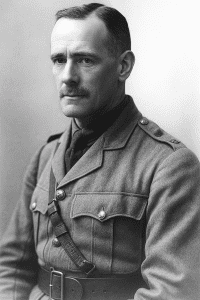
Captain Frederick William Kershaw

Frederick William Kershaw was born in Manchester on April 18, 1885. His father was employed in the management of a Cotton Mill and by 1911, after being educated at Hulme Grammar School, Frederick was living in Marple with his parents and he was working as a textile buyer.

He was commissioned as a Second Lieutenant in the 9th Manchester Regiment on June 28, 1910 (Gazetted July 26, 1910) and promoted to Lieutenant on March 4, 1911. In May 1912, per Divisional Orders, he was examined in “Subject B”, the precursor for promotion to Captain, but as there were 6 other Lieutenants above him in seniority no promotion was immediately forthcoming.

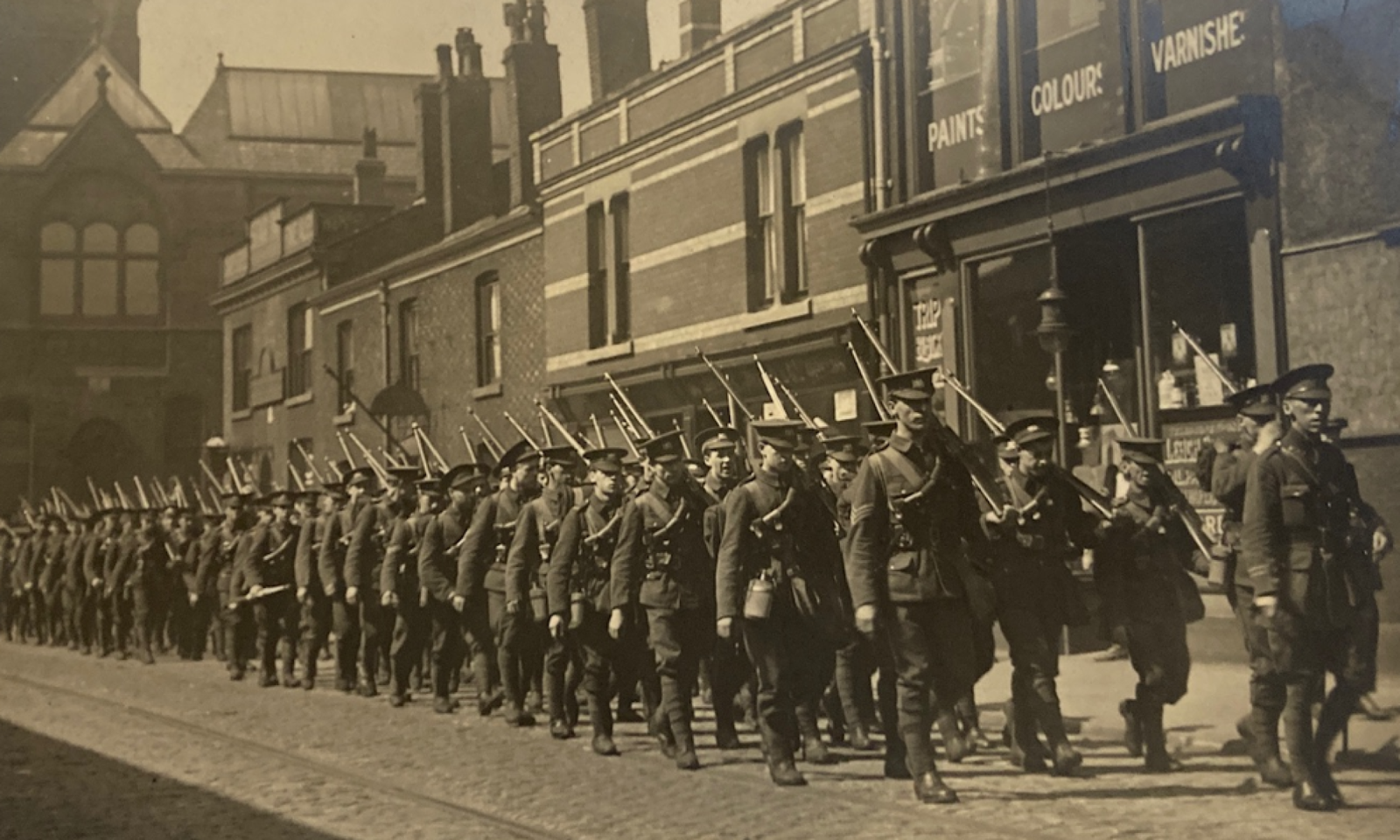
He sailed with the battalion to Egypt and served with them through their training and preparations for action. On November 4, 1914 he was promoted to Captain, while serving in Egypt. Captain Kershaw landed with the Battalion in Gallipoli on May 9, 1915 as second in command of “A” Company.

He is mentioned in the personal diary of 2/Lt. Charles Earsham Cooke:

June 20. Sunday. Capt. KERSHAW arrived today and looked very pale. I don’t know if I did mention it but he landed and did not come in the first night owing to a very bad septic throat and has taken 6 weeks at Malta and Alexandria, lucky fellow in a way. Very nervous at first of course as I dare say we all were. Fancy, it seems very funny to us of course, but he would not realise it, asked me for a cigarette! I had been in the place for 6 weeks!! Funnily enough I had one! We had only been in the trenches 18 days then!!!

There is little mention of him in the Battalion war diary but the 126 Brigade war diary states that he reported sick, and was subsequently medically evacuated to hospital in Malta, on November 9, 1915 and regimental records show that he did not rejoin the Battalion until March 3, 1916 in Egypt. On May 19, 1916 he was able to take 44 days leave in the UK returning on July 2. He remained with the Battalion in Egypt throughout 1916 and managed to get two day’s leave in Cairo in February 20-21, 1917 just before they shipped out the France.

In France he attended a six day course of instruction in trench warfare along with his C.O. Lt-Col. DR Wade. Shortly after that he attended an 8 day course of instruction for Company Commanders in Montigny from April 6-14. In June he attended a school for Lewis Gunners and from July 11-22 took leave in the UK. In October he has hospitalised for 8 days due to sickness and upon his return almost immediately attended another course of instruction. From Nov 17th to December 3rd he took leave again in the UK. A month after his return he was briefly assigned for duty to 1st Corps Headquarters for 4 days.

On the 14th February, 1918 he was assigned for duty in the UK with the 2nd/1st Royal East Kent Yeomanry. The 2nd/1st was formed in 1914 and were converted into a cyclist unit in July 1916. They remained in England until April 1918 when they moved to Ireland. Kershaw joined them on April 18, 1918 as Acting Major and remained with them until November 13th. Two days later he returned to France on November 15, 1918, rejoining the Battalion on December 22, 1918.

In January 1919 he resigned his commission and on February 21, 1919 he proceeded to the UK for demobilisation. However, his commission was not officially announced in the London Gazette until February 1, 1921 the notification granting him the rank of Major.

Major Frederick William Kershaw died on March 24, 1981 in Surrey. He was 95 years old.

Captain George Harold O’Kell

George Harold O’Kell was born in Ashton-under-Lyne on April 8, 1878.

Capt. George Harold O'Kell

He was educated at Albion School Ashton-under-Lyne and then went on to study at the London College of Music,  subsequently training as a solicitor.  On June 27, 1906 he married Ann Tonge and Phyllis Margaret O’Kell was born on March 13, 1909 his wife dying in child birth.  By 1911 he was living in Ashton with his infant daughter, mother-in-law and a domestic servant.

On June 17, 1910 he was commissioned into the 9th Battalion Manchester Regiment as a Second Lieutenant. Later that year, on September 28 he was promoted to Lieutenant and on October 18, 1913 promoted to Captain. Earlier that year, on January 28, he married Agnes Walton.

He sailed with the battalion to Egypt and served with them through their training and preparations for action. In November 1914 his son, Harold Walton O’Kell, was born in England but he sadly died seven weeks later without Captain O’Kell ever seeing him. Needless to say, this greatly affected him and he was evidently struggling with this loss as he served in Egypt. Captain O’Kell landed with the Battalion in Gallipoli on May 9, 1915 as 2nd in Command of “C” Company.

On June 7, 1915 he led the charge against one of two Turkish trenches with Lt. Albert Edward (Ned) Stringer. Lt. Stringer was killed. Attacking the other trench Captain Frank Hamer was also killed and so Captain O’Kell temporarily assumed command of “C” Company. But he was seriously ill with shell shock.

Major Thomas Frankish, Medical Officer of the 1/9th Battalion assessed his condition:

Came under my care on June 8th, the day following an attack on a Turkish trench in which he took part. He was in a very drowsy state, could not be pressed to say much about himself and had a frightened look. This lasted until June 10th, the only symptom he complained of being intense pain on the top of his head. He was quite unfitted to undertake his regimental duties and was sent down to the regimental base for a rest. I saw him there a few days after and his condition appeared much the same. He complained of the head pains, loss of sleep, dizziness, inability to concentrate his thoughts, could not focus a field glass. He rejoined his regiment but could not do his work: and has always a morose appearance. I consider the case to be one of melancholia – brought on by his duties here and certain family troubles.

On June 27th he was admitted to No 11 Casualty Clearing Station suffering from melancholia and transferred to the Hospital Ship Minnewaska 5 days later and sailed for Egypt. On July 6th he was admitted to the Anglo American Hospital, Cairo suffering from nervous prostration and assessed as follows:

Morose aspect and exhibiting a “scared” appearance. Very quiet and rather drowsy. Very difficult to get him to volunteer information about himself. Complains of intense pain and pressure on top of head, of dizziness and difficulty in reading (everything goes misty). No tremor of hands. Appetite fair. Bowels normal.

Four days later he was re-assessed:

Four days rest has brought an improvement in his aspect. The frightened look has disappeared, the drowsiness also, but all the other symptoms remain. He is very restless at night and sleeps but an hour or so at a stretch. Rests all day. has bad dreams in his sleep and looks tired out always. The heat seems to affect him – mostly in regard to his head pains.

He was granted a leave of absence from July 20 to October 19, 1915 and so on July 21st he embarked on the Hospital Ship Wandilla, at Alexandria, for passage to the UK arriving at Plymouth on July 31, 1915.

In the UK he was medically assessed again on October 8th at Manchester, diagnosed with Neurasthenia and found to be still unfit for general service but returned to light duties supporting the recruiting efforts in Ashton. In early December he joined the 3/9th Battalion at Southport just just prior to their move to camp at Codford, Salisbury Plain. A month later he was re-assessed and found to be improving but still unfit for general service.

On March 2, 1917 he was medically assessed at the 3rd Northern General Hospital, Sheffield and found to be still only fit for home service.

On May 1, 1918 he transferred to the Ministry of National Service under whose employ he remained until November 3, 1918. The Ministry of National Service was set up to oversee maintenance of a sufficient labour force and military recruiting during the war. On November 4, 1918 he reported to the 5th Reserve Battalion Manchester Regiment at Scarborough but proceeded the same day to the Claims & Record Officer, Kew for a course of instruction. He returned on November 16 and was immediately sent to the 8th Reserve Battalion, Manchester Regiment at Filey.  He relinquished his commission, on account of ill-health, on January 15, 1919 retaining the rank of Captain.

Captain George Harold O’Kell died in Sheffield on June 2, 1947. He was 69 years old.

Captain Frank Woodhouse

Frank Woodhouse was born in Prestwich on May 6, 1891. His father, Percy Woodhouse (later Sir Percy Woodhouse, KBE, DL, JP), was a cotton merchant and founded the firm Woodhouse, Hambly & Co. Frank had an older brother Ernest and an older sister Nora. We don’t know the specific details of Frank’s education but he most likely followed the same, or similar, path to that of his brother who was educated at St. Anne’s-on-Sea, Bengeo School (Hertford) and Rugby School.

By 1901 Frank was living with his parents, sister and two servants at the family home “Longmead” on Glossop Road, Marple Bridge (near Stockport). He was still living there in 1911 but by now was working in the family business as an apprentice cotton merchant and had been commissioned into the 9th Battalion Manchester Regiment on June 26, 1909. One of the reasons he joined the 9th Battalion was that his uncle, Lieut.-Col. Charles Richard Wainwright, was the commanding officer at that time.  Frank qualified in subject “A”, (a pre-cursor for promotion to Lt.), at an examination at Ashton on November 23 and was quickly promoted to Lieutenant on December 1st of that same year and Captain on July 17, 1913.

He sailed with the battalion to Egypt in September 1914 and served with them through their training and preparations for action. He landed with the Battalion at Gallipoli on May 9, 1915 as second in command of “D” Company. Celebrating his 24th birthday en-route from Port Said.

In Gallipoli he was 2nd in command to Major NOWELL in the Battle of Krithia Vineyard and briefly assumed command of 1/2 of the Battalion when Major NOWELL was wounded. In September he was in charge of 102 men who went to Imbros for training and in October was in command of “A” and “C” Companies when they were temporarily attached to the 1/5th East Lancs Battalion.

In 1916, after the evacuation of the Gallipoli peninsula, and a month after arriving with the battalion in Egypt he took home leave to the UK for 38 days from February 8 to March 17, 1916. Upon his return to Egypt he temporarily took over command of the Battalion from May 18 – 27, 1916 when Lt. Col. DH WADE temporarily assumed command of the 126th Brigade. On September 15, 1916 he left the Battalion to take leave in England and was subsequently ordered to report to the War Office and was struck off the strength of the Battalion. He resigned his commission in August 1921 retaining the rank of Captain.

In July 1919 he married Elsie Kathleen Furniss and they had three children, (Suzanne Furniss Woodhouse b. 1921, Hazel Furniss Woodhouse b. 1925 and William Furniss Woodhouse b. 1930). By 1929 he was living with his wife and daughters in Marple and was employed as a cotton merchant at Woodhouse, Hambly & Co. By 1939, Woodhouse, Hambly & Co. had been dissolved and he was now a company director living in Buxton with his wife and son.

Captain Frank Woodhouse died on July 26, 1984, in Buxton (his wife predeceasing him). He was 93 years old.

Gallipoli Revisited

On April 20, 1934 the SS Duchess of Richmond left Liverpool with 720 passengers, mostly officers and other ranks who had served on the Gallipoli Peninsula, their wives, and relatives of those who fell in the campaign. The company included 10 General officers and General Sir Ian Hamilton saw off the special train that left Euston station for Liverpool.

The ship arrived at Kheli Bay, the entrance to the Dardanelles, in the early hours of April 30th and remained there for 3 days. Excursions were made to Cape Helles, the landing beaches of Anzac and Suvla Bay, and Achi Baba. Large numbers of wreaths were taken and placed in memory of battalions and individuals.

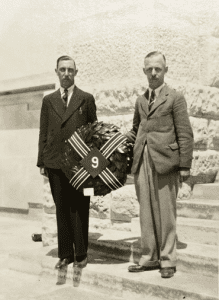
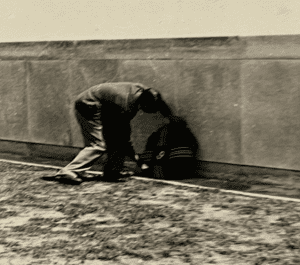
Representing the 9th Battalion Manchester Regiment were Captain Frank Woodhouse and Sergeant John Lawler who brought along a special wreath to be laid for the battalion. After a religious ceremony, the wreath was placed against the the inside of the outer wall at an appropriate location.

Capt Frank Woodhouse - Helles Memorial Wreath
Capt. Frank Woodhouse and Sgt. John Lawler posing with the Wreath
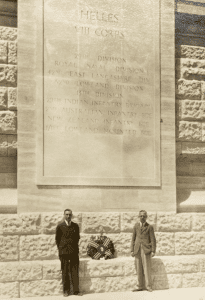
Capt Frank Woodhouse & Sgt Lawler - Helles Memorial Wreath
Capt. Woodhouse and Sgt. Lawler posing with the wreath below the VIII Corps Panel
Capt Frank Woodhouse - Laying the Helles Memorial Wreath
Laying the Wreath Against the Inside of the Outer Wall.

The two men took a number of photographs of their time there and upon their return Captain Woodhouse presented  the battalion with a photograph album containing the photographs mixed with postcards depicting the same locations in 1915.

The trip was widely reported in the press of the time and later commemorated in the book Gallipoli Revisited by W. E. Stanton Hope, F.R.G.S.

Acknowledgements

The photos above (Ref No: MR3/23/6) are reproduced here with kind permission of the Tameside Local Studies and Archive Centre and the Trustees of the Manchester Regiment Archive and remain under their copyright.

Captain Thomas Albert Platt

Thomas Albert Platt was born on April 1, 1880 in Dukinfield, Cheshire. His father, Tom Platt, was a “Beerseller and Clogger” who later became the Publican of the Brunswick Hotel on Park Road, Dukinfield. Young Thomas was the fourth of six sons, all of whom were educated well locally and eventually progressed to respectable middle class occupations.

He attended the Heginbottom Technical School, Ashton-under-Lyne where he received a 2nd Class Certificate in bookkeeping in 1898, when he was 17 years old. By 1901 he was working as an articled clerk at Wainwright, Son & Co. chartered accountants in Ashton and still living at home with his parents and three of his brothers.

In 1906 he married Mary Armstrong and they made their home in Ashton-under-Lyne.  A year later, he joined the 3rd Volunteer Battalion, The Manchester Regiment as a second lieutenant on June 10, 1907 and was appointed to the 9th Battalion Manchester Regiment Territorial Force with rank and seniority when it was formed on April 1, 1908.  In April 1909 battalion orders reported that he passed an examination in Musketry, (per appendix 6, sub-appendix viii), Territorial Forces Act of 1907.

In June 1911 he was appointed Acting Quarter Master when Capt. M.H. Connery proceeded to London for King George V Coronation duties and he was subsequently promoted to Captain on April 20, 1912. Later that year, in October 1912 he was named as one of two honorary secretaries to the newly formed Ashton district detachment of the British Red Cross Society, which was headquartered at the Ashton Territorial Armoury. He served in this position until August 1914 when he was forced to resign due to his mobilisation and imminent departure to Egypt.

In his civilian life he became a Chartered Accountant and also was an uncertified teacher at the Ashton-under-Lyne Mechanics Institute where he was paid 10s for 2hour evening classes and 15s for 3 hour classes.

In February 1914, his father Tom Platt passed away. Tom had been retired for many years and had become a member of the Ashton Board of Guardians (Chairman of the Workhouse Committee), and long time President of the Old Boys Association of Henshaw’s Oldham Blue Coat School, his old school. Consequently, he was widely known and respected in the area and his funeral was attended by many notable people from Ashton and well recorded in the local newspapers.

After the outbreak of war, Captain Platt sailed with the Battalion to Egypt in September 1914 and served with them during their training and preparation for action and he landed with the Battalion in Gallipoli on May 9, 1915 as second in command of “B” Company. There is no mention of Captain Platt in the Battalion, Brigade or Divisional war diaries but regimental records show that he was evacuated to hospital on June 24, 1915. These same records indicate that he was invalided to the UK on September 13 and struck of the strength of the battalion. The brigade war diary adds that he embarked on the Hospital Ship Marathon on September 13, 1915 at Alexandria en-route to the UK. Local newspaper reports confirm that he arrived at his home in Ashton-under-Lyne during the 2nd week of October and by early January 1916 had rejoined the 3/9th Battalion in training at Codford, Salisbury Plain.

No longer fit for overseas service he was seconded to a UK post outside the regiment where he was promoted to Major on August 5, 1917. He remained seconded until the end of the war when he returned to the Manchester Regiment. He resigned his commission on April 15, 1921 retaining the rank of Major.

Major Thomas Albert Platt died in a hotel in Ostend, Belgium on September 9, 1929. He was 49 years old.

Captain Harold Sugden

Harold Sugden was born in Ashton-under-Lyne in 1878.

Capt. Harold Sugden

By 1901 he was living with his uncle Mr. Edwin Whitehead who ran an Auctioneer business where Harold worked as a clerk. Harold took over the business on the death of his uncle.

He was commissioned into the 3rd Volunteer Battalion, The Manchester Regiment as a Lieutenant on 7th April, 1906 and transferred to the 9th Battalion Manchester Regiment maintaining his rank and seniority when the Battalion was formed on April 1, 1908. Earlier that year, on March 3, he married Emily Gertrude Brown and together they had a daughter, Eileen Sugden who was born on July 26, 1912.  He was promoted to Captain on July 6, 1910.

He sailed with the Battalion to Egypt in September 1914 and served with them there throughout their training and preparation for action.  Landing in Gallipoli on May 9, 1915 he was the Officer Commanding “B” Company.

On the evening of June 18, 1915 B Company attacked a Turkish trench but were met with overwhelming resistance and were forced to retire. The Turks then counter-attacked the allied trenches and the remnants of B Company with some men of C Company and some men of the 1/10th Manchesters defended their position.

Captain Harold Sugden was mortally wounded, by a gunshot wound to the lung, and subsequently died of his wounds on June 20, 1915 in hospital at Mudros. He was buried at East Mudros Military Cemetery on the island of Lemnos. He was 36 years old.

East Mudros Military Cemetery

He is also commemorated on the Ashton-under-Lyne Civic Memorial.

Captain Frank Hamer

Frank Hamer was born in Ashton-under-Lyne on March 4, 1880 to William and Ann (nee Whitehead) Hamer. William Hamer was a successful cotton spinner and a pillar of the community later becoming a Justice of the Peace and member of the Ashton Town Council. Frank Hamer was the fifth of seven sons and one of eight children. He was educated at Manchester Grammar School, attending from from 1893 to 1897, and the captain of the school’s cup winning football team of 1896.

By 1906 he was a Chartered Accountant and as such was one of the Honorary Auditors to the Manchester Grammar, Old Mancunians Association and a lecturer in Accountancy to the Institute of Bankers. This was also the year that he joined his father as a member of the Ashton-under-Lyne Town Council.

Capt. Frank Hamer

He was commissioned into the 3rd Volunteer Battalion Manchester Regiment on April 7, 1906 and the following year, on June 4, 1907, he married Winifred Elsie Mallalieu at Delph. After the Haldon reforms, he transferred to the 9th Battalion Manchester Regiment maintaining his rank and seniority when the Battalion was formed on April 1, 1908. On May 29, 1910 his first son, Reginald Hamer, was born. In April 1911 he was appointed scout officer to the East Lancs. Infantry Brigade and on December 7 that same year he was promoted to Captain, and assigned the command of F Company. His youngest son, Frank Mallalieu Hamer was born on September 17, 1913.

He sailed with the Battalion to Egypt in September 1914 and served with them there throughout their training and preparation for action. While in Egypt he was able to take 10 days leave from December 10-24 along with Capt. Howorth. After he returned from leave he was able to briefly meet his older brother Joseph Hamer who had joined the 5th Battalion, Australian Imperial Force on December 21, 1914, arriving in Egypt in February 1915.

After the attempted invasion of Egypt by the Turks, he was appointed second-in-command of the Turkish Prisoners’ Camp at El-Maadi. He was highly commended for his work there and was subsequently promoted to the rank of Adjutant and Quartermaster of the Camp, which by that time was accommodating about 2,000 prisoners. When the 9th Battalion was ordered to the Dardanelles he made several applications for permission to rejoin his battalion, which was finally granted and he rejoined at Port Said at 11:30pm on May 3. Upon landing in Gallipoli he was the Officer Commanding “C” Company.

Captain Frank Hamer was killed in action on the evening of June 7, 1915 leading a charge against a Turkish trench. Captain Hamer was shot and fell before reaching the trench. C Company subsequently captured the trench but were forced to relinquish it at dawn after holding it for around six hours. It was one of the bloodiest events of the Gallipoli campaign for the 1/9th Manchesters. In late September 1915, information was received by his father, William Hamer, that Captain Hamer’s body had been found and given a Christian burial with military honours and a cross placed over the grave.

Captain Frank Hamer was 35 years old. He is commemorated on the Helles Memorial.

The Empire (or Cape Helles) Memorial
Copyright: Harvey Barrison

He is also commemorated on:

  1. Ashton-Under-Lyne Civic Memorial.
  2. Manchester Grammar School Memorial.

The museum of the Manchester Regiment holds a small brass plaque that was originally positioned in Ashton Town Hall where Frank Hamer had been a pre-war town councilor. The plaque reads:

To the memory of Captain Frank Hamer, age 35 years. 9th Manchesters. A member of this Council. Killed in action at Gallipoli on 7 June 1915. Son of William Hamer J.P. of Birch House, Ashton-under-Lyne.

Councilor Henry Thomas Greenwood, the father of Lieut. William Gilbert Greenwood,  was subsequently appointed as Overseer of the Poor in Ashton-under-Lyne to fill the vacancy created by Frank Hamer’s death.

An officer’s death gratuity, payable to his widow, was defined under article 497 of the Royal Warrant for Pay, 1914. This entitled his dependents to 124 days of field pay for his partial year of service (presumably starting from May 9, 1915). For Captain Hamer this worked out to be £77 and 10 shillings based upon his daily pay of 12 shillings and 6d. From this was subtracted his pay for June 8-30th equaling  £14, 7 shillings and 6d leaving a net amount of £63, 2 shillings and 6d. And credits of £11, 5 shillings and 6d for field allowances earned but not paid resulted in a total paid to his widow of £74 and 8 shillings.

Additionally, his widow received a £250 gratuity and a pension of £100 per year. Each of his children received a gratuity of £83, 6 shillings and 8 pence and a “compassionate allowance” of £24 per year.

Further Family Tragedy

Frank Hamer’s younger brother Temporary 2nd Lieutenant (Acting Captain) Samuel Hamer, 26th Battalion, Northumberland Fusiliers was killed in action on April 14, 1917. He was buried at Bailleul Road East Cemetery, Saint-Laurent-Blangy, France.

Frank Hamer’s older brother Pte. Joseph Hamer, Australian Imperial Force, after surviving Gallipoli, was killed in action in France on September 1, 1918. He was buried at Assevillers New British Cemetery, France and is commemorated on the Australian War Memorial, Canberra.

References & Acknowledgements:

Manchester Grammar School Magazine, (ULULA) July 1915 Pg. 134.

Major Thomas Egbert Howorth

Thomas Egbert Howorth was born in Ashton-under-Lyne on the 19th of January 1878.

Thomas Egbert Howorth

In 1898 he contracted paratyphoid A and although he recovered it led to a certain amount of weakness in his lower right leg.

Appointed Lieutenant with the 3rd Volunteer Battalion Manchester Regiment on July 27, 1901, he maintained that rank and retained his seniority when the 3rd Volunteer Battalion became the 9th Battalion Manchester Regiment on April 1, 1908. On May 20th of the following year he was promoted to Captain. Prior to the outbreak of war, he was employed as a Cotton Salesman by Redgrave Mill, Manchester.

He sailed with the 9th battalion to Egypt in September 1914 and served with them there during their training and preparation for action. Contemporaneous reports from 2/Lt. Ned Stringer indicate that during November 1914 Howorth was ill for at least a month and so was sent to Helwan to recuperate for a few days and was then able to take 10 days leave from December 10-24 along with Capt. Hamer. While still in Egypt, he was promoted to temporary Major on February 9, 1915 before landing with the battalion in Gallipoli on May 9, 1915 as “A” Company’s Commanding Officer.

On June 19, 1915 he was admitted to No 11 Casualty Clearing Station suffering from diarrhea, headache and high temperature. He was transferred to a hospital ship the following day arriving at Mudros on June 21st. At Mudros he was admitted to No 16 Stationary Hospital and treated for Colic.  Since he had contracted Enteric Fever 17 years previously he was advised not be inoculated at Gallipoli. He was discharged for duty 8 days later but he was not a well man and on July 20th he was sent sick to hospital and medically evacuated to Malta. He disembarked the Hospital Ship Neuralia on July 25 at Valetta and was immediately admitted to the Military Hospital Mtarfa, seriously ill with Enteric Fever with haemorrhages.

He was medically assessed at Mtarfa on December 4, 1915 and they commented that his temperature had only returned to normal on October 20th, almost 3 months after he arrived. He was convalescing slowly but had now started to regain weight after becoming extremely emaciated.  He was recommended for evacuation to England and on December 19, 1915 boarded the Hospital Ship Massilia at Valetta bound for England. He arrived at Southampton 10 days later and was sent to the 1st Southern General Hospital, Edgbaston. He underwent a slow recovery in England but on August 10, 1916 he was medically assessed at Filey Camp and pronounced fit for General Service.

He rejoined the Battalion in November 1916 as a newly appointed Major (Gazetted November 2, 1916) and served with them in Egypt. In December 1916 he took over command of “C” Company, replacing Captain Oliver Jepson Sutton. He briefly assumed temporary command of the Battalion from February 18-20, 1917.

He sailed with the Battalion to France in March 1917 and by April was Commanding Officer of “A” Company. He spent a week  attending a course of instruction for Company Commanders at Montigny from April 1-7. On June 25, 1917 he was slightly wounded at Havrincourt Wood but remained on duty at his post. He took leave to England from July 20th to August 2nd and attended a Summer rest camp for 12 days from September 15th to 29th while the Battalion was at Ypres. On December 14th he attended an RFC course for senior Officers and then proceeded to the UK on leave for two weeks, rejoining the Battalion on January 11, 1918.

On March 21, 1918 the 9th Manchesters were serving in the 198th Brigade of the 66th (2nd/East Lancashire) Division. The 9th Battalion were in the support line at Hervilly, East of Péronne, on the evening of March 20, 1918. The entire divisional front came under an intense artillery and gas bombardment starting at 4.40am and the Battalion was quickly moved up towards the front.  By 4pm on the afternoon of March 21st, 2 Companies of the 9th Battalion were in front of Trinket redoubt at Hesbécourt. The Battalion retired through Roisel during the evening of the 22nd and early hours of the 23rd. Major Howorth was very severely wounded in the right shoulder on March 22nd and evacuated to hospital at Rouen. On the evening of March 29, 1918 he embarked at Le Havre arriving at Southampton the next day. In England he was treated at the 3rd London General Hospital, Wandsworth and struck off the strength of the 1/9th Battalion.

He remained in London until June 29, 1918 when he was transferred to an Officers’ convalescent hospital at Broad Leys House, Windermere. On July 12, 1918 he was awarded the Belgian Croix de Guerre for conspicuous gallantry for his actions in March. He was medically assessed on October 7th and awarded an additional 3 months leave. On January 9, 1919 he was again assessed and now pronounced fit for home service and recommended for re-assessment in 2 months. He was duly assessed on March 9, 1919 and pronounced fit for General Service. He had been recovering for almost one year.

On March 13, 1919 he was awarded the Territorial Decoration. Now fit, he was attached to the 1st Battalion Manchester Regiment at Kilworth Camp, County Cork, Ireland. In late September 1920 he was medically assessed for war pension and was found to have a 20% disability attributed to his war service. The report found that he appeared “frail” with a slight atrophy of the left leg, below the knee, due to his paratyphoid A contracted in Gallipoli. They also noted that his right arm was slightly weaker than his left due to the shoulder wound received in France. His own testimony recorded that since being wounded he had frequently experienced periods of dizziness.

Major T. E. Howorth Medals

Orders to reform the regiment were received in October 1920 and Lt-Col D. H. Wade was appointed Commanding Officer. A few weeks later the War Office confirmed the re-appointments of some old officers and Major Howorth joined them in July 1921.  He served with the battalion until May 26, 1928 when he retired at age 50, having reached the age limit for service, retaining the rank of Major. Earlier that year he married Florence Elizabeth Archer, a school teacher, who was almost 30 years younger than he was. They lived on Currier Lane in Ashton-under-Lyne where he was heavily involved with the Boy Scouts Movement.

Major Thomas Egbert Howorth, T.D. died on December 5, 1945. He was 67 years old.


Major Richard Bottomley Nowell

Richard Bottomley Nowell was born in Ashton-under-Lyne on September 7, 1880. His father was a medical surgeon and so Richard studied medicine for a time before becoming a “gentleman”.

Richard Bottomley Nowell (1953)

He was commissioned into the 3rd Volunteer Battalion, the Manchester Regiment on February 21, 1903.  Appointed Captain on June 10, 1905 he maintained that rank and his seniority when the 3rd Volunteer Battalion became the 9th Battalion Manchester Regiment on April 1, 1908.

On June 22, 1908 he married Florence Elizabeth Ann Tipler and they moved to Handforth, near Wilmslow, Cheshire where they had two children. His occupation prior to the war was a stockbreeder.

In the battalion orders of May 6, 1911, it was announced that Capt. R.B. Nowell completed a course of instruction in Transport Duties from April 3-19 and was awarded a certificate on Army Form E 535.

He sailed with the Battalion to Egypt in September 1914 and on November 4, 1914 was promoted to Major. Landing with the battalion at Gallipoli on May 10, 1915 (in command of the Transport section), he was second in command and “D” Company commanding officer. 12 days later when Lt. Col. D.H.  Wade was shot by a sniper he temporarily assumed command of the Battalion before turning it over the next day. Later in the campaign he assumed command of the Battalion again from June 9th to July 16th being granted the temporary rank of Lieutenant Colonel.

On August 7, 1915 he was shot through the left shoulder by a rifle bullet while leading 1/2 of the Battalion in the Battle of Krithia Vineyard. The bullet entered the inner border of the left scapula [shoulder blade] approximately 1 1/2″ below the scapula spine and exited approximately 2″ below the acromion at the posterior border of the deltoid muscle. Remarkably, the bullet cleanly exited without passing through the lung or breaking any bones. He was admitted to No 11 Casualty Clearing Station and transferred to the transport ship Ermine at “W” Beach, bound for Mudros. He remained in hospital at Mudros and was additionally treated for Enteritis as he had been suffering from severe diarrhea for some time previously. He was invalided to the UK on August 26 traveling from Mudros to Malta on the Hospital Ship Ermine and from Malta to Devonport aboard the transport ship Ascania, arriving September 11, 1915.

He remained in London for a few weeks, staying at 19 Park Lane, and was medically assessed at Caxton Hall on September 28, 1915 where he was declared unfit for General Service and granted 2 months home leave until November 27th. He was pronounced still unfit in December but on January 31, 1916 he was pronounced fit enough for home service and ordered to report to the 3/9th Manchesters. On April 27 he was medically assessed at the 3rd Northern General Hospital, Sheffield and pronounced fit for General Service.

On June 26, 1916 he was ordered to return to the Mediterranean Expeditionary Force and embarked the transport ship Corsican at Devonport on July 3rd rejoining the Battalion in Egypt on July 20, 1916. Here he was immediately posted as 2nd in command.

On January 31, 1917 he led the advance party at Port Said preparing for the Battalion’s imminent move to France.

In March 1917 the Battalion shipped out to France and Lt. Col. (Temp.) R B Nowell was once again placed in command of the Battalion from April 27 to May 25, 1917 and again from July 27 to 30 when Lt. Col. E. C. Lloyd went on leave to Paris. On August 7 he proceeded to England on leave and after his return took temporary command of the Battalion again from September 15 to October 15 while Lt. Col. Lloyd was away. In December 1917 he proceeded to England on leave from the 13th to the 29th. On January 15, 1918 he proceeded to the UK to report to the War Office and was struck off the strength of the battalion.

In England he was posted to the 5th Reserve Battalion Manchester Regiment on March 5, 1918 and at some point after that was assigned the Headquarters of the Yorkshire Coast Defences. Sadly, in July 1918 his wife Florence died.

On November 26, 1918 he was medically assessed for demobilisation and war pension purposes, at RAMC HQ Scarborough, and although he complained of Myalgia (muscle pain) and occasional Lumbago (lower back pain), was pronounced category A fit and ordered to return to HQ Yorks Coast Defences. He was demobilised on January 29, 1919 and retuned to his home at Outwood House, Handforth, Cheshire but now as a widower.

He remained in the Territorial Army Reserve and was awarded the Territorial Decoration in March 1919. He resigned his commission on April 15, 1921 retaining the rank of Lieutenant-Colonel. Around the same time, he married Annie Brown and they made their home in Lytham St Annes. By 1939 he was living in Devon as a retired stockbreeder. His son had emigrated to Brazil in 1948 and so in 1953 he and his wife also emigrated there.

Lt. Col. Richard Bottomley Nowell, T.D. died in Brazil on February 22, 1959. He was 78 years old.


Captain John Alfred Dearden

John (Jack) Alfred Dearden was born in Douglas, Isle of Man on February 17, 1881 and educated at King William’s College.  His father, John Alfred Dearden was a surgeon and in 1901 he was living in Douglas, Isle of Man with his parents (mother, Mary Selina Beckwith Dickson) and three younger sisters (Cecil Maud Dearden, Violet Selina Dearden and Mary Dorothea Dearden) and two domestic servants. At this time, Jack was serving as a Lieutenant in the Militia in the 6th battalion Liverpool Regiment. He went on to serve in the Boer War from January to May 1902 and was awarded the Queen’s South Africa Medal.

He was awarded a commission in the Regular Army with the Manchester Regiment as a Second Lieutenant on January 28, 1903 and promoted to Lieutenant on February 2, 1907. On March 12, 1912 he was made adjutant of the 9th Battalion Manchester Regiment and granted the temporary rank of Captain in the Territorial Force whilst holding the appointment of Adjutant.

The local newspaper reported on January 13, 1912:

Lieutenant J. A. Dearden, of the 2nd Battalion Manchester Regiment, now at Curragh Camp, Ireland, has been appointed to succeed Captain Minogue as adjutant of the 9th Battalion Manchester Regiment (Ashton Territorials), and will take up his duties in March.

He served with the Battalion in Egypt where he was promoted to Captain on December 1, 1914. He landed with the Battalion at Gallipoli on May 9, 1915, but was invalided to hospital in Malta shortly thereafter, leaving the Battalion on June 7th. He left Valletta on HMT City of Benares on July 4th arriving in the UK (Devonport) on July 13, 1915. Here he was diagnosed with Neurasthenia (an ill-defined medical condition characterized by lassitude, fatigue, headache, and irritability, associated chiefly with emotional disturbance) and prescribed three months leave.

Throughout 1916 he was regularly medically assessed and repeatedly classified as unfit for General Service but was given light duty office work at the War Office. Finally, in December 1916 he was pronounced fit for General Service but not suitably fit to be posted to sunnier climates, such as those of Egypt or India. Since the 9th Battalion were still in Egypt at this time, guarding the Suez Canal, he continued his war service in the UK where he remained until the end of the war. During this time, on May 19, 1917, he was promoted to Major.

After the war, in September 1919, he was transferred to the 1st Battalion Manchester Regiment, as Staff Captain, for the purposes of being definitively assessed for his fitness to continue to serve. He somehow passed this assessment and served with the Manchester Regiment in Ireland when they deployed there in April 1920. This was the time of the Irish war of independence and on January 28, 1921 the 1st Battalion Manchester Regiment was involved in the Dripsey Ambush. There is no evidence to suggest a connection but on February 17, 1921 Major John Alfred Dearden was the defendant in a Field General Court Martial under section 40 (acting to the prejudice of good order and military discipline) and was “severely reprimanded” and encouraged (forced) to resign his commission which he officially did on July 2, 1921. Nevertheless, he was permitted to join the Regular Army Reserve of Officers upon retirement and was paid an Army pension of £258/year.

Throughout his retirement he evidently had no other source of income as he repeatedly petitioned the Army to commute his pension for small amounts of cash. In 1926, due to his age, he was moved to R.A.R.O. Class 2 status (in the event of mobilization, or partial mobilization, you will take no action but should your services be required you will receive instruction from the War Office).

An amalgamation of newspaper reports published on July 27, 1928 follows:

MAJOR FOUND DEAD

Major John Alfred Dearden, the 47- years-old secretary of Knebworth Golf Club, was found dead in bed this morning. A glass containing disinfectant was by the bedside.

The discovery was made by the Club Steward in the Secretary’s bedroom at the Club House. Major Dearden was selected from a large number of applicants for the post of full-time Secretary of the Club some nine months ago, and he tendered his resignation yesterday, after being asked to do so. Major Dearden, who was single, was formerly of the Manchester Regiment.

Major John Alfred Dearden tragically died by his own hand on July 26, 1928 in Hertfordshire. He was 47 years old.

Major Michael Henry Connery, MC

Michael Henry Connery was born in Dublin on May 8, 1856. His father, Michael Connery, was a private on the married establishment of the 96th Regiment of Foot, a precursor to the Manchester Regiment. According to his own testimony, he travelled as a very young boy with the regiment to South Africa and then India before returning to England in October 1868 when the 96th Depot was stationed at Colchester.

Major MH CONNERY

And so it was that on April 19, 1869 he too joined the 96th Regiment of Foot, at Colchester as a boy soldier, giving his age on attestation as 15 when, in fact, he was not yet 13. He was promoted rapidly and by 1873 he was a corporal and living at the barracks at Ashton-under-Lyne. Here he met and married Ellen Egan and together they had three boys. His first son, William Lawrence Connery was born in Ashton-under-Lyne on November 25, 1875.  James Thomas Connery was born in Gorton on June 5, 1877 and Joseph Michael Connery on June 21, 1879. On July 1, 1881 the Childers Reforms came into effect and the 96th Regiment of Foot amalgamated with the 63rd (West Suffolk) Regiment of Foot to form the Manchester Regiment.

But in November of 1882 he discovered that his wife was committing adultery and so he petitioned for divorce and the final decree was granted on August 5, 1884. He retained custody of his three sons.

In May 1886 he married Emily Field while he was a Sergeant Quarter Master for the Manchester Regiment and still living at the Army Barracks in Ashton-under-Lyne. The following year his fourth son Arthur William Field Connery, named after his wife’s father, was born in Ashton on July 19, 1887.

On May 16, 1892 his son James Thomas Connery followed in his father’s footsteps and joined the Manchester Regiment as a 15 year old boy. His younger brother Joseph Michael Connery followed his lead and also attested on June 19, 1893 just before his 15th birthday. His oldest son William Lawrence had joined the militia but on January 10, 1894, (while still serving in the militia), he too joined the Manchester Regiment.

On July 7, 1897 Michael Henry Connery was commissioned as Honorary Lieutenant and Quartermaster for the 3rd & 4th Battalions, Manchester Regiment (since regulations only allowed one Q.M. at the barracks and both battalions shared the depot there). By March 1901 he and his wife were both still living in the Army Barracks at Ashton, their youngest son Arthur away at boarding school.

From June 17, 1901 to September 30, 1902 he served in the South African Campaign as Transport Officer of the 5th Battalion (May 1901 to April 1902) and then Transport Officer of the 6th Battalion (May 1902 to September 1902). During his time with the 5th he also served as Supply & Transport Officer for Colonel Barker’s Mobile Column, at Wynburg (October 1901 to May 1902). He was awarded the South African Queen’s Medal with 5 Clasps: Cape Colony, Orange Free State, Transvaal, South Africa 1901 and South Africa 1902. He was also mentioned in despatches (Gazetted July 29, 1902) as was his oldest son, Colour Sergeant William Lawrence Connery (Gazetted September 10, 1901).  Based upon his service in the Boer War, Lieutenant Connery was promoted to honourary Captain on August 22, 1904 “for his conduct in the  field.”

Since he misrepresented his age when he attested, the Army reckoned that he had reached the mandatory retirement age of 55 years on April 19, 1909, by now serving with the 4th Battalion. Although he was eligible to retire on an annual pension of £200 per year, instead he elected to join the 9th Battalion Manchester Regiment, Territorial Force as their Quarter Master. By 1911 he had been promoted to Honorary Major and Quarter Master, (Gazetted April 22, 1909), and he and his wife had moved out of the Barracks and were living at “Willow Bank” on Henrietta Street, Ashton. In June 1911 he was honored by being selected to attend King George V’s coronation in London as Quartermaster to the composite battalion sent by the East Lancs Division.

He sailed with the 1/9th to Egypt in September 1914 and in April 1915 his youngest son, Arthur William Field Connery, joined him as a freshly commissioned Second Lieutenant and serving as an infantry officer. They landed with the 9th Battalion at Gallipoli on May 9, 1915, the day after his 59th birthday.  On June 14, 1915 Major Connery was slightly wounded in the left arm by shrapnel when a shell landed on his dugout but was treated at a field ambulance and remained at his post. He was again slightly wounded on July 13, this time in the right thigh, but once more remained at his post. A week earlier, his son 2/Lt. Arthur Connery had been wounded in the mouth and medically evacuated to England. On August 22 his son Hon. Lt. Joseph Michael Connery arrived to serve with him but his stay was very brief, becoming sick after 4 days and then subsequently medically evacuated to England.

He left the peninsula with the 1/9th Battalion in December 1915 and on December 29th was appointed Embarkation Officer for the 42nd Division for their move to Egypt. He continued to serve with the battalion in Egypt during the first half of 1916 until he was hospitalised for sunstroke on July 23, 1916 at El Ferdan. He was admitted to the 31st General Hospital at Port Said the following day where he was proscribed rest and then medically assessed on July 7th. They found him to be suffering from Nephritis and Granular Kidney.  He was invalided home from Egypt embarking the Hospital Ship Galika and arriving at Southampton on July 18, 1916. Here he was admitted to the 4th London General Hospital, Denmark Hill where he spent a couple of nights before they confirmed the diagnosis of chronic nephritis and sent him home.

Back in Ashton he went into Manchester and was medically assessed at the 2nd Western General Hospital, Withington Street on August 3 where they noted much albumin in the urine and that his heart beat was irregular. They recommended that he come in for treatment and granted him 1 month’s leave, effective from July 20. He remained in hospital for about 2 weeks.

On October 3, 1916 the War Office informed him that he was to be “Gazetted Out”. Not a man to take things lying down he had himself independently medically examined and wrote back to the War Office respectfully requesting that he be employed, for Home Service, in any other capacity.

Bedford House
Ashton-u-Lyne
October 18, 1916

I have examined Major M.H. Connery, M.C. and find he is still suffering from Nephritis with an intermittent high tension pulse. His general condition is however very good and he expresses himself as feeling very fit.

He is anxious to do something and personally I think he is quite capable of undertaking Home Service which would not in my opinion retard his recovery.
Robert Bleasdale, M.B.

The War Office informed him that due to the amalgamation of the reserve units of the Territorial Force that no vacancies existed for Quarter Masters and he relinquished his commission due to ill-health on October 7, 1916. Later in the year he was awarded the Military Cross for his services in Gallipoli and received his medal from the King at Buckingham Palace in late December.

April 1917 was a tumultuous month for Major Connery. A vacancy appeared with the Scottish Command at a Prisoner of War Camp and he reported for duty to Stobs Military Camp, near Hawick, on April 27, 1917. The following day his wife Emily passed away and was buried at Hurst Cemetery, Ashton. He later became Adjutant & Quartermaster at the Prisoner of War Camp, Caolasnacon, a camp for German PoWs who were building the road along the southern side of Loch Leven. He was still serving here on May 8, 1919 when he was ordered to report to the 2nd Scottish General Hospital, Edinburgh for a medical assessment. They found him to be “very stout”, surely a euphemism for a man over 15st but only 5ft 8″ tall, and still suffering from an irregular heartbeat. They noted that he was short of breath with the slightest exertion but had no pain or other symptoms. As a consequence he was placed on the retired list effective July 1, 1919 and given the honorary rank of Lieutenant-Colonel for his long and distinguished service. He retired on a pension of £300 per year.

Major Connery, M.C.

He died peacefully at home in Ashton on April 25, 1921 at 8:30pm and was buried on April 29th at Hurst Cemetery with his wife, Emily, who predeceased him. Thousands of people lined the streets of Ashton to pay their respects. His oldest son, Lt.-Col. William Lawrence Connery, M.B.E., J.P., and mayor of Ashton, was later buried in the same plot when he died in April 1944.

The Ashton Reporter carried the following article published on Saturday April 30, 1921:

DEATH OF LIEUT.-COL. M. CONNERY

Fifty Years in the Service, and Four Sons with Commissions

POPULAR QUARTER-MASTER OF TERRITORIALS

We regret to report the death of Lieut.-Col. M. H. Connery, M.C., late of the 1/9th Battalion Manchester Regiment, (T.F.), which occurred on Monday night at his residence, Willow Bank. Henrietta Street, Smallshaw. Col. Connery’s end was very peaceful. Although he had been under the care of Dr. Beasedale for some time, he had been able to go about and was out of doors on Monday. In the evening he sat reading in his favourite chair. He put his book down and said to his daughter-in-law, “I don’t think I will read any more”. His head fell on his shoulder and he passed away. He died practically in harness for he had been down to the Armoury practically daily since the Defence Corps was raised.

Col. Connery was born in Dublin 65 years ago. His father was in the old 96th foot (now the 2nd Battalion Manchester Regiment). He joined the Manchester’s as a boy of 16, and served his country for almost half a century. He rose from the ranks and was gazette quartermaster in the Manchester Regt. in July 1887. He served in the Boer War. Once he was thrown from his horse and he often was troubled with his leg as the result of the fall.

WITH THE TERRITORIALS

When he retired from the regular forces in April 1909 he accepted the post of Quartermaster with the 9th Battalion, Manchester Regiment. He needed no Army Manual to teach him the duties of a Quartermaster, he knew everything laid down in regulation and a good deal more besides.

It was his association with the Ashton Territorials that has endeared the name of Connery to Ashton. When Major Connery, (everybody knew him as Major), became the Quartermaster of the First Ninth, he soon became a prime favourite amongst the officers and men. He was no slacker, and he permitted no slacking. When the Major was in a reminiscent mood he could tell stories – tinged with an unmistakable brogue, and the point well emphasized by his slight impediment in speech – until one’s sides ached with laughing. He could conjure up rations and desirables when in camp, in a manner that was the despair and admiration of other quartermasters. He worked on a system, and if he said the transport would be ready at a given time, it was ready to the minute.

THE OUTBREAK OF WAR

When the Territorials were mobilised it was a study to watch the Major’s face when the appeal was made for overseas volunteers. How it lighted up when almost to a man the Battalion stepped forward. “I knew it”, he said, “the Ashton lads were always game!” If they were ready, so was he, and despite his age, he jumped like a schoolboy at the chance of once again taking active service. He endured the heat of Egypt and the trials, the sufferings and the horrors of Gallipoli.

In July 1916 he reluctantly returned home on sick leave after being with the Battalion since it left Ashton in August 1914. His moustache was a little greyer, and the burly figure not quite so pronounced, but his healthy sun-tanned face, with its irresistible smile, belied his years. It was easy to grasp why he was highly esteemed both by the men of the Battalion and the people at home. His warm-hearted sympathy, his cheery good humour, and his solicitude must have been like balm on a sore to the nerve-strung men – some only mere striplings – as they emerged from the firing line. There are many mothers and fathers in Ashton who have thanked God that Colonel Connery was there to cheer and comfort their sons and look after their welfare amid the trials and dangers of the war in foreign lands. He was father, counsellor, and guide to them, and whilst on the Gallipoli Peninsular he saw to it that the men wanted for nothing if he could get it for them.

AWARDED MILITARY CROSS

Whilst in Gallipoli, Colonel Connery was twice wounded and was awarded the Military Cross. The record of recommendation by Major-General Douglas, in charge of the 42nd East Lancashire Territorial Brigade was as follows: –

“For his consistent devotion to duty in the performance of his duties as quartermaster. He has been twice wounded by shrapnel in carrying out his duties but continued to carry them out. He personally saw his convoy of supplies each day to their destination, under heavy shell fire. His influence for good has had a marked effect in his battalion. He has given frequent assistance to inexperienced quartermasters of other battalions. He is one of the best quartermasters I have ever known. I cannot speak too highly of his services.”

A CHAT WITH THE KING

On Dec. 9th, 1916 Colonel Connery was presented to his Majesty the King, who pinned the Military Cross on his breast, and warmly congratulated him upon his gallant conduct.

The King greeted him with a pleasant smile as he advanced and bowed, which at once placed the gallant colonel quite at ease. Then, after pinning the Military Cross on the Colonel’s breast, his Majesty chatted pleasantly with him. The King asked Colonel Connery what length of service he had and was surprised when he was told it was 48 years.

“How old are you, Colonel?”, asked the King, adding “I see you have been wounded twice.”
“Sixty your Majesty,” replied Colonel Connery.
“Have you any sons serving?”
“Four, all bearing your Majesty’s commission,” proudly replied Colonel Connery.
“Wonderful!”, observed the King. “You have done well – very well.”

FOUR SONS WITH COMMISSIONS

Colonel Connery was justifiably proud of the fact that he and his four sons all gained commissions from the ranks. His sons are Captain and Quartermaster W. L. Connery, M.B.E., now stationed at the Ashton depot; Captain J. T. Connery, who holds an appointment at the War Office; Captain Joe Connery, now retired; and Captain Arthur Connery, M. C., who is now in the Argentine.

Colonel Connery was a man of abstemious, almost Spartan, habits. He lived simply and sparingly and was a staunch teetotaller. He has gone, but his memory will live long in the hearts of those who realized the heart of gold which throbbed under a brusque exterior. Simple in tastes, and a man who sincerely tried to do his duty for his King and country; a man who did many a good deed by stealth and blushed to find it fame. The loss of so true a man will be sincerely mourned.

The following paragraph was published in the Manchester Regiment Gazette regarding his funeral:

“The Requiem Mass took place, at St. Mary’s Church, Ashton, on Friday April 29th was attended by a large number of people. Full military honours attended the funeral. Those present included the Colonel’s relatives, a number of officers from the Depot, and a number of Territorial officers who had served with him during the war. A party of Territorials, and also another party from the Depot, marched in the rear. The interment took place at Hurst Cemetery, where, as all along the route, large numbers had assembled to pay their last tribute to an old comrade.”