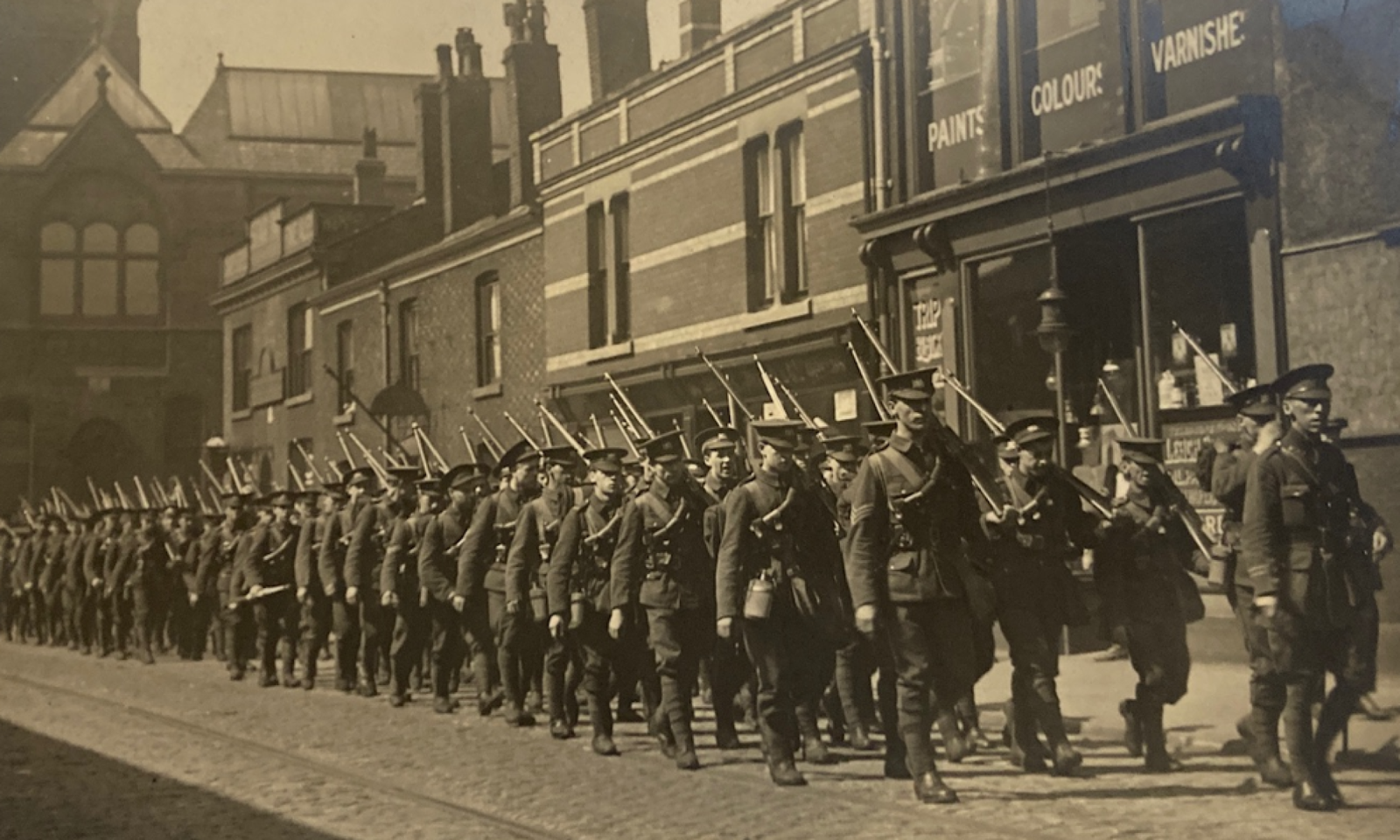
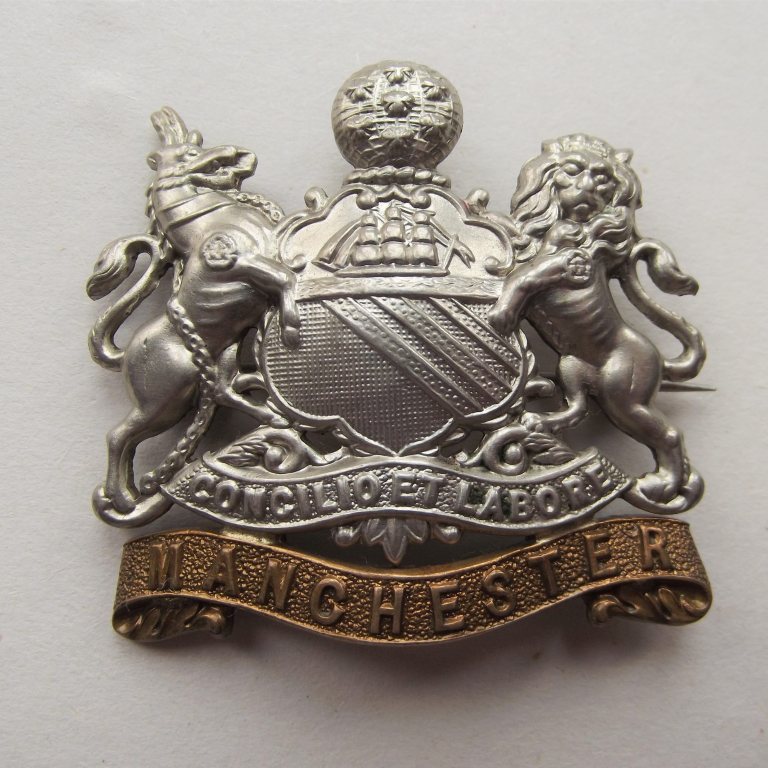
2/Lt. William Neville Broadbent Bury

William Neville Broadbent Bury was born in Salford on June 11, 1890. His father, Joshua Bury, was a Land Agent and Surveyor and owned his own business. William was the youngest of three children and by 1901 he was living in Salford with his father, his mother Lucy Annie Bury (née Taylor), his sisters Dorothy and Nora and two domestic servants. He was educated at Lawrence House School for Young Gentlemen, St Annes on Sea and then at Blundell’s School, Tiverton (1904-07), where he was a member of the Officer Training Corps (OTC). His father’s business flourished and by 1911 he was working with his father as a Land Surveyor and living with his parents, his aunt, two domestic servants and a chauffeur. In August 1913 he married Muriel Lonsdale at Manchester Cathedral.

In 1914 he joined the OCT at Manchester University and was duly commissioned as Second Lieutenant in the 9th Battalion Manchester Regiment (Territorial Force) on November 7, 1914 where he was quickly appointed Temporary Lieutenant two weeks later. He joined the 2/9th Battalion in training at Southport and moved with them to Pease Pottage in June 1915. On October 13, 1915 he embarked for Gallipoli with 10 other Officers, arriving at Mudros on October 24th and joined the Battalion on Cape Helles on October 26, 1915. Upon arrival it was found that two Officers already serving at Gallipoli were of a junior rank and so he relinquished his temporary appointment. Two weeks later he was sent to hospital sick and remained there for 9 days.

He sailed with the Battalion to Egypt, arriving on January 21, 1916. On March 21, 1916 he again was sent to hospital sick and remained there for six days. On May 19, 1916 he was awarded 51 days home leave in the UK and was promoted to Lieutenant on June 1st while he was on leave. After he returned to Egypt he attended a 3 week course of Instruction at Zeitoun, in September, where he qualified as a 1st Class Lewis Gun Instructor. Shortly after he rejoined the Battalion he again reported sick to hospital where he remained for 3 months.

He sailed with the Battalion to France, arriving on March 11, 1917.  On May 6 he left for a course of instruction at Foucaucourt where he remained for 39 days and around 10 days after rejoining the Battalion reported sick to hospital where he remained for 8 days. He was awarded 11 days home leave in the UK from July 17-28th and a month after his return was attached to the 42nd Divisional Depot Battalion. On November 28, 1917 he was seconded to the Tank Corps. He was appointed acting Captain while commanding a tank section on December 11, 1917 and was made temporary Captain on October 19, 1918. Transferring to the unemployed list on January 24, 1919 he resigned his commission sometime later, retaining the rank of Captain.

After the war he briefly attended Cambridge in 1919 and then went into business with his father and brother-in-law, Robert Edgar Stephenson, and they formed the partnership Joshua Bury, Son and Stephenson, Land Surveyors. In 1921 he applied for transfer to the Territorial Army Reserve of Officers.

During the interwar years he became a Fellow of the Chartered Surveyor Institution but eventually retired from the business on April 1, 1935 and moved to Bournemouth. His father died suddenly four months later. While in Bournemouth, he married Mary E. Brooker and they were living there when war broke out in 1939. As a Captain in the Territorial Army Reserve of Officers he submitted an ‘Application for Registration in the Army Officers’ Emergency Reserve for Re-Employment in, or Appointment to, an Emergency Commission in His Majesty’s Land Forces’. His application was accepted and he was duly mobilised as a Captain in the Manchester Regiment. He only served for a short period and, having reached the age limit, retired and retained his rank on November 2, 1940.

Captain William Neville Broadbent Bury died in October 1971. He was 81 years old.

2/Lt. William Henry Demel

William Henry Demel was born in Stretford, Lancashire, on 4 April 1893. His father, Carl Frederick William Demel, was a German national and was living and working in Stretford as a correspondent. 10 years later he was a manager in a shipping office and by 1911 Carl Demel was managing director of a metal merchant and had become a naturalized citizen. By this time, the family which included his wife, Helen Foster Demel, two sons, George Carl Demel and William Henry Demel, and daughter Frieda Eva Demel were living on Sandy lane, Stretford with a domestic servant. William was 17 years old and working as a clerk.

William Henry Demel was commissioned Second Lieutenant in the 9th Battalion Manchester Regiment on 25 February 1915, from the Manchester University Contingent, Senior Division, Officers Training Corps. joined the 2/9th at training in Southport and moved with them to Pease Pottage in June 1915.

On October 8, 1915 he boarded His Majesty’s Transport Ship Demosthenes along with two other Officers and 134 other ranks bound for Gallipoli. They arrived at Mudros on October 20th and joined the Battalion at Cape Helles on October 22, 1915. He served with the Battalion in Gallipoli for the remainder of the campaign and then sailed with them to Egypt where they arrived on January 16, 1916.

On December 14, 1916 he was attached to the Royal Flying Corps, and after a period at the R.F.C. School of Instruction he was transferred to No. 39 Reserve Squadron at Montrose, Scotland, to begin training as a pilot. He was made Flying Officer on May 23, 1917, and whilst still on secondment to the RFC was promoted to Lieutenant in the Manchester Regiment on July 1, 1917. He was subsequently attached to No. 77 (Home Defence) Squadron of the 6th Brigade, based in Edinburgh, specifically to train in night bombing.

After training, he was posted to No. 149 (Night Bomber) Squadron as a Flight Commander on May 22, 1918. The Squadron was sent to France on June 2, 1918 where they remained for the duration of the war, based at various locations.  He took part in 50 flights dropping a total of 389 bombs and on September 16, 1918 successfully made a forced landing on bad ground West of Neuve Eglise when his plane was brought down due to enemy fire whilst on a bombing raid. Both he and his observer were able to walk away uninjured.

For his services he was awarded the Distinguished Flying Cross, and was presented with this D.F.C. by H.M. King George V at Buckingham Palace on May 12, 1920.

D.F.C. London Gazette 3 June 1919:

This Officer has done continuously good work as a Flight Commander in a Night Bombing Squadron. He has crossed the lines on 44 night raids, successfully reaching his objectives frequently under very difficult weather conditions.

Demel was posted to the Home Establishment on November 15, 1918, but remained in France until being invalided to England from Wimereux on March 8, 1919 with Influenza. Transferring to the unemployed list on March 20, 1919, he relinquished his Royal Air Force commission on March 4, 1921, and was appointed Captain in the 9th Battalion, Manchester Regiment (Territorial Force) when he relinquished his Territorial commission due to ill-health on 21 June 1924.

He married Phyllis Brundrit Higham on July 19, 1922 and together they had two children. John Glassford Demel was born on July 10, 1923 and Janet Ruth Demel was born on December 23, 1932. The family lived in Birmingham and William worked as a sales manager in the metals industry.

On 25 March 1939, Demel was granted a commission as Flight Lieutenant in No. 915 (County of Warwick) Squadron, a Barrage Balloon Squadron of the Auxiliary Air Force. Since William was to be away for an extended period, his wife and children moved to Anglesey and in August 1939, shortly before the outbreak of world war two, his 16 year old son sailed to Brazil to finish his studies.

William transferred to the Balloon Branch on March 27, 1940, and was promoted to Temporary Squadron Leader on September 1st of that year, transitioning from flying duties to administrative duties. He transferred to the Administrative and Special Duties Branch on July 17, 1941, and then to the Headquarters of the newly-formed No. 44 (Ferry Service) Group on August 15, 1941.  He became head of both Administration and Organisation and was granted the non-substantive rank of acting Wing Commander. Demel was granted to the non-substantive rank of temporary Wing Commander on January 1, 1944, before resigning his commission on October 1, 1944, retaining the rank of Wing Commander. Tragedy struck on October 9, 1944 when his son, Flight Officer John Glassford Demel was killed in a flying accident while serving as a flying instructor in the South African Air Force, at 25 Air School in Standerton South Africa. He was just 21 years old.

For his services during the Second World War Wing Commander William Henry Demel was twice recommended for the O.B.E. (which he did not receive) but he was awarded the Air Efficiency Award in 1949.

After the War he returned to working within the metal industry, and between 1958 and 1960 was Chairman of the Midlands Area Council of the Royal Metal Trades Pension and Benevolent Society. Shortly thereafter, he retired and moved with his wife to Anglesey.

Wing Commander William Henry Demel, D.F.C. died in Anglesey on December 24, 1979 his wife predeceasing him. He was 86 years old.

2/Lt. Beltran Ford Robinson

Beltran Ford Robinson was born in Ashton under Lyne on June 19, 1886. His father, John Robinson, was a solicitor. The family lived on Taunton Rd in Ashton and Beltran lived there with his father, mother Alice (née Garside), his sister Vera Ford Robinson and a domestic servant. By 1911 Beltran was working as a Solicitor at Bromley, Hyde and Robinson in Ashton.

2nd Lieut. Beltran Ford Robinson
Copyright Manchester Regiment Image Archive. Ref No: MR03038

Shortly after the outbreak of war he was appointed as a Second Lieutenant in the 9th Battalion Manchester Regiment (Territorial Force), along with 10 others, on October 12, 1914. Beltran joined the 2/9th at training in Southport and moved with them to Pease Pottage in June 1915.

On October 8, 1915 he boarded His Majesty’s Transport Ship Demosthenes along with two other Officers and 134 other ranks bound for Gallipoli. They arrived at Mudros on October 20th and joined the Battalion at Cape Helles on October 22, 1915. He served with the Battalion in Gallipoli for the remainder of the campaign and then sailed with them to Egypt where they arrived on January 16, 1916.

In Egypt he was promoted to Lieutenant on June 1, 1916. He left the Battalion for a three week course of instruction at Zeitoun on November 23, 1916 and on February 20, 1917 left them again for 38 days home leave in the UK. He rejoined the Battalion in France on March 30, 1917. Immediately upon his arrival he was detached to the dive school as an instructor and remained there for 12 days. Two weeks after he returned he was seconded to the 3rd Corps School of Instruction as an instructor where he remained for the duration of the war. On November 18, 1918 he was appointed temporary Captain. He left France for demobilization on February 19, 1919.

After the war, orders to reform the regiment were received in October 1920 and Lt-Col D. H. Wade was appointed Commanding Officer. A few weeks later the War Office confirmed the re-appointments of some old officers including Lt. Beltran Ford Robinson. He was promoted to Captain on June 21, 1921 and Major on January 31, 1929. On January 28, 1932 he took over command of the 9th Battalion Manchester Regiment, (from Lt.-Col. George William Handforth), and was simultaneously promoted to Lieutenant-Colonel. He remained in command for 6 years, during which time he was awarded the Territorial Decoration, vacating command on January 28, 1938. He was appointed Brevet Colonel when he relinquished command and transferred to Territorial Army Reserve of Officers (TARO).

In his personal life outside the Regiment he continued his work as a solicitor and in April 1922 he married Elsie Blakely Holderness and they lived on Mellor Road in Ashton (across the road from Stamford Park and just a few doors down from his more senior brother Officer George William Handforth). He was awarded the O.B.E. in the 1938 King’s Birthday Honours List and made a Deputy Lieutenant of the County Palatine of Lancaster on January 15, 1946. On Mar 12, 1949, having exceeded the age limit, he relinquished his commission in the T.A.R.O. retaining the rank of Lieutenant-Colonel and Brevet Colonel.

Brevet Colonel Beltran Ford Robinson, O.B.E., T.D., died in hospital on March 12, 1976 (he wife predeceasing him). He was 89 years old.

Acknowledgements

The Manchester Regiment Image Archive photo above is reproduced here with kind permission of the Tameside Local Studies and Archive Centre and the Trustees of the Manchester Regiment Archive and remains under their copyright.

2/Lt. Thomas Ainsworth

Thomas Ainsworth was born on 26 December, 1894 in Great Hardwood, (5 miles North East of Blackburn), to Thomas Ainsworth Snr the manager of a cotton mill. Thomas was the youngest of six children and he was educated at Denstone College, in Staffordshire, where he was a member of the Officer Training Corps for 3 years between 1910 and 1912.

Thomas Ainsworth was commissioned as a Second Lieutenant into the 9th Battalion Manchester Regiment, Territorial Force on April 12, 1915. From June to July 1915 he attended an Officers training course at Balliol College, Oxford, residing at the college for a month. On October 8, 1915 he boarded His Majesty’s Transport Ship Demosthenes along with two other Officers and 134 other ranks bound for Gallipoli. They arrived at Mudros on October 20th and joined the Battalion at Cape Helles on October 22, 1915.

He survived Gallipoli unscathed and sailed with the Battalion to Egypt, arriving January 16, 1916. In Egypt he attended a 10-day school of instruction from May 28 to June 7, 1916 and he was later attached to the 126th Brigade Stokes Trench Mortar Battery on June 27, 1916.

He sailed with the Battalion to France arriving March 11, 1917. Shortly after arriving he took home leave in the UK for two weeks, from March 25 to April 8, 1917. Shortly after returning he attended a Trench Mortar School from April 13-24, 1917. On June 7th he was taken sick to hospital and remained there for 34 days. During this time, he was promoted to Lieutenant on July 1, 1917. Shortly after his return to the Battalion he was permanently attached to the 126th Brigade Trench Mortar Battery where he remained for the duration of the war. While serving with them, on October 15, 1917, he proceeded to the UK for 10 days leave.

He was mentioned in Sir Douglas Haig’s Despatch of November 8, 1918 and was awarded the Military Cross in the 1919 New Year’s Honors List. On April 1, 1919 he was awarded a Bar to his Military Cross the citation reads:

Awarded a Bar to the Military Cross:
Lt. Thomas Ainsworth, M.C., 1/9th Bn.
Manch. R., T.F., att’d. 126th L.T.M. By.

For marked gallantry and good leadership. At Braistre on 20th October, 1918, he led his section forward and, charging an enemy machine-gun post, killed the crew. His promptness of action on this occasion and later in assisting to clear up several machine-gun posts on the railway was of great value to the company to which he was attached.

(M.C. Gazetted 1st January, 1919.)

He resigned his commission on February 26, 1921 and retained the rank of Lieutenant.

In 1923 he married Elizabeth Baines and their son William Thomas Ainsworth was born in 1925. Their daughter Kathleen followed in December 1929. But by 1939, Thomas was widowed and living in Blackpool as a boarding house keeper, and looking after his two children.

On December 18, 1940 he was granted an emergency commission as a Lieutenant in the Royal Artillery and immediately attended a month’s training at the “Z” Battery Training Wing at Shrivenham, (133rd OTC Group, Royal Artillery, Anti Aircraft). He was then posted to the newly formed 127th Anti-Aircraft “Z” Battery at Nottingham (part of the 6th Anti-Aircraft “Z” Regiment) where he remained for 9 months, until September 1941. From here he was attached to the Depot of the 6th Anti-Aircraft Regiment at Woolwich for the next 3 months where he attended a short training course. In December 1941 he was posted to the 7th Anti-Aircraft Regiment in County Durham which was the location of the newly formed 228 Anti-Aircraft “Z” Battery, manned by a mixture of the Royal Artillery and the Home Guard. He remained there until April  25, 1942 when he was relegated to the unemployed list, finally relinquishing his commission on March 15, 9154.

Hon. Lt. Joseph Michael Connery

Joseph Morial Cardinal Connery was born in Gorton in July 1878.  His father, Michael Henry Connery, was the long serving Quartermaster of the 9th Battalion Manchester Regiment.

On June 19, 1893, when he was just 14 years and 11 months old, he joined the Manchester Regiment as Joseph Michael Connery. He spent 21 years with the Regiment, rising to the rank of Company Sergeant Major. Serving with the 1st Battalion, he deployed to Gibraltar in 1897 and then fought in the Boer war in South Africa where he spent more than 3 years. From South Africa the 1st Manchesters deployed to Singapore returning to the UK in 1904. On January 24, 1906 he married Edith Kate Whitehorn and about nine months later his first son Arthur Henry Connery was born. Geoffrey James Connery followed in April 1910.

At the outbreak of war, he was serving with the 2nd Battalion Manchester Regiment who deployed to France in August 1914. He was wounded at the battle of Mons and invalided back to the UK in September 1914. Upon his return to Ashton under Lyne he was discharged to pension from the 2nd Battalion due to completing 21 years of service and subsequently applied for, and was awarded, a commission of Honorary Lieutenant and Quartermaster in the 9th Battalion Manchester Regiment Territorial Force.

On August 2, 1915 Hon Lt. Joseph Michael Connery embarked on His Majesty’s Transport Ship Arcadian along with 3 other Officers and 145 other ranks en-route to Mudros where they arrived on August 19th and joined the Battalion at Cape Helles on August 22nd.  Within 4 days he was sent sick to hospital and invalided to the UK three weeks later. After he recovered, he was retained in the UK by the War Office and was promoted to Honorary Captain on January 17, 1918.

After the war he moved with his family to Great Horkesley, near Colchester. Captain Joseph Michael Connery died there on November 30, 1934. He was 56 years old.

2/Lt. Percy Ainsworth

Percy Ainsworth was born in Blackburn on January 14, 1890. His father, Edwin James Ainsworth, was a Cotton Manufacturer. Percy was the youngest of 5 children, (John “Jack” James, Isabel, Alice and Edwin). Educated at Blackburn Grammar school, by 1911 he was living with his parents and Isabel and Edwin in St. Annes-on-Sea, along with a domestic servant. Percy was employed as a Yarn Salesman, as was his father.

On September 3, 1914 he joined the 17th Manchester Regiment as a private. He was quickly promoted to Corporal and then Lance Sergeant. On April 16, 1915 he was discharged from the 17th Battalion as he had been granted a commission as a Second Lieutenant with the 9th Battalion Manchester Regiment (Territorial Force). He joined the 2/9th at training in Southport and moved with them to Pease Pottage in June 1915.

On August 2, 1915 2/Lt. Percy Ainsworth embarked on His Majesty’s Transport Ship Arcadian along with 3 other Officers and 145 other ranks en-route to Mudros where they arrived on August 19th and joined the Battalion at Cape Helles on August 22nd. He was assigned to C Company but in late September took over the Battalion machine gun section. He served the remainder of his time in Gallipoli without incident.

He sailed with the Battalion to Egypt, arriving January 18, 1916 but 10 days later reported sick to hospital. He transferred to the Royal Flying Corps on March 14, 1916 where he underwent training. On October 8, 1916 he was appointed as a Flying Officer (Observer) and attached to the 67th Squadron, Australian Flying Corps, Kantara. On April 7, 1917 he was appointed Flying Officer and attached to 63rd Squadron in Mesopotamia.  He made his way back to the UK before departing Devonport on June 23rd for Basra. He joined the 63rd Squadron in Basra on August 13, 1917 and during his sea passage was promoted to Lieutenant. He contracted sand fly fever within a week of arriving and spent 8 days in No 3 British General Hospital and the Beit Nama Officers convalescent hospital. In April 1918 he earned six weeks leave in India departing on April 17th and returning on May 31st.  He remained with the 63rd Squadron until July 18, 1918 when he embarked Basra for Egypt and the No 32 Training Wing. In Egypt he was attached to the No 20 Training Depot Station in Shallufa, where he remained for 3 months except for a two-week training course at the 32 Wing Flying Instruction School. He was then briefly attached to the No 58 Training Squadron before he was re-assigned for duty in the UK. In England he was attached to the No. 4 Training Depot Station, (at Hooton Park on the Wirral), where he was appointed Aeroplane Officer. He resigned his commission on January 27, 1919 retaining the rank of Lieutenant, and he was demobilised on March 17, 1919.

In 1937 he married Mollie Jenkinson and they lived in Altrincham where he had resumed his profession as a yarn salesman. Lt. Percy Ainsworth died in Cheshire in 1963. He was 73 years old.

2/Lt. Harold Harrison Knight

Harold Harrison Knight was born in Ashton under Lyne on December 13, 1891. His father, John Wallwork Knight was a cotton wool broker and mill furnisher with business address in Cavendish Street, Ashton. He was educated at William Hulme’s Grammar School, Manchester (1902-1907). By 1911, Harold was working as an assistant in his father’s business and living with his parents and older sister, (Winifred), and a domestic servant on Henrietta Street in Ashton. During this time, he joined the Ashton Golf Club and was one of several 9th Battalion Manchester Regiment officers who were members of the club.

Shortly after the outbreak of war he was appointed as a Second Lieutenant in the 9th Battalion Manchester Regiment (Territorial Force), along with 10 others, on October 12, 1914. Harold joined the 2/9th at training in Southport and moved with them to Pease Pottage in June 1915. A month prior to receiving his commission he was the best man to Lt. Alfred Gordon Birchenall (9th Battalion Manchester Regiment) in his marriage to Harold’s sister Winifred, Lt. Birchenall being unable to travel to Egypt with the Battalion due to illness.

Lt. Harold Harrison Knight

On August 2, 1915 2/Lt. Harold Harrison Knight embarked on His Majesty’s Transport Ship Arcadian along with 3 other Officers and 145 other ranks en-route to Mudros where they arrived on August 19th and joined the Battalion at Cape Helles on August 22nd. Less than two weeks later he was admitted to the 1/3rd East Lancs Field Hospital suffering from dysentery and was invalided to the UK on September 3, 1915 on the hospital ship Delta. He arrived at Southampton on September 15th where he spent some time in hospital in London and convalesced in Wales before returning home to Ashton in late November.

By December 1915 he was fully recovered from Dysentery but still too weak and underweight for active service. He was passed fit for home service in January 1916 rejoining the the 2/9th Manchesters who were at camp in Codford. He was passed fit for active service a month later but remained with the 2/9th as they moved to camp at Witley, in Surrey. On June 12, 1916 he was again best man at the wedding of a brother Officer, this time for Lt. William Marsden Barratt. He rejoined the 1/9th Battalion in Egypt on November 8, 1916 traveling with 69 other ranks. He was promoted to Lieutenant on June 1, 1916 otherwise his time in Egypt was uneventful, only attending a 3 week course of instruction in Cairo in January 1917.

He sailed with the Battalion to France, arriving March 11, 1917 and two months later spent 11 days sick in hospital. Shortly after his return to the Battalion he was appointed Town Major for 7 weeks. He then took home leave in the UK for 11 days, leaving on July 27, 1917. On August 27 he was attached to the 42nd Division and remained attached for just over a month. He took another home leave pm December 7, 1917, this time for two weeks and upon his return was attached to the 126th Infantry Brigade Headquarters for two weeks.

In February 1918 the army was about to go through a dramatic reconstruction with Brigades being reduced from 4 to 3 Battalions. On February 21, 1918 Lt. Harold Harrison Knight was posted to the 1/6th Battalion Manchester Regiment. On March 27, 1918 the 1/6th Manchesters were close to Ablainzevelle, South of Arras. They came under repeated attack by German forces and although the attacks were repulsed, they suffered heavy casualties from shell fire. 15 other ranks were killed or reported missing and 65 wounded. While two Officers were wounded and one killed. The Officer killed was Lt. Knight.

Lt. Harold Harrison Knight was killed in action on March 27, 1918 and is buried in the Douchy-Les-Ayette British Cemetary and is commemorated on the Albion United Reformed Church War Memorial and the Ashton under Lyne Civic War Memorial. He was 26 years old.

2/Lt. Percy Aspden Woodhouse

Percy Aspden Woodhouse was born in Blackburn on July 21, 1893. His father, Charles Harrison Woodhouse, was a commercial salesman. Percy was educated at Queen Elizabeth’s Grammar School, Blackburn and by 1911 he was living with his parents, three younger sisters (Winifred Mary, Kathleen and Dorothy) and a domestic servant at Adelaide Terrance, Blackburn. He was working as a salesman in the cotton business at Messrs. J. H. Agnew and Bro, cloth agents, Manchester.

Shortly after the outbreak of war, on September 2, 1914, he joined the 12th Reserve Cavalry Regiment as a private (#16950) and after six months training in Aldershot was awarded a commission with the 9th Battalion Manchester Regiment Territorial Force on April 29, 1915. He joined the 2/9th at training in Southport and moved with them to Pease Pottage in June 1915.

On August 2, 1915 2/Lt. Percy Aspden Woodhouse embarked on His Majesty’s Transport Ship Arcadian along with 3 other Officers and 145 other ranks en-route to Mudros where they arrived on August 19th and joined the Battalion at Cape Helles on August 22nd. Two weeks later he was taken sick to hospital. He died of dysentery on the Hospital Ship Delta on his way back to England, somewhere near Gibraltar.

2/Lt. Percy Aspden Woodhouse died on September 11, 1915 and was buried at sea. He is commemorated on the Helles Memorial. He was 23 years old.

The Empire (or Cape Helles) Memorial
Copyright: Harvey Barrison

2/Lt. William Gilbert Greenwood

William Gilbert Greenwood was born in Ashton under Lyne on May 9, 1893. His father Henry Thomas Greenwood was an accountant and financier and in later life became a member of the Ashton town Council. William had an older sister, Gladys Mary Greenwood, and a younger brother Henry Winston Greenwood. He was educated at Elmfield College, York where he was captain of the school cricket and football teams. By 1911 William was working as an accountant’s clerk in his father’s business, managing the office in Stockport, and was living with his parents and brother in Ashton under Lyne, his sister was in Southport at boarding school.

Lt. William Gilbert Greenwood

Shortly after the outbreak of war he was appointed as a Second Lieutenant in the 9th Battalion Manchester Regiment (Territorial Force), along with 10 others, on October 12, 1914. He joined the 2/9th in training at Southport before moving with them to Haywards Heath and Pease Pottage. 2/Lt. William Gilbert Greenwood was the lowest ranking, (by precedence), of the 5 Officers (and 222 men) who traveled to Gallipoli in July 1915, joining the Battalion at Cape Helles on July 23rd.

He is not mentioned in the Battalion war diary in Gallipoli but on September 20, 1915 he was sent sick to hospital in Gibralter, with enteric fever, and was invalided to the UK on October 30th.

After he recovered he rejoined the Battalion on March 24, 1916 while they were in Egypt. He was promoted to Lieutenant on June 1, 1916 and was sent to a school of instruction with the Suez Canal Transport Corps in December.

He sailed with the Battalion to France, arriving March 11, 1917 and six weeks later, on April 27th, left for 15 days leave in the UK. At this time, he was serving as a Platoon Commander, C Company, and was noted in the war diary as such at Havrincourt Wood in May 1917. In June he attended the 42nd Divisional Bombing School for two weeks. In September 1917 the Battalion was at Ypres and they took over the front line on the evening of September 10th. Late in the evening of September 11, 1917 C Company unsuccessfully led an attack on enemy lines and were forced to withdraw due to machine gun and rifle fire. Lt. Greenwood was wounded along with 9 other ranks, with 2 others killed or missing. He was sent to hospital and on September 19, 1917 was invalided to the UK. He did not return to the battalion and resigned his commission due to ill health on March 9, 1918.

After the war, on October 19, 1919 he married Ena Mawer and for a time, in 1920, they lived in Oldham but by 1928 William Gilbert Greenwood was living in Ashton under Lyne working as an accountant, serving on the town council and unsuccessfully ran as the Liberal candidate in the 1929 by-election.

Councillor William Gilbert Greenwood

Lt. William Gilbert Greenwood died in Ashton on May 9, 1969. He was 75 years old.

2/Lt. Harold Ingham

Harold Ingham was born in Moston, Manchester on March 19, 1886. His father, William Walter Ingham was a cotton yarn agent. Harold was educated at private school in St. Annes on Sea which he attended with his older brother Claude Harrop Ingham. By 1911 Harold was living at “Vine House” in Moston with his parents, his brother Claude and his younger sister Irene. The family employed two servants. Harold and Claude worked in their father’s business as cotton yarn agents.

On September 9, 1914, Harold joined the 6th Reserve Battalion Manchester Regiment as a private (#2746) and was subsequently promoted to Corporal. On March 11, 1915 he was commissioned as a Second Lieutenant into the 9th Battalion Manchester Regiment and joined the 2/9th in training at Southport. 2/Lt. Harold Ingham was one of the 5 Officers (and 222 men) who traveled to Gallipoli in July 1915, joining the Battalion at Cape Helles on July 23rd.

There is no mention of him in the Battalion war diary but there is anecdotal evidence from the Ashton Reporter Newspaper, (and confirmed by his service record), that he transferred to C Company in late August and took over command of the Company on September 17th when temp. Captain George William Handforth was admitted to hospital in Imbros and subsequently medically evacuated to Malta. The London Gazette notes that he was made a temporary Captain on September 20, 1915 while he was in charge of a company.  However, he too succumbed to the endemic sickness at Cape Helles and on December 24, 1915 was sent sick to hospital reporting that for the previous 4 days had suffered from profuse diarrhea, passing blood and mucus up to 30 times a day. He remained in hospital at Mudros and after he sufficiently recovered arrived at Malta on the hospital ship Letitia on January 15, 1916. Here he was admitted to St. Andrews Hospital and diagnosed with dysentery remaining there until January 24 when he resumed his journey to England, again on the Letitia. He arrived in England on February 1, 1916 and was admitted to the 3rd London General Hospital, Wandsworth.

It was a slow and difficult road to full recovery, only being passed fit for home service (except for route marches) in July and reporting to camp at Witley. He was passed fit for General Service on October 16, 1916. Once recovered, he was attached to the 21st Battalion, Manchester Regiment, posted to France and was subsequently promoted to Lieutenant on July 1, 1917.

On October 26, 1918 at Le Cateau, he suffered shrapnel wounds to the left side of his neck and left leg. The shrapnel produced a small wound just above the clavicle and on his left tibia. He was X-Rayed at the CCS without issue and quickly removed to the 1st British General Hospital. From there he was evacuated back to England arriving at Southampton on November 3, 1918 where he was admitted to the 3rd London General Hospital, Wandsworth where he had been in 1916. The wounds were not life threatening and he recovered over the next few months, mainly regaining strength of the middle left trapezius muscle in his upper back which had atrophied as a consequence of the neck wound.

On December 18, 1918 he was sufficiently fit to marry Marjorie Howorth and 11 months later his son, William Norman Ingham was born.

He was was demobilised on March 4, 1919 but remained in the Territorial Reserve. Throughout his service with the 21st Manchesters in 1917 and 1918 he had been made temporary Captain several times and when he finally resigned his commission on February 22, 1921, he was granted the right to retain the rank of Captain.

By 1939 the family were living in Didsbury and Harold was working as a commercial traveler in the timber trade. Captain Harold Ingham died on November 9, 1953 and is buried in the family plot at the Southern Cemetery in Chorlton-cum-Hardy. He was 67 years old.