Lieutenant Thomas Grimshaw Hyde

Thomas Grimshaw Hyde was born in Chorlton on March 30, 1896. His father, Thomas Hyde, was a Master Brewer and the owner of Hyde’s Brewery Ltd. Thomas was educated at Gresham’s School in Holt, Norfolk and is shown as a boarder there in the 1911 census along with his younger brother Alfred Neal Hyde. After he left school he worked in the family brewing business.

Thomas’s mother Margaret Hyde, (née Neal), was the younger sister of the 9th Battalion’s Commanding Officer Lt.-Col. D.H. Wade’s wife Ada and no doubt because of this family connection Thomas was commissioned into the 9th Battalion on April 27, 1914 when he was just 18 years old. The London Gazette listing reads as follows:

9th Battalion, The Manchester Regiment. Thomas Grimshaw Hyde (late Cadet Lance-Corporal, Gresham’s School Contingent, Junior Division, Officers Training Corps) to be Second Lieutenant. Dated 27th April, 1914.

He sailed with the battalion to Egypt serving with them through their training and preparations for action. Whilst in Egypt he was promoted to full Lieutenant on November 4, 1914 along with several other junior officers. He is not mentioned in the Battalion or Brigade war diaries in Gallipoli but regimental and service records indicate he landed with them on May 9, 1915 and remained there until June 16th when he was attached to the rest camp on Imbros as a staff member. On July 22nd he reported sick to the 25th Casualty Clearing Station and was evacuated from there where he was diagnosed with Jaundice. They quickly evacuated him to the Military Hospital Tigné, Malta disembarking the H.S. Gloucester Castle on July 29th. After a couple of nights there he embarked H.M.A.T. Ceramic arriving at Devonport on Aug 7, 1915.

In the UK he was treated for Jaundice and Varicocele and pronounced fit for duty on December 7, 1915 by a medical board at the 2nd Western General Hospital, Manchester.

He rejoined the Battalion in Egypt arriving from the UK, with a draft of 66 other ranks on May 19, 1916. The London Gazette notes that he was appointed temporary Captain with precedence from January 3, 1916 (which often means that this was the date he assumed command of a Company). He attended a 10-day course of instruction in Zeitoun in early June and was appointed acting Battalion Quarter Master upon his return in mid June.

He is mentioned again in the Battalion war diary of 1917, when they were in France, noting that he went on leave to the UK on May 24, 1917. He was promoted to Captain on June 7, 1917 and accepted as an RFC Flying Officer (Observer) on Probation on Aug 28, 1917 and permanently left the Battalion on September 2, 1917. He trained at the Wireless and Observers School in Winchester and was Appointed as Flying Officer (Observer) and posted to No 4 Squadron, France on Dec 23, 1917.  He was subsequently posted to 42 Squadron on March 24, 1918. On May 20, 1918 he left for a month’s instruction in flying and after attending Air School was posted to No 37 Training Depot Station to gain experience.

Sadly, his brother Alfred Neal Hyde was killed in action in France on September 21, 1918 while Thomas was at flight school. Second Lieutenant A. N. Hyde of R.A.F. 205 Squadron B.E.F. was killed in action returning from a bombing raid on Busigny, France.

Thomas was in hospital for 10 days in early November and upon his discharge rejoined No 37 Training Depot Station. But by now the war had ended and so on November 27 he ceased instruction on aviation and proceeded home on dispersal. He resigned his commission on January 29, 1919.

After the war, Thomas Grimshaw Hyde married Rose Margaret Miller, the daughter of John Cambre Miller, the Modern Languages Master at Gresham School, in April 1924 in Norfolk. Their first son, Alfred Neal Grimshaw Hyde named after his late brother, was born in 1926. Christopher Grimshaw Hyde was born four years later on April 28, 1930.  By this time Thomas was working in the family brewery business and was living at “Gresham House” in Moss Side, Manchester.

By 1939 Thomas was a Master Brewer and Managing Director of Hyde’s Brewery, Ltd. and was living with his wife, her widowed mother and his youngest son in Hale, Cheshire.

Captain Thomas Grimshaw Hyde died on April 2, 1947. He was buried in Chorlton-Cum-Hardy, Manchester and was 51 years old.
Lieutenant Robert Gartside Wood

Robert Gartside Wood was born in Stalybridge on June 10, 1890. His father, Robert Wood, was a licensed victualer (landlord of a pub) and later became an alderman of Stalybridge. In 1911 Robert Gartside Wood was living with his family at the Fox Tavern on Ridge Hill Lane and working as a clerk at a cotton mill but by 1914 he was working at the Stalybridge Corporation Gas Works and had recently passed the senior course examination in gas manufacture at the Manchester School of Technology (which became part of Manchester University).

He was commissioned into the 9th Battalion Manchester Regiment on February 20, 1914 and qualified in examination “subject A”, (a pre-cursor for promotion to Lt.), at Ashton on June 24. He sailed with the battalion to Egypt serving with them through their training and preparations for action. Whilst in Egypt he was promoted to full Lieutenant on November 4, 1914 along with several other junior officers.

Lieutenant Wood landed with the Battalion in Gallipoli on May 9, 1915 and the 1/9th went into the line for the first time on May 21st. Divisional orders were to advance the line 100 yards by digging new fire trenches at night, under cover of darkness. The 1/9th achieved their goal but the 1/10th Manchesters, immediately to their left, failed and so were compelled to try to achieve the same goal but now in broad daylight. Major Richard B. Nowell in a letter to Alderman Wood described what happened and it was published in the Ashton Reporter on November 13, 1915.

The letter stated that Lt. Wood went from his own lines to the assistance of a man wounded in the forward trench of the 10th Manchesters, which was under construction. He reached it in safety, though the approach was swept by machine gun fire, but was shot in the leg immediately after he got out the wounded man. He succeeded in rolling back into the trench, where he in his turn was rescued from drowning in the liquid mud by Private Burke and Private Smith. He was subsequently brought away by these two men, and carried to hospital.

He was wounded on May 25, 1915 by a machine gun bullet to the left buttock and left tibia with compound fracture. He was medically evacuated from Lemnos to Malta sailing on the hospital ship Neuralia, embarking on May 26 and disembarking on June 4th. In Malta he was admitted to the  Blue Sisters Hospital where he remained for approximately 2 months. At Malta, he subsequently embarked the hospital ship Somali on August 2nd, disembarking at Gibraltar on August 6th. Three weeks later he embarked on the Andania finally arriving at Plymouth on August 30, 1915. Here he was medically assessed and admitted to Mrs. Burns’ Hospital for Officers, Stoodley Knowle, Torquay where he remained for several weeks, meeting the King and Queen who happened to make an official visit to the hospital while he was there.

Lt. Wood, who was by this time recuperating at home, was interviewed by the Ashton Reporter, and stated:

“When I was wounded our surgeon saw that both the ankle bones were broken, and it looked almost impossible for it to heel. He said there was no hope, and on the hospital ship that took me away from the Peninsula they asked me if they might take the leg off. I said I would wait until we got to hospital at Malta to see what they said there. At Malta I was placed under a surgeon who, before being attached to the forces, was the head surgeon in St. Thomas’ Hospital, London. I went under two operations, and after the second it was thought there was no hope of saving my foot. I lay on my back absolutely numb for three months. My foot was saved, and I am recovering very well from the injury.”

Lt. Wood was awarded the Military Cross for his actions that day (Gazetted November 8, 1915) and was later also awarded the French Croix de Guerre (Gazetted February 24, 1916). He received his Military Cross from the King at Buckingham palace on Thursday February 3, 1916.

Despite his upbeat statement to the press, his recovery was long and painful and throughout the course of the next two years he was medically assessed on a regular basis. Shortly after receiving his medal from the King he rejoined the 3/9th Battalion at Codford passed fit for light duty, (office work). This was a little optimistic and he was subsequently granted 6 weeks medical leave from June 2 to July 13, 1916.  He was again passed fit for light duty and on November 23 joined the Command Depot at Heaton Park. As a decorated officer he was a natural fit for recruiting and so on March 10, 1917 he was assigned to recruiting duties in the Manchester recruiting area.

On September 12, 1917 he was promoted to Captain with precedence from June 1, 1916 and in January 1918 joined the 8th Reserve Battalion, Manchester Regiment at Filey. Here, on March 4, 1918, he was pronounced permanently unfit for active service, the medical report noting that his operations had left him with a permanently shortened leg and that he still walked with a limp.

Somewhat remarkably, the Ministry of Labour requested his services and he was eventually transferred to the 191 Prisoner of War Company which was a Labour Corps company that used prisoners of war as skilled but forced labour.

On October 15, 1918 he married Eliza Esther Hardy, of Stalybridge, at Manchester Cathedral but there wasn’t to be much of a honeymoon as he embarked for France 4 days later en-route to a Prisoner of War camp. He was finally demobilised on November 2, 1919, with medical category B2 and joined the Territorial Reserve. He was promoted to Captain in the Territorial Reserve on February 3, 1921 and finally relinquished his commission on Sept 30, 1921 retaining the rank of Captain.

In 1923 he was accepted into the Special Constabulary, a part-time volunteer  arm of the regular police force, where he served for at least the next 19 years. reaching the rank of Inspector.  He served in this capacity during World War Two and subsequently received the Defence Medal to accompany his Special Constabulary Long Service Medal with Long Service Clasp. Throughout this time he and his wife continued to live in Stalybridge, on Mottram Old Road, where he worked for a brewery until they retired to Blackpool. Captain Robert Gartside Wood, M.C., died in 1965 in Blackpool. He was 75 years old.

Lieutenant Henry Chorlton Shaw

Henry Chorlton Shaw was born in Ashton-under-Lyne on November 19, 1890. His father Henry was an Accountant, (and future Mayor of Ashton), and his mother Mary Emma Shaw, (née Tobin), died when Henry Chorlton Shaw was very young.

By 1911 he was living with his father and older brother, James, in Ashton and working as a secretary at a cotton mill. He was commissioned into the 9th Battalion Manchester Regiment as 2nd Lieutenant on February 16, 1914 and promoted to Lieutenant on September 2, 1914 the same day that Brigadier-General D. G. Prendergast, commanding the East Lancashire Infantry Brigade, visited the Battalion at Bury during their final preparations to leave for Egypt.

He sailed with the battalion to Egypt on September 10th and served with them through their training and preparations for action. He landed with the Battalion in Gallipoli on May 9, 1915 assigned to D Company. He was not subsequently mentioned in the Battalion or Brigade war diaries but in January 1916 he was reported to be in hospital at Oxford after having spent some time in hospital in Malta.

After recuperating, he joined the 3/9th Battalion and was considered unfit for any additional overseas service. He was promoted to Captain on August 9, 1917 with precedence from June 1, 1916.

Sometime in 1916, he met and fell in love with Elsie May Nickson who was at the time recently married to a private serving in the Army Service Corps, and was by 1916 deployed in France. The result was that their daughter, Betty Shaw was born on June 5, 1918 and divorce proceedings were filed two months later. The decree nisi was granted in December 1918 and the divorce was made final on June 30, 1919, after a damages payment of £350. Henry Chorlton Shaw and Elsie May Wood married shortly thereafter.

Henry Chorlton Shaw relinquished his commission on February 5, 1919 due to ill health contracted on active service, retaining the rank of Captain.

By 1939 he was living on Mottram Road, Stalybridge with his wife, daughter Betty, and son Henry. His occupation was estate agent and money lender.

Captain Henry Chorlton Shaw died in Stalybridge on July 22, 1973. He was 82 years old.

Lieutenant George William Handforth

George William Handforth was born in Ashton-under-Lyne on January 1, 1886 to Robert Handforth, a rent and debt collector, and Jane Alexandrina Handforth (née Dobie). George was educated at the Parish Church School but by the age of 15 had left school and was working as a solicitor’s clerk.

On April 18, 1902 he joined the 3rd Volunteer Battalion, the Manchester Regiment as a private. He was promoted to Corporal on January 29, 1907 and maintained his rank and seniority when the 9th Battalion Manchester Regiment, Territorial Force was formed on April 1, 1908 and was given service number 14. On December 1, 1909 he was promoted to Sergeant.

In his civilian life, by 1911 he was working as a clerk in the Ashton-under-Lyne Education Office and living with his widowed mother and his two younger sisters, Edith, a teacher, and Margaret who was still at school.

Based upon the recommendation of the battalion’s commanding officer he was commissioned into the 9th Battalion Manchester Regiment as 2nd Lieutenant on June 28, 1913, and promoted to Lieutenant on January 24, 1914 after passing the necessary exam.

He sailed with the battalion to Egypt and served with them through their training and preparations for action. He landed with the Battalion in Gallipoli on May 9, 1915 assigned to B Company.  He took over command of C Company in June 1915 after their terrible losses that month and was officially appointed temporary Captain on June 18, 1915 in recognition of this new responsibility. He was involved in the battle of Krithia Vineyard in August, commanding 100 men of C and D companies. Later that month he reported sick to hospital after suffering from ill health for some time. He was sufficiently recovered by September 9th to take command of 102 men going to the light training camp at Imbros. Nevertheless, he reported sick to Hospital in Lemnos 10 days later, (and relinquished his temporary rank of Captain). He spent 21 days in Hospital in Malta before being invalided to the UK on October 8, 1915. Back in the UK he was awarded two months sick leave which was extended by an additional month in December, finally being passed fit for general service in January 1916.

The next official mention of him is rejoining the Battalion in Egypt, from the UK, on March 23, 1916 where he was once again awarded the temporary rank of Captain.  The battalion war diary provides no mention of his activities but he was later to be mentioned in the despatch of July 17 by General Sir Archibald Murray for his distinguished services in the Sinai with the Desert Column. He sailed with the Battalion to France in March 1917 and in August 1917 he was promoted to Captain with precedence from June 1, 1916.

In France, he attended a course of instruction for Company Commanders at Flixecourt in April before proceeding to the UK for 11 days home leave, rejoining the Battalion in France on May 5, 1917. On June 26 he attended a school of instruction with the 3rd Army, rejoining the Battalion on August 2, 1917 after 37 days. He then spent almost two weeks sick in hospital from September 23rd to October 5th. 10 days after rejoining the Battalion he proceeded to leave in the UK for 12 days, returning on October 27, 1917. On February 20, 1918 he was transferred to the 1/7th Manchester Regiment and was struck off the strength of the Battalion. He remained in France until he was demobilised on August 27, 1919.

After the war he became a Freemason and was initiated into the Fidelity Lodge at Ashton-under-Lyne on May 18, 1919.  Also members of this lodge were Frederick Arthur Makin and Robert Gartside Wood, who had joined in 1915 and 1917 respectively. He also studied and received a BA from London University.

Orders to reform the regiment were received in October 1920 and Lt-Col D. H. Wade was appointed Commanding Officer. A few weeks later the War Office confirmed the re-appointments of some old officers including Captain Handforth. He remained in the Territorials and on October 31, 1920 was awarded the Territorial Decoration for long service whilst holding the rank of provisional Major. He was confirmed in his rank of Major on January 27, 1925.

On January 28, 1926 he assumed command of the battalion, when Lt-Col. John Broadbent retired, and was simultaneously promoted to Lieutenant-Colonel.  Four years later he was appointed Brevet Colonel and promoted to full Colonel on January 28, 1932 when he relinquished command of the battalion.

In April 1932 he married Dorothy Kershaw in Ashton-under-Lyne and on November 5th of the following year their first daughter, Pauline was born. Their second daughter, Susan Handforth was born in 1935.

By 1939 he was the Director of Education for Ashton and living on Mellor Road with his wife, two children and a domestic servant. During World War II he rejoined the service, finally retiring from the Territorial Army on January 1, 1943 and retaining the rank of Colonel. He was made a Deputy Lieutenant of the County Palatine of Lancaster on January 15, 1946.

Colonel George William Handforth, T.D. died on May 22, 1955. He was 69 years old.

Lieutenant Frederick Arthur Makin

Frederick Arthur Makin was born in Ashton-under-Lyne on September 25, 1874. He was educated at the Albion School & “Whitelaw’s Stamford Academy” in Ashton and joined his father’s mineral (soda) water manufacturing business as an engineer and chemist when he grew up.

On February 6, 1897 he married Hannah Ogden, a publican’s daughter, in Audenshaw and in May that year their first daughter Dorothy May Makin was born.

On January 5, 1900 he enlisted as a private (#2711) in the Imperial Yeomanry and fought with the 1st Battalion of the 23rd Company in the 2nd Boer War in South Africa. The Imperial Yeomanry were a mounted volunteer force and Officers and men were required to bring their own horses, clothing and saddlery with the Government providing arms, ammunition, camp equipment and transport. He served in South Africa from February 11, 1900 to January 28, 1901 and was discharged by his own request after, completing his service, on March 18, 1901. For his services he was awarded the Queen’s South Africa Medal with Clasps “Cape Colony”, “Orange Free State” and “S. A. 1901”.

His first son, James Makin, (named after Frederick’s father), was born on November 31, 1901 approximately 9 months after Frederick’s return to the UK. Mary Makin was born in 1906 followed by Eric Makin in 1909 and Marjorie Makin in 1910.

Frederick was commissioned as a second lieutenant into the 9th Manchester Regiment effective May 24, 1913 after serving as a cadet for 3 years in the Officers Training Corp of Manchester University. He was promoted to full Lieutenant on January 24 of the following year and appointed officer in charge of the machine gun section in May, 1914.  He sailed with the battalion to Egypt and served with them through their training and preparations for action. He landed with the Battalion in Gallipoli on May 9, 1915. Regimental records show that he left the Battalion on June 3rd and was evacuated sick to the Deaconess Hospital in Alexandria, (later known as the 19th General Hospital), where he was admitted with Enteric on June 7, 1915. Later diagnosed with Typhoid Fever, he was subsequently invalided to the UK and struck off the strength of the Battalion when he embarked on the hospital ship Asturias, at Alexandria on August 15, 1915 after 68  days of treatment. He arrived at Southampton on August 26th and was admitted to the 3rd London General Hospital, Wandsworth.

He is not mentioned in any of the Battalion or Brigade war diaries but the following article appeared in the Ashton Reporter on September 4, 1915:

Lieut. FREDERICK A. MAKIN, of the 1/9th Battalion, Manchester Regiment, Ashton Territorials, returned to his home, The Nest, Taunton Road, Ashton, on Monday, having arrived at the Wandsworth Hospital, London, on Thursday week. He is still very weak as a result of an extremely severe attack of typhoid fever contracted while fighting in the Dardanelles. He is still confined to his bed, but is making steady progress towards recovery. He gave a Reporter representative an interesting account of his experiences on active service.

“We Territorials occupied trenches on the middle of the front. The village of Krithia was on our left, and Achi Baba right in front. There are few places where the shells do not reach, and even when we were bathing in sheltered positions near the beach the shells would come flying over and splashing into the water. Achi Baba is a very strong defence position, and the Turks and their German officers have made it almost as impregnable as Gibraltar itself. Under such circumstances frontal attacks are death traps, and that is where our losses have been caused. The Turks have some splendid marksmen, and hundreds of their snipers have been caught and shot. We had some very narrow escapes from these sharpshooters.

In Gallipoli it is very hot at times, and then it rains heavily, so that you are up to the knees in water in the trenches. After a few days rest you often find your dugout when you return to it full of water, and you have to sleep on the edge of it.

The Ashton Territorials have been in the thick of the fighting during the whole time they have been there. There was no choosing of soft jobs for the Territorial Regiment. The quartermaster is in as much danger as the man in the firing line, because he is well within the line of shells, which come flying through the camp all the time. They skim along the ground from the way they fire them, and these are especially dangerous. The Turkish losses have been terrific. They are fatalists, and they think that if they are to be killed they will be killed, and so they rush on full tilt.

I was on the Peninsula only about a month, when the doctor ordered me to go to Lemnos for a few days rest. I had boarded the ship, and I was watching some of our cruisers giving the Turks a rousing up by shelling them on Achi Baba, when I fell unconscious, and remained so for a week. I never remembered anything more till I woke up a week later in the Deaconess Hospital, Alexandria. Somehow it seems to be my luck to get into hospitals. During the South African War I had malarial fever, and had to go in hospital there. Now I shall have to have another bar to represent another hospital. I would like everybody to know how well the sisters and the doctors and the orderlies look after the sick and wounded. The way the members of the R.A.M.C. work is wonderful.

I was sorry when I knew I had to leave my comrades, and that I was forced to leave them, because you could not imagine a better set of pals than were the officers of the 1/9th, every one of them. We kept getting split up and decimated, but for good comradeship I never found their equal. The Ashton Territorials have done well, and they think a great deal of their commander, Colonel Wade, and everybody was right down sorry when he got knocked out. It was just as if the head of the family had gone.”

He was well enough to be initiated into the Freemason Lodge of Fidelity in Ashton-under-Lyne on November 18, 1915.  Lieutenants Robert Gartside Wood and George William Handforth joining the same lodge in 1917 and 1919 respectively.

Lieut. Makin was medically assessed and assigned to permanent home service, light duty (office work) and joined the 3/9th Battalion at Codford, Salisbury Plain in March 1916. Here he traveled to Tidworth to be medically assessed and was pronounced permanently unfit for military service. He relinquished his commission on account of ill-health contracted on active service, and was granted the Hon. rank of Lt. on April 2, 1916 and awarded retired pay of £75 per year. He was later awarded the Silver War Badge in December 1916.

To his credit he did not accept the Army’s medical assessment and twice wrote to the War Office requesting to contribute to the war effort. In November 1917 he requested a commission in the Army Service Corps. Motor Transport division noting that he had been driving petrol cars and wagons for 12 years, ran his own car, and knew everything there was to know about engines. He was rejected. Unperturbed, he again wrote to the War Office in September 1918 requesting command of a Volunteer Unit based upon his prior service. He was again rejected.

Lieutenant Frederick Arthur Makin died on May 21, 1924 in Ashton-under-Lyne. He was 49 years old.

Captain Frederick William Kershaw

Frederick William Kershaw was born in Manchester on April 18, 1885. His father was employed in the management of a Cotton Mill and by 1911, after being educated at Hulme Grammar School, Frederick was living in Marple with his parents and he was working as a textile buyer.

He was commissioned as a Second Lieutenant in the 9th Manchester Regiment on June 28, 1910 (Gazetted July 26, 1910) and promoted to Lieutenant on March 4, 1911. In May 1912, per Divisional Orders, he was examined in “Subject B”, the precursor for promotion to Captain, but as there were 6 other Lieutenants above him in seniority no promotion was immediately forthcoming.

He sailed with the battalion to Egypt and served with them through their training and preparations for action. On November 4, 1914 he was promoted to Captain, while serving in Egypt. Captain Kershaw landed with the Battalion in Gallipoli on May 9, 1915 as second in command of “A” Company.

He is mentioned in the personal diary of 2/Lt. Charles Earsham Cooke:

June 20. Sunday. Capt. KERSHAW arrived today and looked very pale. I don’t know if I did mention it but he landed and did not come in the first night owing to a very bad septic throat and has taken 6 weeks at Malta and Alexandria, lucky fellow in a way. Very nervous at first of course as I dare say we all were. Fancy, it seems very funny to us of course, but he would not realise it, asked me for a cigarette! I had been in the place for 6 weeks!! Funnily enough I had one! We had only been in the trenches 18 days then!!!

There is little mention of him in the Battalion war diary but the 126 Brigade war diary states that he reported sick, and was subsequently medically evacuated to hospital in Malta, on November 9, 1915 and regimental records show that he did not rejoin the Battalion until March 3, 1916 in Egypt. On May 19, 1916 he was able to take 44 days leave in the UK returning on July 2. He remained with the Battalion in Egypt throughout 1916 and managed to get two day’s leave in Cairo in February 20-21, 1917 just before they shipped out the France.

In France he attended a six day course of instruction in trench warfare along with his C.O. Lt-Col. DR Wade. Shortly after that he attended an 8 day course of instruction for Company Commanders in Montigny from April 6-14. In June he attended a school for Lewis Gunners and from July 11-22 took leave in the UK. In October he has hospitalised for 8 days due to sickness and upon his return almost immediately attended another course of instruction. From Nov 17th to December 3rd he took leave again in the UK. A month after his return he was briefly assigned for duty to 1st Corps Headquarters for 4 days.

On the 14th February, 1918 he was assigned for duty in the UK with the 2nd/1st Royal East Kent Yeomanry. The 2nd/1st was formed in 1914 and were converted into a cyclist unit in July 1916. They remained in England until April 1918 when they moved to Ireland. Kershaw joined them on April 18, 1918 as Acting Major and remained with them until November 13th. Two days later he returned to France on November 15, 1918, rejoining the Battalion on December 22, 1918.

In January 1919 he resigned his commission and on February 21, 1919 he proceeded to the UK for demobilisation. However, his commission was not officially announced in the London Gazette until February 1, 1921 the notification granting him the rank of Major.

Major Frederick William Kershaw died on March 24, 1981 in Surrey. He was 95 years old.

Captain George Harold O’Kell

George Harold O’Kell was born in Ashton-under-Lyne on April 8, 1878.

Capt. George Harold O'Kell

He was educated at Albion School Ashton-under-Lyne and then went on to study at the London College of Music,  subsequently training as a solicitor.  On June 27, 1906 he married Ann Tonge and Phyllis Margaret O’Kell was born on March 13, 1909 his wife dying in child birth.  By 1911 he was living in Ashton with his infant daughter, mother-in-law and a domestic servant.

On June 17, 1910 he was commissioned into the 9th Battalion Manchester Regiment as a Second Lieutenant. Later that year, on September 28 he was promoted to Lieutenant and on October 18, 1913 promoted to Captain. Earlier that year, on January 28, he married Agnes Walton.

He sailed with the battalion to Egypt and served with them through their training and preparations for action. In November 1914 his son, Harold Walton O’Kell, was born in England but he sadly died seven weeks later without Captain O’Kell ever seeing him. Needless to say, this greatly affected him and he was evidently struggling with this loss as he served in Egypt. Captain O’Kell landed with the Battalion in Gallipoli on May 9, 1915 as 2nd in Command of “C” Company.

On June 7, 1915 he led the charge against one of two Turkish trenches with Lt. Albert Edward (Ned) Stringer. Lt. Stringer was killed. Attacking the other trench Captain Frank Hamer was also killed and so Captain O’Kell temporarily assumed command of “C” Company. But he was seriously ill with shell shock.

Major Thomas Frankish, Medical Officer of the 1/9th Battalion assessed his condition:

Came under my care on June 8th, the day following an attack on a Turkish trench in which he took part. He was in a very drowsy state, could not be pressed to say much about himself and had a frightened look. This lasted until June 10th, the only symptom he complained of being intense pain on the top of his head. He was quite unfitted to undertake his regimental duties and was sent down to the regimental base for a rest. I saw him there a few days after and his condition appeared much the same. He complained of the head pains, loss of sleep, dizziness, inability to concentrate his thoughts, could not focus a field glass. He rejoined his regiment but could not do his work: and has always a morose appearance. I consider the case to be one of melancholia – brought on by his duties here and certain family troubles.

On June 27th he was admitted to No 11 Casualty Clearing Station suffering from melancholia and transferred to the Hospital Ship Minnewaska 5 days later and sailed for Egypt. On July 6th he was admitted to the Anglo American Hospital, Cairo suffering from nervous prostration and assessed as follows:

Morose aspect and exhibiting a “scared” appearance. Very quiet and rather drowsy. Very difficult to get him to volunteer information about himself. Complains of intense pain and pressure on top of head, of dizziness and difficulty in reading (everything goes misty). No tremor of hands. Appetite fair. Bowels normal.

Four days later he was re-assessed:

Four days rest has brought an improvement in his aspect. The frightened look has disappeared, the drowsiness also, but all the other symptoms remain. He is very restless at night and sleeps but an hour or so at a stretch. Rests all day. has bad dreams in his sleep and looks tired out always. The heat seems to affect him – mostly in regard to his head pains.

He was granted a leave of absence from July 20 to October 19, 1915 and so on July 21st he embarked on the Hospital Ship Wandilla, at Alexandria, for passage to the UK arriving at Plymouth on July 31, 1915.

In the UK he was medically assessed again on October 8th at Manchester, diagnosed with Neurasthenia and found to be still unfit for general service but returned to light duties supporting the recruiting efforts in Ashton. In early December he joined the 3/9th Battalion at Southport just just prior to their move to camp at Codford, Salisbury Plain. A month later he was re-assessed and found to be improving but still unfit for general service.

On March 2, 1917 he was medically assessed at the 3rd Northern General Hospital, Sheffield and found to be still only fit for home service.

On May 1, 1918 he transferred to the Ministry of National Service under whose employ he remained until November 3, 1918. The Ministry of National Service was set up to oversee maintenance of a sufficient labour force and military recruiting during the war. On November 4, 1918 he reported to the 5th Reserve Battalion Manchester Regiment at Scarborough but proceeded the same day to the Claims & Record Officer, Kew for a course of instruction. He returned on November 16 and was immediately sent to the 8th Reserve Battalion, Manchester Regiment at Filey.  He relinquished his commission, on account of ill-health, on January 15, 1919 retaining the rank of Captain.

Captain George Harold O’Kell died in Sheffield on June 2, 1947. He was 69 years old.

Captain Frank Woodhouse

Frank Woodhouse was born in Prestwich on May 6, 1891. His father, Percy Woodhouse (later Sir Percy Woodhouse, KBE, DL, JP), was a cotton merchant and founded the firm Woodhouse, Hambly & Co. Frank had an older brother Ernest and an older sister Nora. We don’t know the specific details of Frank’s education but he most likely followed the same, or similar, path to that of his brother who was educated at St. Anne’s-on-Sea, Bengeo School (Hertford) and Rugby School.

By 1901 Frank was living with his parents, sister and two servants at the family home “Longmead” on Glossop Road, Marple Bridge (near Stockport). He was still living there in 1911 but by now was working in the family business as an apprentice cotton merchant and had been commissioned into the 9th Battalion Manchester Regiment on June 26, 1909. One of the reasons he joined the 9th Battalion was that his uncle, Lieut.-Col. Charles Richard Wainwright, was the commanding officer at that time.  Frank qualified in subject “A”, (a pre-cursor for promotion to Lt.), at an examination at Ashton on November 23 and was quickly promoted to Lieutenant on December 1st of that same year and Captain on July 17, 1913.

He sailed with the battalion to Egypt in September 1914 and served with them through their training and preparations for action. He landed with the Battalion at Gallipoli on May 9, 1915 as second in command of “D” Company. Celebrating his 24th birthday en-route from Port Said.

In Gallipoli he was 2nd in command to Major NOWELL in the Battle of Krithia Vineyard and briefly assumed command of 1/2 of the Battalion when Major NOWELL was wounded. In September he was in charge of 102 men who went to Imbros for training and in October was in command of “A” and “C” Companies when they were temporarily attached to the 1/5th East Lancs Battalion.

In 1916, after the evacuation of the Gallipoli peninsula, and a month after arriving with the battalion in Egypt he took home leave to the UK for 38 days from February 8 to March 17, 1916. Upon his return to Egypt he temporarily took over command of the Battalion from May 18 – 27, 1916 when Lt. Col. DH WADE temporarily assumed command of the 126th Brigade. On September 15, 1916 he left the Battalion to take leave in England and was subsequently ordered to report to the War Office and was struck off the strength of the Battalion. He resigned his commission in August 1921 retaining the rank of Captain.

In July 1919 he married Elsie Kathleen Furniss and they had three children, (Suzanne Furniss Woodhouse b. 1921, Hazel Furniss Woodhouse b. 1925 and William Furniss Woodhouse b. 1930). By 1929 he was living with his wife and daughters in Marple and was employed as a cotton merchant at Woodhouse, Hambly & Co. By 1939, Woodhouse, Hambly & Co. had been dissolved and he was now a company director living in Buxton with his wife and son.

Captain Frank Woodhouse died on July 26, 1984, in Buxton (his wife predeceasing him). He was 93 years old.

Gallipoli Revisited

On April 20, 1934 the SS Duchess of Richmond left Liverpool with 720 passengers, mostly officers and other ranks who had served on the Gallipoli Peninsula, their wives, and relatives of those who fell in the campaign. The company included 10 General officers and General Sir Ian Hamilton saw off the special train that left Euston station for Liverpool.

The ship arrived at Kheli Bay, the entrance to the Dardanelles, in the early hours of April 30th and remained there for 3 days. Excursions were made to Cape Helles, the landing beaches of Anzac and Suvla Bay, and Achi Baba. Large numbers of wreaths were taken and placed in memory of battalions and individuals.

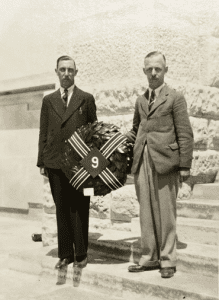
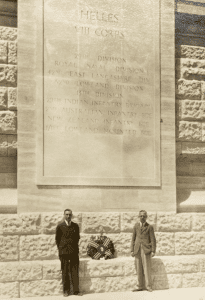
Representing the 9th Battalion Manchester Regiment were Captain Frank Woodhouse and Sergeant John Lawler who brought along a special wreath to be laid for the battalion. After a religious ceremony, the wreath was placed against the the inside of the outer wall at an appropriate location.

Capt Frank Woodhouse - Helles Memorial Wreath
Capt. Frank Woodhouse and Sgt. John Lawler posing with the Wreath
Capt Frank Woodhouse & Sgt Lawler - Helles Memorial Wreath
Capt. Woodhouse and Sgt. Lawler posing with the wreath below the VIII Corps Panel
Capt Frank Woodhouse - Laying the Helles Memorial Wreath
Laying the Wreath Against the Inside of the Outer Wall.

The two men took a number of photographs of their time there and upon their return Captain Woodhouse presented  the battalion with a photograph album containing the photographs mixed with postcards depicting the same locations in 1915.

The trip was widely reported in the press of the time and later commemorated in the book Gallipoli Revisited by W. E. Stanton Hope, F.R.G.S.

Acknowledgements

The photos above (Ref No: MR3/23/6) are reproduced here with kind permission of the Tameside Local Studies and Archive Centre and the Trustees of the Manchester Regiment Archive and remain under their copyright.

Captain Thomas Albert Platt

Thomas Albert Platt was born on April 1, 1880 in Dukinfield, Cheshire. His father, Tom Platt, was a “Beerseller and Clogger” who later became the Publican of the Brunswick Hotel on Park Road, Dukinfield. Young Thomas was the fourth of six sons, all of whom were educated well locally and eventually progressed to respectable middle class occupations.

He attended the Heginbottom Technical School, Ashton-under-Lyne where he received a 2nd Class Certificate in bookkeeping in 1898, when he was 17 years old. By 1901 he was working as an articled clerk at Wainwright, Son & Co. chartered accountants in Ashton and still living at home with his parents and three of his brothers.

In 1906 he married Mary Armstrong and they made their home in Ashton-under-Lyne.  A year later, he joined the 3rd Volunteer Battalion, The Manchester Regiment as a second lieutenant on June 10, 1907 and was appointed to the 9th Battalion Manchester Regiment Territorial Force with rank and seniority when it was formed on April 1, 1908.  In April 1909 battalion orders reported that he passed an examination in Musketry, (per appendix 6, sub-appendix viii), Territorial Forces Act of 1907.

In June 1911 he was appointed Acting Quarter Master when Capt. M.H. Connery proceeded to London for King George V Coronation duties and he was subsequently promoted to Captain on April 20, 1912. Later that year, in October 1912 he was named as one of two honorary secretaries to the newly formed Ashton district detachment of the British Red Cross Society, which was headquartered at the Ashton Territorial Armoury. He served in this position until August 1914 when he was forced to resign due to his mobilisation and imminent departure to Egypt.

In his civilian life he became a Chartered Accountant and also was an uncertified teacher at the Ashton-under-Lyne Mechanics Institute where he was paid 10s for 2hour evening classes and 15s for 3 hour classes.

In February 1914, his father Tom Platt passed away. Tom had been retired for many years and had become a member of the Ashton Board of Guardians (Chairman of the Workhouse Committee), and long time President of the Old Boys Association of Henshaw’s Oldham Blue Coat School, his old school. Consequently, he was widely known and respected in the area and his funeral was attended by many notable people from Ashton and well recorded in the local newspapers.

After the outbreak of war, Captain Platt sailed with the Battalion to Egypt in September 1914 and served with them during their training and preparation for action and he landed with the Battalion in Gallipoli on May 9, 1915 as second in command of “B” Company. There is no mention of Captain Platt in the Battalion, Brigade or Divisional war diaries but regimental records show that he was evacuated to hospital on June 24, 1915. These same records indicate that he was invalided to the UK on September 13 and struck of the strength of the battalion. The brigade war diary adds that he embarked on the Hospital Ship Marathon on September 13, 1915 at Alexandria en-route to the UK. Local newspaper reports confirm that he arrived at his home in Ashton-under-Lyne during the 2nd week of October and by early January 1916 had rejoined the 3/9th Battalion in training at Codford, Salisbury Plain.

No longer fit for overseas service he was seconded to a UK post outside the regiment where he was promoted to Major on August 5, 1917. He remained seconded until the end of the war when he returned to the Manchester Regiment. He resigned his commission on April 15, 1921 retaining the rank of Major.

Major Thomas Albert Platt died in a hotel in Ostend, Belgium on September 9, 1929. He was 49 years old.

Captain Harold Sugden

Harold Sugden was born in Ashton-under-Lyne in 1878.

Capt. Harold Sugden

By 1901 he was living with his uncle Mr. Edwin Whitehead who ran an Auctioneer business where Harold worked as a clerk. Harold took over the business on the death of his uncle.

He was commissioned into the 3rd Volunteer Battalion, The Manchester Regiment as a Lieutenant on 7th April, 1906 and transferred to the 9th Battalion Manchester Regiment maintaining his rank and seniority when the Battalion was formed on April 1, 1908. Earlier that year, on March 3, he married Emily Gertrude Brown and together they had a daughter, Eileen Sugden who was born on July 26, 1912.  He was promoted to Captain on July 6, 1910.

He sailed with the Battalion to Egypt in September 1914 and served with them there throughout their training and preparation for action.  Landing in Gallipoli on May 9, 1915 he was the Officer Commanding “B” Company.

On the evening of June 18, 1915 B Company attacked a Turkish trench but were met with overwhelming resistance and were forced to retire. The Turks then counter-attacked the allied trenches and the remnants of B Company with some men of C Company and some men of the 1/10th Manchesters defended their position.

Captain Harold Sugden was mortally wounded, by a gunshot wound to the lung, and subsequently died of his wounds on June 20, 1915 in hospital at Mudros. He was buried at East Mudros Military Cemetery on the island of Lemnos. He was 36 years old.

East Mudros Military Cemetery

He is also commemorated on the Ashton-under-Lyne Civic Memorial.