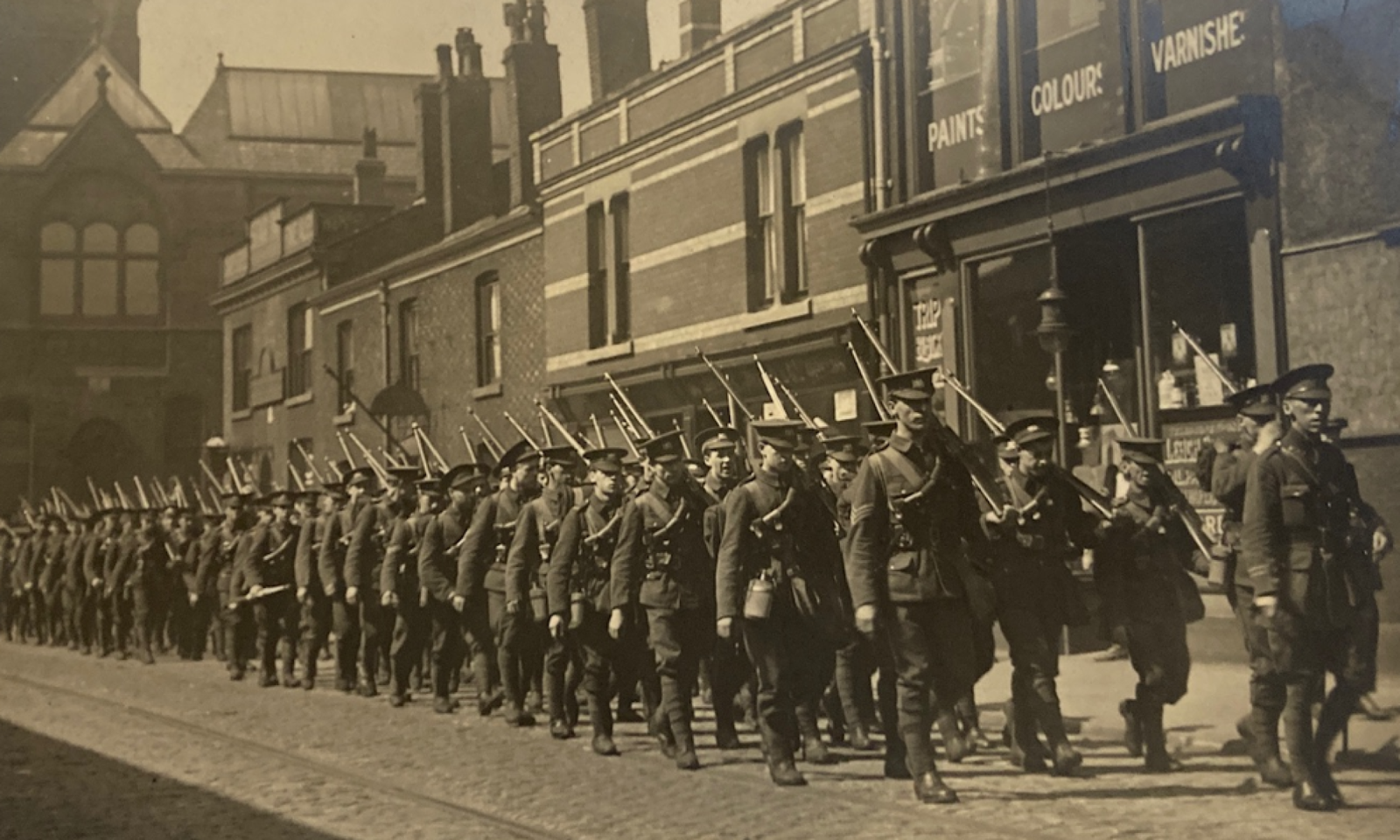
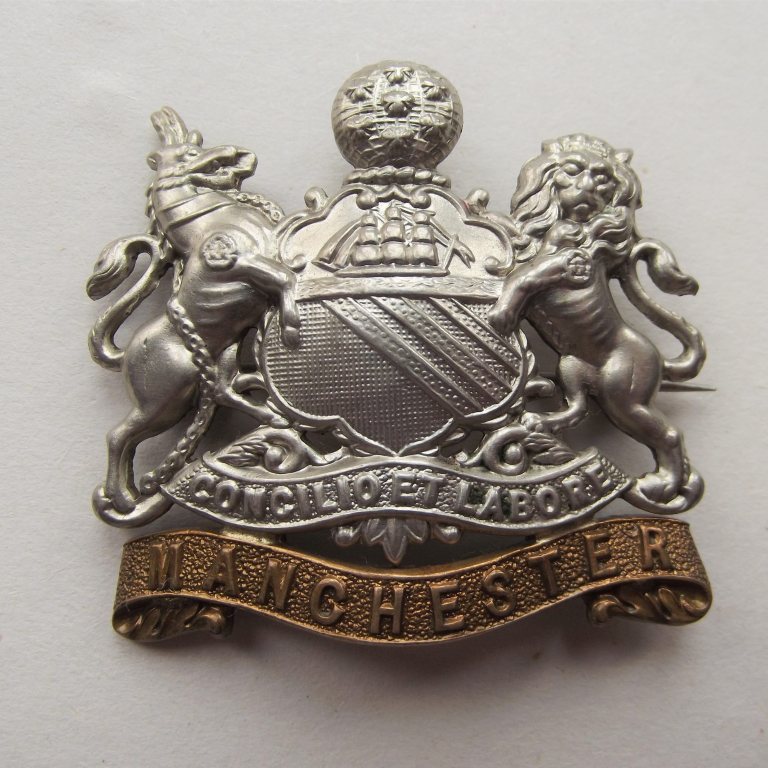
Belle Vue Pyrodramas

Several of the letters published in the Ashton Reporter from the men of the 9th Battalion Manchester Regiment make reference to “Belle Vue”, which was a famous local amusement park in West Gorton, Manchester. For example, take the letter written by Private Tom Littleford, to his mother, and published in the Reporter on Saturday July 17, 1915:

 “Private Jas. Ryder has had one or two narrow escapes. One day, when they were taking us in the trenches, a bullet took his hat straight off his head, and another bullet lodged in the overcoat, which was strapped on his back. Both night and day shrapnel shells are bursting around us. Talk about Belle Vue, it isn’t in it. When we were at home they called the Territorials England’s last hope, but we are England’s first aid at present”.

But in this case, the references to Belle Vue were specifically comparing the real world experience of battle they were now witnessing first-hand to those re-enacted in “Pyrodramas” at Belle Vue that they and their friends and family had seen together in happier times.

Belle Vue Main Entrance 1953
Courtesy Chetham's Library, Manchester

The founder and driving force behind Belle Vue was John Jennison (1790-1869) who bought the original 36 acre site, off Hyde Road and Kirkmanshulme Lane. Belle Vue opened in 1836, expanded over time and eventually occupied 165 acres. At the height of its popularity, 2 million people visited every year.

Belle Vue Plan 1892
By Foreign and Commonwealth Office Collection (Contributed by: The University of Manchester, The John Rylands University Library)

In 1851, Jennison, visited the Great Exhibition in London and whilst there, paid a visit to Surrey Zoological Gardens. It was here that he witnessed a ‘stupendous Diaphanic Panopticon’, which portrayed the horrors of war. Described in publicity of the time as a ‘gigantic panorama’ it measured 200 feet in length, and had figures 15 feet in height, and ‘was ‘the first ever attempted.’ Constantly looking for new ways to attract the public, on his return to Manchester Jennison formulated a plan to dramatically increase the quality, and expand the scale and visual impact of his own static panorama displays.

Edwardian Visitors to the Static Panorama
Courtesy Chetham's Library, Manchester

He envisioned large firework shows presented against the backdrop of a huge painted canvas representing a famous historical or contemporary event. He hired George Danson, (of Messrs. Danson), who had created the Surrey Zoological Gardens panorama which so impressed him, to come to Manchester and create the sets for the Belle Vue Pyrodramas. Danson constructed enormous backdrops, 300 feet wide and 60 feet high, hand-painted in the open air by professional artists who, for the rest of the year, worked in the Royal Opera House and the theatres of Covent Garden and Drury Lane. These backdrops were then installed on the “firework island” that formed the setting for the dramatic orchestrated shows, punctuated by fireworks and acted out by ever larger casts of actors. So successful were the Pyrodramas that Danson, and his sons, Thomas and Robert Danson, would come back to Manchester and paint them for each of the next 44 years.

Belle Vue Zoological Gardens Handbill, 1900 Season
Courtesy Chetham's Library, Manchester

Pyrodramas were included in the price of admission and visitors could watch from what used to be an open air dance floor or could pay extra to watch from an elevated viewing platform. The Pyrodramas were spectacular and turned out to be immensely popular, watched by tens of thousands each year, and their addition as an attraction in the zoological gardens helped secure the financial future of Belle Vue.

Battle of Blenheim, 1907 Season
Courtesy Chetham's Library, Manchester
« of 4 »

The first of the Pyrodramas was “The Bombardment of Algiers” in 1852 and the sequence of shows through 1926 are outlined below:

List of Representations at Belle Vue Manchester from 1852-1924
Courtesy Chetham's Library, Manchester
Year Pyrodramas
1852 The Bombardment of Algiers
1853 The Storming of Seringapatam
1854 Burning of Moscow
1855 Siege of Sebastopol
1856 The Storming of Malakoff
1857 The Siege of Gibraltar
1858 The Storming of Delhi
1859 The Temple of Janus
1860 The Storming of the Badajoz
1861 The Emperor’s Palace & the City of Pekin
1862 The Battle of the Nile
1863 The Relief of Lucknow
1864 The Siege of Charlestown
1865 Earthquake at Lisbon
1866 Carnival of Rome
1867 Storming of St. Jean d’Acre
1868 Battle of Trafalgar
1869 Storming of Magdala
1870 Capture of Quebec
1871 Bombardment of Strasburg
1872 Napoleon Crossing the Alps
1873 The Spanish Armarda
1874 Battle of Waterloo
1875 Capture of Coomassie
1876 The Prince at Calcutta
1877 The Fall of Alexinatz
1878 The Fall of Plevna
1879 The Afghan War
1880 Burning of the Tuilleries (City of Paris)
1881 Battle of Navarino (Fought in 1827)
1882 Carnival of Venice
1883 Battle of Tel-el-Kebir (Egypt)
1884 Siege of Constantinople, 1453
1885 Siege and Defence of Khartoum
1886 Storming of San Sebastian
1887 City of London
1888 Siege of Malta
1889 Storming of the Bastille
1890 Storming of Cairo
1891 Battle of Inkerman
1892 Battle of Cape St. Vincent
1893 American Indian War
1894 Siege of Granada
1895 Storming of Port Arthur
1896 Battle of Alma
1897 Matabele War
1898 Storming of Dargai
1899 Battle of Omdurman
1900 Siege of Ladysmith
1901 Siege of Pekin
1902 Battle of Paardeberg
1903 Capture of Gibraltar
1904 Attack on Port Arthur
1905 Battle of Mukden
1906 Storming of the Kashmir Gate, Delhi (1857)
1907 Battle of Blenheim, Aug 13th, 1704
1908 Defence of Mafeking
1909 Bombardment of Alexandria
1910 Battle of Manchester
1911 The Relief of Lucknow
1912 Burning of Hankow
1913 The Balkan War – Battle of Lule Burgas
1914 The Battle of Kandahar
1915 The Battle of the Marne
1916 War in Flanders
1917 The Battle of the Ancre
1918 The Fight for Liberty
1919 Mons 1914-1918
1920 The Capture of Jerusalem
1921 Chinese War – Storming of the Taku Forts
1922 Storming of Kotah (Indian Mutiny 1858)
1923 The Redskins
1924 Mexico
1925 The Cannibals
1926 Reign of Terror

By 1923 the themes of the Pyrodramas changed from well-known military actions to less militaristic depictions, not wholly surprising after a run of 70 consecutive annual shows, and perhaps reflecting a change in public appetites after the great war. The last Pyrodrama produced at Belle Vue was “Robin Hood” in 1956.

In 1925, Belle Vue Zoological Gardens was sold to a London-based syndicate and during the 1950s it was purchased by the hotel and catering conglomerate, the Forte Group. As anyone of a certain age from Manchester can tell you, Belle Vue continued to be quite a popular local destination and an amusement park, miniature railway and speedway racing were added to the list of attractions. But by the 1970s, Belle Vue entered a death spiral as other more popular public attractions became available and attendances dwindled. Belle Vue finally closed for good in 1979.

References:

[1.] Chetham’s Library, Manchester
[2.] “The Belle Vue Story”, by Robert Nicholls. ISBN: 9781852160708
Gilbert the Filbert

Basil Hallam
© National Portrait Gallery, London

Basil Hallam Radford was born on April 3, 1888. He attended Charterhouse School and went on to become a well known actor and light comedian performing under the name ‘Basil Hallam’. In early 1914 he created and played the character of a privileged young “Knut”, Gilbert the Filbert, for The Passing Show which opened at the Palace Theatre, London, on 20 April 1914. The composer was Herman Finck and the lyrics were written by Arthur Wimperis.

Hallam became an overnight sensation and the whole country was singing the song and young men of a certain station started to refer to themselves as “Knuts”.

I’m Gilbert, the Filbert,
The Knut with a “K”,
The pride of Piccadilly,
the blasé roué.
Oh, Hades! the ladies
who leave their wooden huts
For Gilbert, the Filbert,
The Colonel of the Knuts.

The widespread popularity can be glimpsed in letters from the front, published in local newspapers, where men refer to themselves as ‘Knuts’ and further evidenced by a short article, written by P. G. Wodehouse, about the “Knuts O’ London” in the September 1914 edition of Vanity Fair.

Knuts O' London
Vanity Fair, September 1914

But, as for many others, the war got in the way of his success and on September 14, 1915 he was gazetted a probationary Second Lieutenant in the Royal Flying Corps.

On August 20, 1916 he was a temporary Captain and a member of No 1 Army Kite Balloon Section, stationed in France. On that day, the balloon broke away from its moorings and began to drift towards enemy lines. Following protocol, the three man crew proceeded to throw out their instruments and maps before planning to save themselves. Basil Hallam Radford did not survive the jump and is buried in the Couin British Cemetery. He was 27 years old.

References:

The September 1914 Vanity Fair article by P.G. Wodehouse can be found here.
Details regarding the death of Captain Basil Hallam Radford can be found here.

P.S.A. Movement

Several of the letters published in the Ashton Reporter from the men of the 9th Battalion Manchester Regiment have editorial references to the man being a member of the “P.S.A.” Additionally, the Reporter published short articles regarding the meetings and activities of the local P.S.A. brotherhood in Ashton and district and at one point published a P.S.A. “Roll of Honour”.

The Pleasant Sunday Afternoon (P.S.A.) movement was founded by John Blackham, a linen draper from West Bromwich, who was a prominent member of the local community. By the time he was 30 he was already a deacon at the West Bromwich Ebenezer Congregational Church, and was already active in the Adult School Movement which was originally intended to teach literacy to working class adults primarily through the study of the bible, especially the New Testament. No doubt his involvement in this endeavor caused him to think generally about how to increase attendances and especially how to regain the interest of those who had previously attended Church Sunday Schools but had since stopped.

In 1875, when he was 41, he traveled to Birmingham to hear the well-known American evangelists, Moody and Sankey who were speaking at the Town Hall one Sunday afternoon. Unable to get in, due to the large crowds, he ended up attending a small Sunday School bible study class at the Ebenezer Congregational Chapel in nearby Steelhouse Lane. Opened in 1816, this was a very large church with capacity for a thousand worshippers but on that day only a few dozen young men were in attendance. What a contrast. Thousands of people clamored to see the American evangelists preach the word of God but just a few minutes’ walk away, a capable and engaging speaker could barely summon up a handful of faithful men. Blackham had a breakthrough moment and perhaps for the first time clearly saw that in order to fill seats, the format, content and delivery mattered more than anything else. “I realized that if men were to be won, we must give them a service neither too long nor too learned. We must avoid dullness, prolixity, gloom and constraint”, he is later reported to have said.

On his return, he met with the West Bromwich Ebenezer Congregational Church Sunday School officials, and laid out his ideas of how to boost attendance, and reclaim lapsed members, by introducing a new kind of bible study class that would be short and bright and last no more than three-quarters of an hour. Importantly, as a member of a Congregationalist church the only people who needed to be persuaded to do something radical were his local church elders. Evidently, he was able to gain their consent and so he quickly set out to find as many local young men as he could who had previously attended Sunday School but who now no longer regularly attended church. The following Sunday afternoon, around 120 young men that he had recently canvased on the streets of West Bromwich duly arrived at the Ebenezer Chapel to attend the first meeting of what was shortly to become the Pleasant Sunday Afternoon (P.S.A.) movement.

The meetings were wildly successful and the popularity of the P.S.A. meetings slowly spread throughout the Black Country, across the Midlands and to the rest of the country. Within ten years, around 1885, they had reached Ashton-under-Lyne, gained traction and became an integral part of the religious establishment thus earning their place in the Ashton Reporter.

The P.S.A. and the Ashton Reporter

Saturday, September 11, 1915:

On Sunday, at the Ashton P.S.A. Society, at an open service for men and women, the veteran and distinguished elocutionist, Mr. Barnish Barnsdale is announced to recite “The Sermon That Wasn’t Preached”, “What Shall it Be”, and “Unconquered”. These are items that Mr. Barnsdale has made his own, and his elocutionary abilities ae acclaimed everywhere.

P.S.A. Roll of Honour

UNVEILING CEREMONY PERFORMED BY MRS. A. PARK

Saturday, October 30, 1915:

The gathering of the P.S.A. Society’s Bible Class on Sunday morning took the form of an open service, the first of its kind in the 30 years’ history of the class. There was a large attendance, which included a number of soldiers. The special feature of the gathering was the unveiling of the class Roll of Honour, which contains the names of all those who are doing military service in various parts of the world.

Mr. A. Park, J.P., president of the society, was in the chair, and he was accompanied on the platform by Mrs. Park. Several friends, by giving voice and recitations, added to the brightness of the service, and the members of the Singing Class rendered musical items in pleasing fashion.

The Chairman made sympathetic and appropriate reference to the members whose names appeared on the roll, and mentioned the loss they had sustained by the deaths in action of Gunner William Booth, R.F.A., and Staff-Sergeant Harry Owen of the Royal Garrison Artillery.

Ms. Park gave a short address of patriotic and religious character, and then proceeded to unveil the roll of honour, which contains the following names: –

Sergeant Thomas William Boon, 1st South Wales Borderers.
Company Quartermaster-Sergeant John Williamson, 1/9 Manchester Regiment.
Company Quartermaster-Sergeant Herbert Bradshaw, 2/9 Manchester Regiment.
Staff-Sergeant Harry Owen, 1st Siege Battery, R.G.A., killed in action.
Staff-Sergeant Wm. H. Martin, 1/9 Manchester Regiment.
Private Walter Eastwood, 3/9 Manchester Regiment.
Private Harry Hobson, 2/9 Manchester Regiment.
Private Wm. Bromley, 1/9 Manchester Regiment.
Private John Oldham, 3/9 Manchester Regiment.
Private Roland Bromley, 2/9 Manchester Regiment.
Private John Seedall, 6th Cheshire Regiment.
Private Frank Briggs, 8th South Lancashire Regiment.
Gunner Wm. Booth, R.F.A., killed in action.
Gunner Geo. H. Watkins, R.F.A., 181st Brigade.
Private James Beaumont, R.A.M.C.
Private Harry Kerrick, 3/9 Manchester Regiment.
Private Stanley Townley, 3/9 Manchester Regiment.
Private James Hague, 3/9 Manchester Regiment.

Serbian Silver Medal

Foreign Gallantry Awards

Foreign gallantry awards were sometimes given as a “consolation” if a British medal was not awarded.  In some cases men were recommended for a Distinguished Conduct Medal (DCM) and it was downgraded to a Mentioned in Despatches (MiD) as it passed up the chain of command. Foreign awards were slightly different in that they generally passed down the chain of command and therefore there was more certainty over their award. The Military Medal was not established until March 1916 and although it was possible to make a retrospective award, it often didn’t happen and of course was not available in 1915.

Some foreign medals seem to have been made available to the British on a reciprocal basis, and were awarded to men who were chosen by British commanders as being particularly deserving, but who did not, for some reason, qualify for a British gallantry medal.

One particular feature of some of these foreign awards (which was in effect an MiD with related medal) was that they could be awarded posthumously. The French Croix de Guerre as an example. This made it especially useful for awarding to men who had lost their lives in gallant circumstances but who fell short of the requirements for the Victoria Cross, the only British gallantry medal that could be awarded posthumously. Confusingly, one hears sometimes of apparently posthumous awards of ‘lesser’ British gallantry medals, but on investigation these turn out to be confirmations after the recipient’s death of awards for which they had already been recommended.

Pte. WILLIAM SHEEKEY (2231) 1/9th Manchester Regiment was one such man who was awarded the Silver Medal, otherwise known as the Serbian “Milos Obilic” Silver Medal of Valour.  In the London Gazette, the Serbian Silver Medal was listed under the heading of “Decorations and medals conferred by HIS MAJESTY THE KING OF SERBIA” and awarded for “gallantry and distinguished service in the field” which is the only citation available.  [Gazetted Feb 15, 1917]

Silver Medal Background:

Milos Obilic was a medieval Serbian knight, considered an epitome of bravery and honesty, and who, legend has it, was captured by the Ottoman Turks at the end of the Battle of Kosovo in 1389. Presented as a prisoner of war to the Turkish Sultan Murad I, Obilic produced a hitherto-hidden dagger and stabbed and killed the Sultan, an act for which Obilic was beheaded.  Ever since he personified the fearless, heroic Serbian warrior, ready to sacrifice own life in face of threatening defeat.

In the summer of 1913, the Kingdom of Serbia was overhauling its gold and silver Medals for Bravery, both in design and regulations, and opted to use the name and image of the great Serbian hero, Milos Obilic, in the design.

Award Criteria:

The medal was awarded for valour on the battlefield:

  • The gold version of the medal could be awarded to officers for “valour tested in battle” and, in exceptional cases, to NCOs for “fearless bravery in battle”.
  • The silver version could be awarded to NCOs and enlisted men for “bravery in battle”.

Description:

On one side of the medal is an ideal portrait of Milos Obilic in profile, wearing his armour and, near the edge, his name in Serbian Cyrillic, ‘MИЛОШ ОБИЛИЋ’.

Serbian Silver War Medal Front

On the other side of the medal, a cross with a pair of diagonal swords and, in the centre, the Serbian Cyrillic text, ‘ЗА ХРАБРОСТ’, which transliterates as ‘Za Hrabrost’, and translates to ‘For Bravery’.

Serbian Silver War Medal Back

Serbian recipients of the Milos Obilic Medal were exempt from taxes and it was the highest ranking Serbian medal at the time, which meant that, for a set of Serbian medals, it was worn in the leftmost position of the medal group, with the lower-ranking medals in their respective, regulated order or rank, being worn to the right of the Obilic medal.

References:

  1. ‘Serbian and Yugoslavian Orders and Decorations, 1859-1941’ by Pavel Car and Tomislav Muhić, 2009.
  2. The Europeana Collections Web Site.

Scabies in WW1

Pte. Arthur Slater was hospitalised for Scabies twice during his service in World War One.  He was not unusual in this.

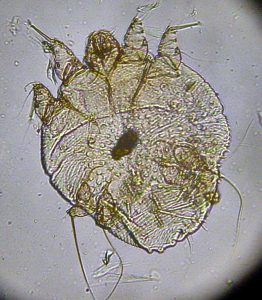
Scabies Mite
Sarcoptes Scabei. Kalumet, CC BY-SA 3.0, via Wikimedia Commons

The information below is primarily from Medical Services; Diseases of the War, Volume II, by Sir W. G. Macpherson.

Treatment of Scabies in WW1

The principles underlying the treatment of scabies included first, the exposure of the parasite and ova, secondly, their destruction by a suitable parasiticide, and thirdly, disinfection of contaminated articles of clothing and bedding.

Of all remedies, sulphur is generally acknowledged to be the most efficient, and by reason of its procurability and cheapness it was especially suited for the extensive requirements of the army.

During the war many preparations of sulphur were tried. After experiment the old-fashioned plan of inunction with the B.P. ointment was found to be the most satisfactory, although good results were obtained with sulphur in other forms, such as Vlemingkx’s solution*. Reference may be made to the “sulphur vapour treatment,” for it obtained a certain vogue. A number of instances of the after results came under observation. It proved an unsatisfactory and unreliable form of treatment; cure was uncertain, and severe secondary dermatitis common.

The treatment of scabies as adopted by MacCormac may be outlined as follows. On the first day the patient was thoroughly rubbed with soft soap for fifteen minutes. He then entered a warm bath where he lay for twenty minutes; during the last five minutes the infected sites were gently scrubbed with a soft brush. This procedure was designed to open up the burrows and expose the acari and ova. Steam or shower baths could not accomplish this satisfactorily and were therefore unsuitable. After drying, a liberal quantity of sulphur ointment (B.P.) was rubbed over the whole body below the neck, special attention being paid to the hands, feet, and penis. This inunction was repeated on the second and third days. On the fourth day, but not before, the patient was given a second bath and supplied with clean clothing and bedding. Such articles as socks, wrist straps, gloves, and the string of identification discs also required disinfection.

This routine procedure was successful in the vast majority of cases. Occasionally, it caused some degree of dermatitis, a condition easily allayed by simple ointment or dusting powder. This dermatitis was of importance; it usually made its first appearance five to seven days after sulphur treatment had been completed and was associated with itching, and therefore occasionally led to the false conclusion that relapse had occurred.

It should be noted that the preliminary bath was solely intended to expose the parasite and ova, therefore no disinfectant had to be added. In applying the sulphur preparation the whole body below the neck had to be treated, otherwise a few insects might escape destruction, with consequent re-infection. The sulphur ointment was employed on three days only; further application was unnecessary and might cause severe dermatitis. Finally, unless all contaminated material was disinfected, relapse was probable.

In 1918 a pamphlet on scabies was issued to the army. While it represented the result of much careful investigation reference may be made to it since it differed in certain respects from what has been said above. Moreover, dermatologists will hardly concur in the recommendation that the parasiticide liquor calcis sulphuratae should not be allowed to run on to the glans penis. This was a region very commonly found to be infected and therefore required special attention in treatment.

The severe type of scabies commonly met with in France required 31-7 days for cure as against three days for the average early case. But these severe types were in themselves evidence that disease had been present for a considerable time during which the infected man was capable of contaminating others. Early detection, therefore, not only shortened the period of treatment but also served as a means of preventing the spread of disease. Such early detection demanded first, familiarity on the part of the medical officer with the prevalent and unusual type of scabies; and secondly, the provision of sufficient opportunities for complete inspection. Early treatment was complementary to early diagnosis and was of equal importance. It has been shown that 30-29 days elapsed before a man affected with skin disease reached the base. Where treatment was carried out near the front area this figure was reduced, but, on the other hand, the more accessible the unit the less adequate must the means of treatment be unless this duty was undertaken specially. The provision of scabies hospitals for each army corps would seem to satisfy all requirements under conditions of active service, for they would afford early and skilled treatment, thereby both shortening the period of treatment and limiting the opportunities for spreading infection.

* Vleminckx’ solution is an orange-colored solution containing sulfides of calcium made by boiling a mixture of hydrated lime and sublimed sulfur in water and applied externally as a topical antiseptic and scabicide.  Also called Sulfurated Lime Solution.

Thresh Disinfector

Thresh Disinfector HM HS Vita

Sanitation was a huge issue in World War One. Soldiers in the trenches, both on the Western Front and in Gallipoli, living for months (and years) in difficult circumstances contracted various infestations and diseases related to the unsanitary conditions. Pte. Arthur Slater was twice hospitalized for scabies and men were also hospitalized for lice infestations. In such cases, apart from medically treating the patient, it was also necessary to disinfect their clothes and personal effects. The Thresh Disinfector was used for this purpose.

In Mesopotamia, disease (at least in the early years) was almost as dangerous to the health of the soldiers as the Turks.  The war diary of the Assistant Medical Director Services, Basra makes mention of Thresh Disinfectors being ordered, arriving and being distributed to the various camps used by the troops.

Some History

In 1870, Washington Lyon was working in the field of chemical disinfectants and served as the chair of his local sanitary committee. He took an interest in the process of vermin disinfection which lead to his high pressure Steam Disinfector patent ten years later.

In 1904, John Thresh, of the Thresh Disinfector Company of 66 Victoria Street, Westminster, London, took out a patent for an improved Disinfector – a device by which low pressure steam was used to disinfect bedding and clothing. Hot air was also created within the appliance, enabling drying of the contents to also take place. These disinfectors, sometimes mounted on wheels, were supplied to the War Office as well as Crown Agents for sale and use across the colonies. The appliances were made in Keighley, West Yorkshire.

Thresh Disinfectors used a calcium chloride solution to create steam that could penetrate materials at lower pressures than previous methods and could complete disinfection in as little as fifteen minutes. The basic process was as follows. First, infected materials including clothing, sheets, and mattresses were wheeled into the chamber and the chamber door was closed, providing an airtight seal. Next, low-pressured steam entered the interior chamber through the inlet valve, penetrating materials inside at a high, constant temperature. Finally, the steam was blown off the materials with hot air and the other chamber door was opened to wheel the materials out. The entrance and exit were separated to prevent contact between infected and disinfected materials.