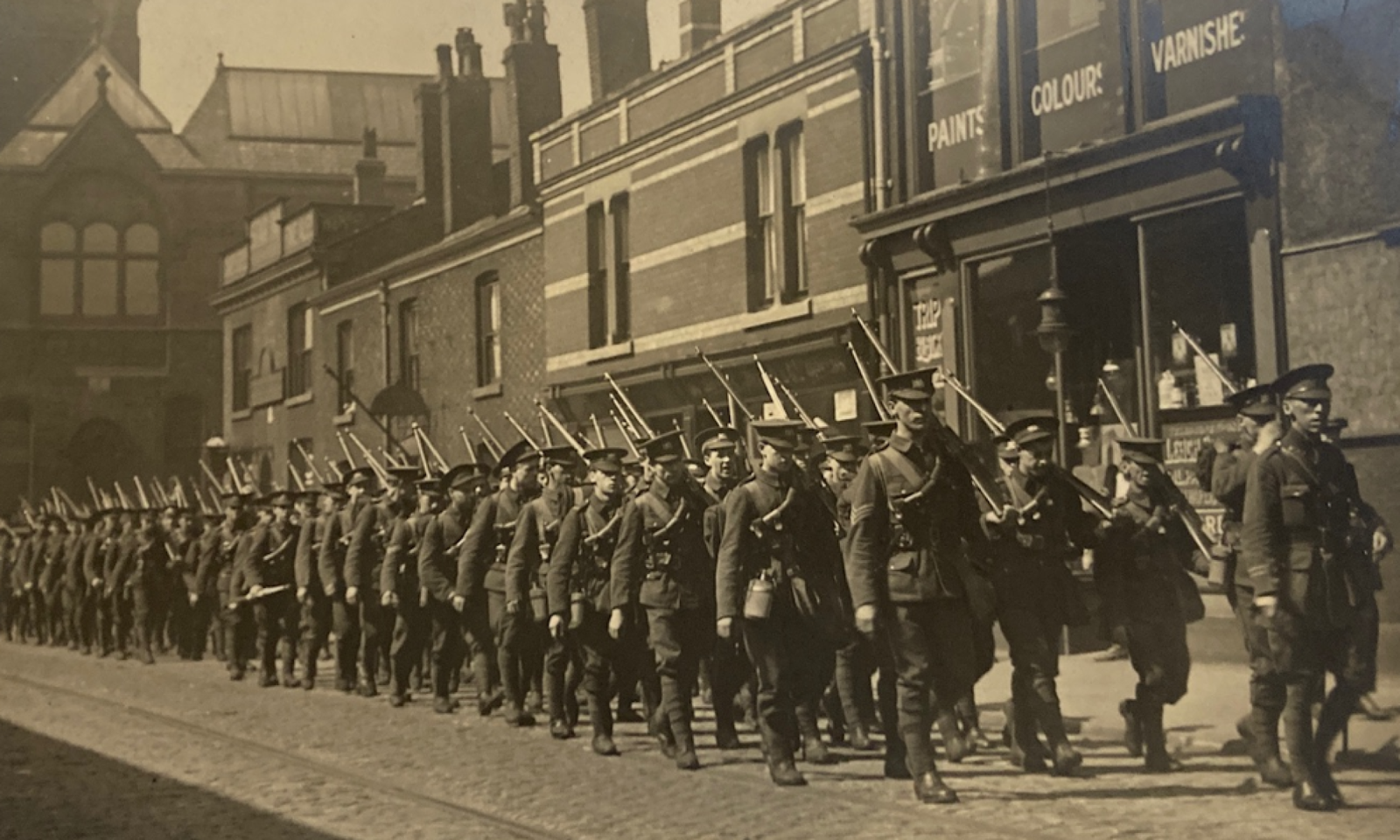
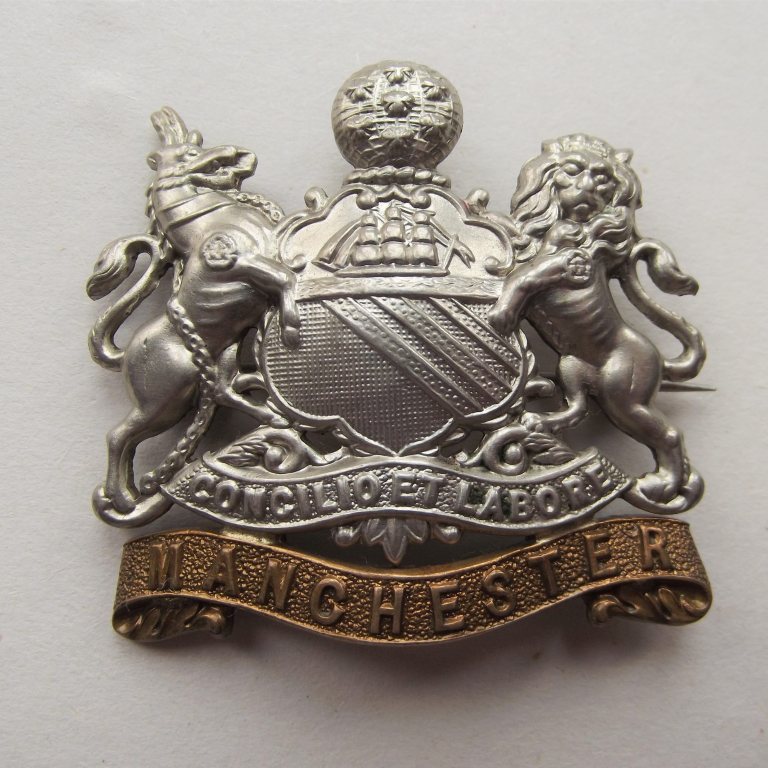
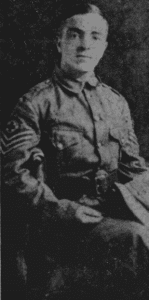
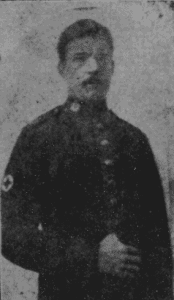
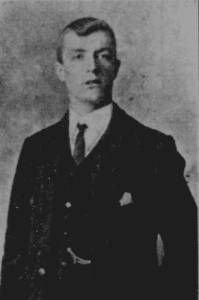
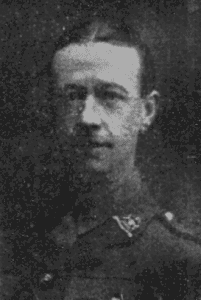
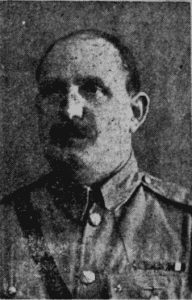
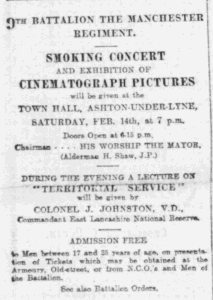
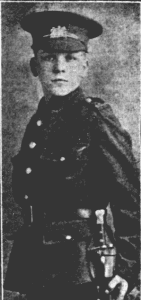
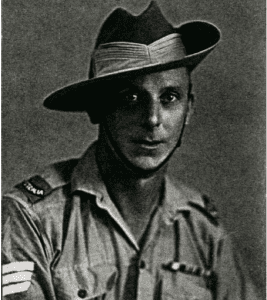
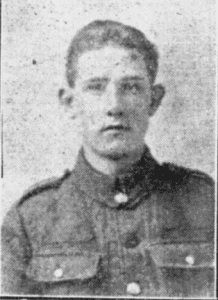
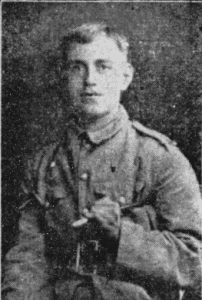
The Ashton Reporter newspaper announced that the 9th Battalion Manchester Regiment appointed Lieutenant Frederick Arthur Makin as officer in charge of the machine gun section in its May 2, 1914 edition. Three months later the same newspaper published the nominal roll of the battalion including the current members of the machine gun section:
No
Rank
First
Middle
Surname
526
Sgt
Thomas
Moss
1364
Cpl
Frank
Howard
1285
Pte
Albert
MacCormack
1199
Pte
Thomas
Radcliffe
1353
Pte
John
William
Dodd
471
Pte
William
Fogg
1371
Pte
Abert
Edward
Neale
1360
Pte
John
Levi
Kendall
1903
Pte
Harold
Ellis
1157
Pte
William
Henry
Illingworth
1349
Pte
Robert
Bell
–
Pte
H
Cook
1354
Pte
William
Loyd
Shuttleworth
1325
Pte
Joseph
Kent
1314
Pte
John
William
Andrews
1274
Pte
John
William
Donnelly
Enlisted Men of the Machine Gun Section, Aug 1914
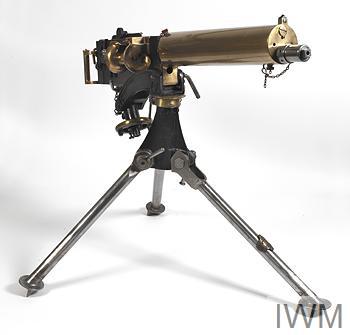
At this time, the battalion’s machine gun section consisted of two .303 calibre Maxim Machine Guns. The British-manufactured Service Maxim was used from late 1890s until its replacement by the Vickers Machine Guns that were introduced into British Service in 1912 and not declared obsolete until 1968. But by the outbreak of war only 109 of the new Vickers Machine Guns had been delivered to the Army.
It’s not possible to know precisely which model of Maxim Machine Gun the battalion was in possession of and so the following description is of a general nature.
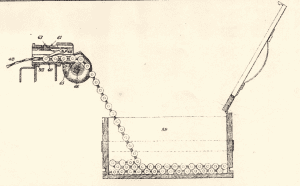
The Maxim Machine Gun operated automatically through a combination of two forces; the recoil generated from the explosion of the powder in each cartridge which pushed backwards and a strong spring which then pushed forwards. A sophisticated set of precisely calibrated and well lubricated mechanical components used this movement to eject the spent cartridge and pull the next live round into position ready to be fired. The gun was belt-fed from 250 round reusable ammunition belts, (made from waterproofed linen with brass strips and eyelets to properly set the ammunition spacing), and was capable of firing 450 rounds per minute (rpm) in rapid fire and a more sedate 70 rpm in controlled fire.
The Maxim was water-cooled, the gun-metal barrel casing holding about seven pints of water to keep the barrel cool when firing. It had three openings, one on the upper right side near the breech for filling, one underneath near the muzzle for drawing off the water, and the third for allowing the steam but not the water to escape. Steam was vented via a flexible tube into a can so that plumes of steam did not give the gun’s position away. When the barrel casing was filled with water about 2,000 rounds could be discharged at short intervals without replenishing, depending on the rapidity of fire. However, once the water started to boil, it evaporated at a rate of around 1 pint for every additional 1,000 rounds fired.
The Maxim Machine Gun was heavy and bulky, weighing 60lbs. When water was added for cooling it added almost another 10lbs. The tripod weighed around 48lbs and a fully loaded belt plus ammunition box weighed around 22lbs.
Maxim Machine Guns were operated by a crew of four to six men: The Gunner fired the gun; the Reloader quickly reloaded the gun when the 250 round ammunition belt was expended; the Spotter identified and directed fire towards enemy targets; the Ammunition and Water Carriers carried and prepared ammunition and water; and Mounters were responsible for moving and mounting the weapon on its tripod.
Gallipoli (May – June 1915)
When the 9th Battalion Manchester Regiment landed at Gallipoli on May 9, 1915 the machine gun section was already short two enlisted men. Pte 471 William Fogg and Pte 1349 Robert Bell were discharged on medical grounds in Egypt before the battalion sailed for Gallipoli.
Additionally, when Lieut. Sydney Marsden was wounded on June 6th, he was reported to be the Officer in charge of the machine gun section and therefore must have replaced Lieut. Makin either in Egypt or shortly after the battalion landed at Gallipoli. Lieut. Makin himself was medically evacuated from the peninsula the following day suffering from typhoid fever. And since Lt. Makin was the natural replacement for Lt. Marsden this caused a problem and the command of the machine gun section passed to Second Lieut. John Matley Robson who had only just arrived in Gallipoli on June 2nd having remained behind in Egypt serving as Officer in Charge of the Base, at Port Said, El Kantara, and Alexandria.
The machine gun section suffered another loss on June 9, 1915 when 1354 Pte. William Loyd Shuttleworth was killed in action. Sergeant 643 Squire Ellor had by this time taken over as senior NCO of the section, (vice Sergeant 526 Thomas Moss), and wrote the following letter to Pte. Shuttleworth’s mother:
“I am sorry to convey this message to you of your brave son’s death. He passed away early this morning. I cannot praise your son’s services enough as a machine gunner. He was a thorough master of his work, and as fearless as anyone in the section. We are very sorry we have had to part with him, but it is God’s will, and we cannot alter His works. Your boy died at his post. Only on Monday night last he kept awake for seven hours attending to two wounded comrades. He said to me that if he had to die, he hoped the Lord would not let him suffer in the way those two men had suffered. He died immediately he was shot. He was a credit to his battalion and his country. May he rest in peace.”
The newspaper report went on to say that Private Shuttleworth formerly worked at Ashton New Moss Colliery, (one of many men in the battalion from the Colliery), and he was killed shortly before his 21st birthday.
8 days later, Pte 1285 Albert MacCormack reported sick with Enteric Fever and was medically evacuated taking no further part in the campaign, eventually being repatriated to England on October 15, 1915.
Meanwhile, 2/Lt. Robson, having been appointed Officer in charge of the machine gun section without any prior experience or training, was ordered to report to the base depot at Gallipoli, behind the firing lines, where he underwent a 10-day course of instruction in the Maxim Machine Gun. He referred to this training in a letter he wrote on June 22, 1915:
“It’s much worse here than in the firing line. Shells are continually dropping round our dug-outs. You can imagine how difficult it is to concentrate your attention on what the instructor is saying when shrapnel and Jack Johnsons are flying round. The battalion has done exceedingly well, and has been praised by the generals, but the cost has been frightful.”
Gallipoli (July 1915)
2/Lt. Robson reported sick with Enteric Fever on July 7, 1915 and was medically evacuated to the 15th General Hospital at Alexandria where he died 10 days later on July 17, 1915. An old Boy of Manchester Grammar School, John Matley Robson was 23 years old. At this point the command of the machine gun section passed to Lieut. George William Handforth who transferred from B Company to C Company to temporarily take over command after they lost their entire group of officers who had landed six weeks earlier.
On July 12, 1915 Private 1501 George Markham, one of the men added to the machine gun section after the battalion arrived in Egypt, was killed in action. Remarkably, there is no mention of his death in the local newspapers save for a short family-supplied death notice:
In loving memory of our dear son and brother of Private Geo. Markham, 1/9th Manchester Regiment (machine gun section), aged 22 years, who fell in action at the Dardanelles July 12th, 1915.
We’ll not forget you, boy, who died for England. We’ll meet you once again in some far place; Where those we’ve loved and lost will greet us grandly. And tell us how you met death face to face.
And in mid-July the machine gun section lost their second gunner when Pte. 1157 William Henry Illingworth became sick from powder fumes from a Turkish lyddite shell and was medically evacuated to St. George’s Hospital, Malta for treatment. He remained in Malta for 3 months, (until at least late October), and likely returned to Gallipoli after he left the Għajn Tuffieħa Convalescent Camp there.
Machine Gun Section Replacements
Throughout their time at Gallipoli a small set of enlisted men were brought into the machine gun section to fill the holes left by the original members who were killed, wounded or sick. Since such assignments were not recorded on any service records or official records the men below are provided solely from newspaper reports.
No
Rank
First
Middle
Surname
643
Sgt
Squire
Ellor
1978
Cpl
Arthur
Spurrett
2049
Cpl
Charles
William
Gibson
2074
Pte
James
Hall
1968
Cpl
Arnold
Willerton
1985
Pte
Leonard
Smart
1534
Pte
Alfred
Edwin
Snape
1501
Pte
George
Markham
1667
Pte
John
Hill
Machine Gun Section Replacements 1915
Gallipoli (August 1915)
In August, the 9th Battalion Manchester Regiment was involved in the Battle of Krithia Vineyard (August 6-13) and the machine gun section suffered more casualties.
1353 John William Dodd, (now promoted to Corporal), suffered a bullet wound to the leg on August 7, 1915 and was medically evacuated to England where he spent time in hospital in Plymouth. He did not return to Gallipoli.
A few days later, on August 12, Corporal 2049 Charles William Gibson was also wounded when he took a bullet to the left knee. He too was medically evacuated to England but died on September 15, 1915 from septic poisoning. The September 25, 1915 edition of the Ashton Reporter in part stated:
Most impressive scenes marked the burial, on Saturday, of Corporal Charles William (Carl) Gibson, 23 years, of 342, Mossley-road, Ashton. Corporal Gibson, who was a fitter by trade, and formerly employed at the Patent Loom and Tape Works, Broadbottom, was wounded during, the severe fighting in the Gallipoli Peninsula on August 12th. He was attached to the machine gun section of the 1/9th Manchester Regiment. He was resting in the trench, and had fallen asleep, when he was struck on the knee by a poisoned bullet. Under a rain of lead his comrades carried him out of the trench. On August 29th he was admitted to the 2nd Military Hospital at Weaste, and after strong hopes had been entertained of his recovery he died on September 15th from septic poisoning and syncope.
The body was conveyed home from Weaste on Friday evening. At the interment on Saturday thousands of townspeople lined the streets. The burial was accompanied by full military honours Comrades of Corporal Gibson acted as bearers, and walked on either side the hearse, which was drawn by four horses. A firing party of 16 wounded and invalided Territorials back from Egypt and the Dardanelles were in command of Captain Lees. Lieut. Colonel D. H. Wade was also present.
On August 29, Pte 1314 John William Andrews, one of the original members of the machine gun section, died of wounds. He was buried the following day by the Reverend J.K. Best on a cliff overlooking Gully Beach.
Gallipoli (September – December)
2/Lt. Percy Ainsworth arrived in Gallipoli on Aug 19, 1915 as part of a draft of 4 Officers and 145 men and was allocated to C Company. On September 17th Capt. (temp) Handforth reported sick to hospital after being sick for some time and 2/Lt. Ainsworth took over command of the machine gun section. 2/Lt Ainsworth remained with the battalion until they evacuated the peninsula on December 27th and there is no indication that anyone else took over his command until he left the battalion in March 1916 when he joined the Royal Flying Corps in Egypt.
On December 12, 1915 the machine gun section suffered its final fatality of the Gallipoli Campaign when 18-year-old Pte 1534 Alfred Edwin Snape was killed in action. Born on December 30, 1896 Alfred joined the 9th Battalion Manchester Regiment a few weeks before his 17th birthday and turned 18 while they were training in Egypt. By the Army’s own regulations, he should not have been serving in a combat role at Gallipoli before his 19th birthday. Alfred had been wounded earlier in the campaign when he took a bullet to the thigh, (breaking a sixpenny piece in his pocket into three pieces), and was medically evacuated to Malta where he spent 3 months recovering. He had recently returned and was killed when a shell burst over his machine gun position. A letter of condolence was sent to his parents by his section NCO, Corporal 1968 Arnold Willerton, (himself only 18 years old when he landed in Gallipoli).
Egypt 1916
The 9th Battalion Manchester Regiment evacuated Gallipoli on December 27, 1915 and after a brief stop in Mudros arrived at Alexandria on January 17, 1916. They were taken by train to Cairo and from Cairo Station to Mena Camp by tram. A week later they moved to Tel-el-Kebir, located about 68 miles north-north-east of Cairo. Shortly after, they moved to El Shallufa on the Suez Canal, making camp on the East side of the canal. On February 10th they moved again, this time to El Kabrit, about 20 miles north of Suez where they remained for some time.
The 126 Company, Machine Gun Corps was formed by transfer of the battalion Machine Gun Sections of each of the four battalions of the 126th Infantry Brigade, 42nd (East Lancashire) Division. Throughout the Gallipoli campaign, Divisional Order of Battle and Field State reports consistently recorded that these four battalions were equipped with 2 machine guns each. However, since 28 men of the 9th Manchesters transferred, (with similar numbers from each of the 5th East Lancs, 4th East Lancs and 10th Manchesters), this indicates that the 126 Company’s machine gun count had doubled to 16 most likely with the addition of the newer Vickers machine guns.
Although it is widely accepted that the 126 Company, Machine Gun Corps was formed on March 14, 1916 the surviving service records of the 28 men of the 9th Battalion Manchester Regiment contradict this. Their service records indicate that they were transferred to the “Machine Gun Corps, 126 Bdge” on this date. These same men were all subsequently posted to the 126 Company, Machine Gun Corps on August 10, 1916. It is worth noting here that in military terminology that transferred meant a man had been permanently moved to another corps, while posted meant that a man had permanently moved to another unit of the same corps. This implies that the 126 Company was not actually formed until August 10, 1916.
During this period of transfer and posting, many of the men from the 9th Manchesters who transferred went through a formal 10-day machine gun training class at the Imperial School of Instruction, Zeitoun, (a suburb of Cairo), on June 23, 1916. At least three of them were awarded the proficiency badge of 1st Class Machine Gunner; Thomas Cronin Hardy, James Hall and Mathew Ellison.
Because the Machine Gun Corps was considered to be part of the Regular Army, all of the men from the Territorial Force who transferred had to effectively terminate their engagement with the Territorials and then re-enlist with the Machine Gun Corps. This, among other things, necessitated them undergoing a new medical examination by the Machine Gun Corps doctors to verify their medical eligibility. The paperwork that officially sanctioned their transfer was signed by Lt. Col D.H. Wade on September 29, 1916 while the 9th Manchesters were at Hod en Negiliat, (a “hod” is a plantation of date palms), en-route to El-Arish.
The 28 men of the 9th Battalion Manchester Regiment who transferred to the Machine Gun Corps on March 14, 1916 had all served in Gallipoli but only 3 were from the original 16 men of the machine gun section who left England on September 10, 1914.
No
MGC No
Rank
First
Middle
Surname
643
39621
Sgt
Squire
Ellor
1364
39622
L/Cpl
Frank
Howard
1968
39623
Cpl
Arnold
Willerton
3853
39624
L/Cpl
Albert
Shepley
1816
39625
Pte
Alexander
McKenzie
Whittet
1360
39627
Pte
John
Levi
Kendall
1515
39628
Pte
James
William
Cheetham
1880
39629
Pte
Thomas
Cronin
Hardy
2145
39630
Pte
Thomas
Lumley
1702
39631
Pte
Arnold
Myers
3705
39632
Pte
Matthew
Ellison
3717
39633
Pte
John
Burgess
3039
39634
Pte
George
Andrew
Brocklehurst
3224
39635
Pte
James
Buckley
1268
39636
Pte
Jesse
Edwin
Connolly
1891
39637
Pte
Joseph
Jackson
2883
39638
Pte
Albert
Loader
1330
39639
L/Cpl
Harry
Potter
2960
39640
Pte
John
Samuels
1667
39641
Pte
John
Hill
1573
39642
Pte
Sam
Entwistle
3301
39643
Pte
Charles
Henry
Ward
2074
39649
L/Cpl
James
Hall
1737
39650
Pte
Thomas
Rackstraw
2624
39651
Pte
William
Cooper
2549
39652
Pte
William
Matley
1325
39653
Cpl
Joseph
Kent
1695
39654
Pte
Alfred
Smith
Machine Gun Corps Men from the 9th Manchesters, 1916
Note: The rank shown is the rank held upon transfer to the Machine Gun Corps.
This group of men, (with two notable exceptions who were under the age of 19 when they landed in Gallipoli), were generally slightly older than the remainder of the battalion. But life in the Machine Gun Corps was dangerous and four men were later killed in action in France with another five being discharged due to wounds or sickness. Between the 28 men were two winners of the Distinguished Conduct Medal, three winners of the Military Medal and three awards of the Territorial Efficiency Medal and Territorial Force Efficiency Medal.
References:
Handbook for the 0.303″ Maxim Machine Gun (Magazine Rifle Chamber), 1901.
The Devil’s Paintbrush (Sir Hiram Maxim’s Gun) by Dolf L. Goldsmith.
A review of the WO 213: Judge Advocate General’s Office: Field General Courts Martial and Military Courts, Registers. Field General Courts Martial (1915) shows officers and men of the 1/9th Battalion Manchester Regiment were subjected to 32 cases of Courts Martial in Gallipoli and at least two in Egypt in 1916. The range of offences was quite broad resulting in punishments ranging from the loss of one day’s pay to a sentence of death.
In the late 1800s, Military law was codified by the Army Discipline and Regulation Act, 1879, which was subsequently replaced by the Army Act, 1881. This code of military law continued in force from year to year by an Annual Act, known originally as the Army (Annual) Act which both reaffirmed and provided amendments to the Army Act, 1881. In 1915, the practical application of military law applied in Gallipoli was outlined in the Manual of Military Law, published by the War Office, 1914.
The Army Act, 1881 defined, amongst other things, those offences that were punishable by death and those that were not, and offences that were punishable more severely on active service as well as the differences in punishments for officers and enlisted men. In practice, the offences that the men of the 9th Manchesters were charged with at Gallipoli included Theft, Disobedience, Absence from Camp, Sleeping on Duty, Quitting their Post, Disobeying Orders, Malingering and “Acting to the prejudice of good order and military discipline” – a catch-all offence for anything not explicitly defined in the Act.
In 1915 the British Army recognized three kinds of Courts Martial; Regimental, District and General. Each court held different power of punishments and only the highest, a General Court Martial, could award punishments of penal servitude or death. General Courts Martial required a minimum of five officers, ideally from different regiments and battalions with each having held their commission for at least three years. The president of the court was appointed by the convening officer and could not be below the rank of Major, with a higher rank strongly preferred if available. A Field General Court Martial is an exceptional kind of General Court Martial held overseas or on active service. Due to the exceptional nature of the court a Field General Court Martial required only three officers unless the convening officer was of the opinion that three were not available in which case, they were allowed to consist of only two. However, a court of only two officers could not award any sentence exceeding two years imprisonment or three months field punishment. Regardless, a sentence of death required the concurrence of all the members of the court.
In Gallipoli, verdicts and sentences rendered by the Field General Courts Martial for battalions in the 42nd (East Lancs) Division were reviewed by the G.O.C. 42nd Division and then by the G.O.C. 8th Army Corps. The courts held the responsibility of prosecuting the cases, rendering the verdicts and applying statutory sentences while the higher authority of the Divisional and Corps quashed, commuted, suspended or endorsed sentences to normalize the court rulings and apply some element consistency.
Let’s look more closely at the offences that were tried and the punishments given out to the 9th Battalion Manchester Regiment in Gallipoli.
Offence: Theft
The 9th Manchesters landed at Gallipoli on May 9, 1915 and less than two weeks later two men were tried and convicted of theft. In order to prove the case, the court had to find an intention to steal and that the men fraudulently took property without the owner’s consent with the intent of permanently depriving the owner of said property. Whether the theft was from the military establishment or from a comrade we do not know but we can see that both men received a relatively light sentence of 14 days Field Punishment. Consequently, we can reasonably assume that the offence was proven but not considered particularly serious.
Rank
No
First
Surname
FGCM Date
Theft
FP
Pte
2208
GEORGE
PRICE
21-May-15
X
14 days
Pte
1660
HAROLD
GARTSIDE
21-May-15
X
14 days
Note:
There were two categories field punishment. Field punishment No. 1, which consisted of heavy labouring duties, and being restrained in handcuffs or fetters, and being tied to a fixed object, such as a post or wheel, for two or more hours a day. Field punishment No. 2 differed, in that the offender was not liable to be attached to a fixed object.
Offence: Sleeping on Duty or Quitting Post without Permission
Section 6 of the Army Act 1881, Offences Punishable more Severely on Active Service than at Other Times, point (1) sub-section (k) states:
(1.) Every person subject to military law who commits any of the following offences; that is to say,
(k ) Being a soldier acting as sentinel, commits any of the following offences; that is to say,
(i.) sleeps or is drunk on his post; or (ii.) leaves his post before he is regularly relieved,
shall, on conviction by court-martial, if he commits any such offence on active service, be liable to suffer death, or such less punishment as is in this Act mentioned.
Needless to say, when on active service in a combat zone, any soldier acting as a sentinel who either sleeps on his post or leaves his post before he is relieved commits a very serious offence endangering the lives of his comrades and jeopardizing the safety of his unit. Not surprisingly these offences are clearly called out in the Army Act, 1881 and carry a sentence of death or some other lower but serious penalty. In order to render a death sentence the three officers of the Field General Court Martial must be unanimous in their decision.
Rank
No
First
Surname
FGCM Date
Chg
Hard Lab
Remit’d
Pte
–
–
HARGREAVES
22-Jun-15
S
6m
Susp
Pte
1434
PERCY
LEE
22-Jun-15
S
9m
Susp
Pte
–
J
JACKSON
22-Jun-15
S
9m
Susp
Pte
1915
GEORGE
MURPHY
06-Jul-15
S
24m
Susp
Pte
1644
ARTHUR
ADSHEAD
09-Sep-15
S
Death
Comm
Pte
1693
ALBERT
ORTON
24-Sep-15
S
12m
Comm
Pte
1629
JOSEPH
WHIPP
09-Jul-15
Q
24m
Susp
Notes:
The Field General Courts Martial register provides only the surname and initials of the men charged and, in some cases, not even the initial. In the table above, “HARGREAVES” could be either Pte 1580 Norman Hargreaves or (more likely) Pte. 1952 Harold Hargreaves.
“J JACKSON” could be any one of three men; Pte. 1891 Joseph Jackson, Pte. 2169 John Jackson or Pte. 2171 John Jackson.
A suspension of punishment meant that the case was periodically reviewed and the punishment liable to be reinstated if the man’s subsequent behaviour warranted it, whereas commuting the sentence, although not erasing the conviction, permanently reduced or removed the punishment associated with it and was therefore not subject to periodic review.
Looking at each of these cases a little more closely:
The first three cases were brought approximately six weeks after the battalion landed in Gallipoli and on the same day that they returned to bivouac after almost 3 straight weeks in the trenches. A period that saw the two bloodiest days that the battalion would experience at Gallipoli. All three cases were for sleeping on post and since the case against Hargreaves resulted in a lower punishment than the others, we can conclude that court felt there were some mitigating circumstances there. Upon review by a higher authority, (the G.O.C. 42nd Division), all three sentences were suspended implying that the charges were primarily brought to make the point to all members of the battalion that potentially serious consequences awaited anyone caught sleeping on post.
But if that was the intent it didn’t have the desired effect because just two weeks later, Pte. 1915 George Murphy was convicted of the same offence and given a substantially harsher sentence of 2 years hard labour. This sentence, like the previous three, was subsequently suspended upon review. And a few days later, Pte. 1629 Joseph Whipp was convicted of leaving his post before being properly relieved, (the only man in the battalion to be so charged in the Gallipoli campaign), and received the same sentence of 2 years hard labour, again suspended upon review.
At this point it’s worth remembering that the Field General Court Martial date was the date of the trial and not the date of the offence, which was of course committed sometime earlier. June saw the biggest casualty figures for the battalion during the whole Gallipoli campaign and apart from a very small draft of one officer and 16 men arriving in late June the first substantial draft of men to bolster the dwindling numbers of combat ready men in the 9th Manchesters did not arrive until July 23, 1915. This perhaps played a role in the suspension of sentences as every able-bodied soldier was needed.
Pte. 1644 Arthur Adshead was the next man to be tried for sleeping at his post on September 9, 1915 and was found guilty and given a sentence of death. Without the trial transcripts we have no way to know why his case was treated significantly more harshly than the previous cases but the record shows that his sentence was commuted to 10 years of penal servitude. But we also know that Pte. Adshead went on to win the Military Medal in April 1918, (one of four men court martialed in Gallipoli to subsequently be awarded medals for bravery), while still serving with the Manchester Regiment and so we must assume that at some point the military authorities came to their senses and suspended the commuted sentence.
Pte. Adshead was incarcerated at the Gabbari Military Prison in Alexandria where he contracted dysentery and was admitted to the 19th General Hospital on October 16, 1915. He remained in hospital for 31 days eventually being released back to prison on November 15, 1915.
The last man of the 9th Manchesters to be charged with sleeping at his post was Pte. 1693 Albert Edward Orton. Fortunately, his service record has survived and it contains the following notes:
Deputy Judge Advocate General (DJAG), MEF September 24, 1915
Tried by FGCM Section 6(1k). When a soldier acting as a sentinel on active service, sleeping on his post in that he, in the field, on 6th Sept 1915 about 10:15pm when acting as a sentry in the trenches was asleep. Found guilty and sentenced to be imprisoned with hard labour for one year. (The Court recommends the accused to mercy on the grounds that he is very young and had been unreasonably overworked). Confirmed by G.O.C. 42nd Division who remitted six months of the imprisonment. Sentence commuted to one of Field Punishment No 1 for three months by G.O.C. 8th Army Corps dated October 13, 1915.
Battalion October 6, 1915
Awarded 10 days Field Punishment No 2 for absenting himself while on fatigue.
The court’s recommendation conveys two key pieces of information; that he was “very young” and that he had been “unreasonably overworked”.
Pte. Orton was an underage soldier who joined the battalion during the big recruiting drive of February 14, 1914 when he was 17 years old. After serving with the battalion in Egypt from September 1914 to May 1915 he was still only 18 years old when he landed in Gallipoli and would not turn 19 until September 11, 1915. By the military’s own regulations, he should not have been allowed to serve in a front-line combat role but instead should have been posted to a training or other unit behind the firing line. The battalion knew his age, he did not lie on his attestation papers, and deployed him into the firing line at Gallipoli anyway, along with dozens of other underage soldiers. Because of this, Pte. Orton celebrated his 19th birthday in captivity awaiting trial by Field General Court Martial and probably aware that the last man of the battalion who was charged with sleeping on duty received a death sentence.
Throughout their time on the peninsula the men and boys of the 9th Manchesters were required to work almost constantly on fatigue duties whenever they were out of the firing line. By September 6th Pte. Orton had been in Gallipoli for almost 4 months and had endured the most dangerous and difficult living conditions imaginable. The effects of poor food, contaminated water, intense heat and little or no ability to properly rest accumulated in all the men and dozens of them with less robust constitutions and fitness reported sick. To say that the men were unreasonably overworked was an understatement and in retrospect it would have perhaps been expedient to make sure that men held sentry duty in pairs to prevent sleeping.
It’s also worth noting that Pte. Orton went on to win the Military Medal for bravery in the field in April 1918 while still serving with the battalion.
Offence: Absence from Camp
Section 15 of the Army Act 1881, Absence from Duty Without Leave, points (1) and (3) state:
Every person subject to military law who commits any of the following offences; that is to say,
(1.) Absents himself without leave; or
(3.) Being a soldier, when in camp or garrison or elsewhere, is found beyond any limits fixed or in any place prohibited by any general garrison or other order, without a pass or written leave from his commanding officer.
shall on conviction by court-martial be liable, if an officer, to be cashiered, or to suffer such less punishment as is in this Act mentioned, and if a soldier, to suffer imprisonment, or such less punishment as is in this Act mentioned.
Rank
No
First
Surname
FGCM Date
Abs
Field Punish
Cpl
2765
WALTER
TRACEY
27-Jun-15
Q
Ranks
Pte
2719
GEORGE
DEAN
27-Jun-15
Q
60 days
Pte
2713
JOSEPH
TAYLOR
27-Jun-15
Q
60 days
Pte
2802
REGINALD
JONES
27-Jun-15
Q
60 days
Pte
1979
WILLIAM
COYNE
28-Aug-15
X
56 days 2
Pte
1345
ERIC
GOLIGHTLY
28-Aug-15
X
56 days 2
This charge was used against men who had left their trench without explicit permission to do so for any reason, including in the face of an overwhelming assault by the enemy that they stood no chance of repulsing.
On Saturday November 6, 1915 the Ashton Reporter published an article written by an anonymous NCO of C Company which in part recounted some details of the bayonet charge on the night of June 18th:
During the period the company was in this trench “B” Company made an attempt on the 18th June to clear the Turks out of two small trenches, but they found the Turks in such great numbers that they had to retire, and the Turks charged our trench, which was held by a few of “C” Company and a number of 10thManchesters, and gained a footing in a part of it. Both Lieut. Wade and Lieut. Connery took part in “B” Company’s attack, volunteering for the job, and led portions of the men, but Lieut. Wade unfortunately failed to return when the company retired. It was a terrible night, and several attempts were made by various units to recover the ground lost, but without success. “B” Company lost heavily, and Capt. Sugden was mortally wounded.
The 9th Manchesters’ war diary noted that they suffered 9 killed, 17 missing and 33 wounded in addition to the loss of Capt. Sugden and 2/Lt. Jack Wade.
On June 26th thirteen men of the 10th Manchesters were court martialed under Section 15. All were found guilty and each one was awarded 14 days field punishment number 1. The following day, four men of the 9th Manchesters were court martialed on the same charge, almost certainly for their part in the events that night. Corporal 2765 Walter Tracey lost his stripe and the other three men were awarded 60 days field punishment. All four had just days before arrived in Gallipoli as part of a small draft and were ill equipped to be thrust into the situation they found themselves embroiled in that night.
Later in the war, one of those men, Pte 2713 Joseph Taylor went on to win the Military Medal for bravery in the field, awarded in June 1918 after he had transferred to the Machine Gun Corps.
In late August, another two men were convicted of the same offence and were each given a sentence of 8 weeks field punishment number 2. One of the men, Pte 1345 Eric Golightly, was at the time only 18 years old and, like Pte Orton who was convicted of sleeping on sentry duty, should not have been in Gallipoli before his 19th birthday. However, unlike Pte Orton, there is no record of Pte Golightly receiving any clemency from the Divisional or Corps authorities for his age.
Offence: Disobedience
Section 9 of the Army Act 1881, Disobedience to Superior Officer, states:
Every person subject to military law who commits the following offence; that is to say,
Disobeys in such manner as to show a wilful defiance of authority any lawful command given personally by his superior officer in the execution of his office, whether the same is given orally or in writing, or by signal or otherwise, shall on conviction by court-martial be liable to suffer death, or such less punishment as is in this Act mentioned; and
Every person subject to military law who commits the following offence; that is to say, disobeys any lawful command given by his superior officer, shall, on conviction by court-martial, if he commits such offence on active service, be liable to suffer penal servitude, or such less punishment as is in this Act mentioned; and if he commits such offence not on active service, be liable, if an officer to be cashiered, or to suffer such less punishment as is in this Act mentioned, and if a soldier, to suffer imprisonment, or such less punishment as is in this Act mentioned.
Rank
No
First
Surname
FGCM Date
Chg
HL
FP
Pte
3345
GEORGE
HAMBLETON
09-Sep-15
S.9.1
18m
Pte
517
FRANK
CAWLEY
13-Mar-16
X
6m
L/Cpl
1792
ALBERT
DAVIES
09-Sep-15
Sgt
90d – 2
Pte
885
FRANK
GODDARD
22-Jul-15
SO
42d – 1
A/Sgt
1592
EDWARD
ALLOTT
25-Oct-15
SO
Note:
Acting Sergeant Edward Allot was found Not Guilty.
The Manual of Military Law. War Office, 1914 provides some guidance on the nature of this offence:
Closely connected with the offence of mutiny is the offence of disobedience to a lawful command, which is punishable under S. 9 of the Act (a). No offences differ more in degree than offences of this class. The disobedience may be of a trivial character, or may be an offence of the most serious description, amounting, if two or more persons join in it, to mutiny. Accordingly, the object of this section is to enable charges to be framed in such manner as to discriminate between different degrees of the offence.
Pte 3345 George Hambleton joined the 9th Manchesters on the 9th or 10th of January, 1915. He trained in the UK with the 2/9th Battalion at Southport and then Pease Pottage before landing in Gallipoli on August 22, 1915 as part of the second large draft of men that reinforced the 1/9th Manchesters. Within two weeks of landing, he must have committed his act of disobedience and was charged with the more serious offence of wilful disobedience. Found guilty he was sentenced to 18 months of hard labour.
Pte 517 Frank Cawley was a long-time member of the 9th Manchesters attesting on January 6, 1909. He attended all of the battalion’s summer camps from 1909 until the outbreak of war and had re-engaged for four more years on April 1, 1913. He deployed with the battalion to Egypt in September 1914 and landed on Gallipoli on May 9, 1915. His service record shows no evidence of being sick or wounded throughout the campaign and he subsequently deployed to Egypt in 1916 with the rest of the battalion. But something about him had changed on the peninsula and in January and February 1916 he was given 7-days confinement to barracks followed by 14-days of field punishment number 2 for two counts of “inattention on parade”. His service record then contains the following:
Tried by FGCM, El Kabrit, for when on active service March 6, 1916 (wilfully) disobeying a lawful command given by his superior officer in the execution of his office. Sentenced to six months imprisonment with hard labour. March 13 to September 12, 1916.
Sentence of 6 months imprisonment with hard labour now suspended. June 9, 1916.
He was released on June 15th but he continued to be written up for a series of minor acts of defiance, (late on parade, absent from parade, hesitating to obey an order), during 1916 and 1917. In 1918 he transferred to the 2nd East Lancs Regiment where he again committed a series of minor infractions (failing to salute the Regimental Sergeant Major, Insolence to the Regimental Police and falling out of line during a march without permission). In 1919, since he was still carrying a suspended sentence, his case came up for review and his commanding officer somewhat remarkably recommended that his sentence should be remitted since “his character has been very good (3 trivial offences) and he has carried out his duties in a willing manner and to the complete satisfaction of his superiors.” And indeed, his sentence was remitted by the Brigadier-General of the 100th Infantry Brigade on September 11, 1919.
L/Cpl 1792 Albert Davies joined the 9th Manchesters on February 16, 1914 which was the Monday immediately following the big recruiting drive. All of those men who attended the “Smoking Concert” at Ashton Town Hall on the previous Saturday but ran out of time to attest were told to report to the Armoury on February 16th. Albert was 17 years and 6 months old when he attested and gave his correct age. Consequently, he was still only 18 years old when he landed in Gallipoli and did not turn 19 until July 7, 1915. So, although he should have been held back in Egypt for two months before landing in Gallipoli, he was 19 years old when he committed his offence in September. He was found guilty and awarded 3 months of field punishment number 2. Based upon this sentence we can conclude that the charge against him was not one of wilful disobedience. Nevertheless, this means that he had just completed his sentence when, on December 19, 1915 he won the Distinguished Conduct Medal.
Pte 885 Frank Goddard was a long-time member of the 9th Battalion Manchester Regiment attesting in 1909 and by the outbreak of war he was a Lance Corporal. Nevertheless, on July 22nd 1915 he was convicted of disobedience to a senior officer and awarded 6 weeks of field punishment number 1. Based upon this sentence we can conclude that the charge against him was not one of wilful disobedience.
Offence: Malingering
Section 18, point (1) of the Army Act 1881, Disgraceful Conduct of Soldier, states:
Every soldier who commits any of the following offences; that is to say,
(1.) Malingers, or feigns or produces disease or infirmity shall on conviction by court-martial be liable to suffer imprisonment, or such less punishment as is in this Act mentioned.
More specifically, the Manual of Military War, 1914 specifies that Section 18.1b is Feigning or Producing disease or infirmity, (as opposed to malingering).
Rank
No
First
Surname
FGCM Date
Charge
Not Guilty
Pte
2328
WILLIAM
GODDARD
25-Aug-15
S.18.1b
X
Pte
–
J
JACKSON
25-Aug-15
S.18.1b
X
Pte
–
T
McCLUSKY
25-Aug-15
S.18.1b
X
L/Cpl
1553
HAROLD
MORRIS
25-Aug-15
S.18.1b
X
Notes:
“J JACKSON” could be any one of three men; Pte. 1891 Joseph Jackson, Pte. 2169 John Jackson or Pte. 2171 John Jackson.
There was no “T McCLUSKY; there was only Pte 2005 Francis (Frank) McClusky and Pte 2072 Henry (Harry) McClusky.
At the time of the Field General Court Martial on August 25, 1915 Major Thomas Frankish, RAMC was attached to the 9th Battalion Manchester Regiment as its Medical Officer, (M.O.), a role that he filled until he was transferred on August 31st. It is likely that the charges originated with him but no surviving records exist. Major Frankish was appointed the battalion’s M.O. just before they landed in Gallipoli replacing their long-time M.O. Surgeon Major Albert Hilton who died from meningitis in Egypt in February 1914. Thus, Major Frankish did not know any of the men and was likely not sympathetically disposed towards them. The assumption is that each of these men reported sick in late August, were examined by Major Frankish and summarily put on a charge. Since they were all found not guilty it’s possible that, left untreated, one or more of them became undeniably sicker by the time of the trial and were consequently exonerated.
Regardless of what actually happened, all four men were found not guilty, Major Frankish was transferred to the 1/3rd East Lancs Field Ambulance shortly thereafter and no more men of the battalion were charged with this offence throughout the remainder of the campaign.
Offence: Conduct to the Prejudice of Military Discipline
Section 40 of the Army Act 1881, Conduct to the Prejudice of Military Discipline, states:
Every person subject to military law who commits any of the following offences; that is to say,
Is guilty of any act, conduct, disorder, or neglect, to the prejudice of good order and military discipline, shall on conviction by court-martial be liable, if an officer, to be cashiered, or to suffer such less punishment as is in this Act mentioned, and if a soldier, to suffer imprisonment, or such less punishment as is in this Act mentioned. Provided that no person shall be charged under this section in respect of any offence for which special provision is made in any other part of this Act, and which is not a civil offence; nevertheless the conviction of a person so charged shall not be invalid by reason only of the charge being in contravention of this proviso, unless it appears that injustice has been done to the person charged by reason of such contravention; but the responsibility of any officer for that contravention shall not be removed by the validity of the conviction.
Rank
No
First
Surname
FGCM Date
Chg
HL
Remitted
Pte
1350
GEORGE
WILTON
11-Jul-15
S.40
12m
Susp
Pte
–
J
HAMPSON
20-Jul-15
S.40
12m
Susp
Pte
1658
JONATHAN
POTTER
03-Oct-15
S.40
12m
Comm
Table 1 – Serious Cases of Section 40
Note:
“J HAMPSON” could be either Pte 1246 John Hampson or Pte 1836 James Hampson.
Rank
No
First
Surname
FGCM Date
Chg
FP
Pte
–
E
JONES
16-Aug-15
S.40
1m – 2
Pte
2854
FRANCIS
HAWKINS
16-Aug-15
S.40
1m – 2
L/Cpl
2413
HERBERT
PARKINSON
16-Sep-15
S.40
42d – 1
Pte
3378
WILLIAM
HADFIELD
25-Sep-15
S.40
42d – 2
Pte
2174
HARRY
PRATT
03-Oct-15
S.40
56d – 2
Table 2 – Moderate Cases of Section 40
Note:
“E JONES” could be Pte 1613 Edward Jones, Pte 1897 Edward Jones or Pte 2073 Everett Jones.
The case against Pte. William Hadfield was quashed.
Rank
No
First
Surname
FGCM Date
Chg
Pay
CQMS
108
ROBERT
JACKSON
09-Sep-15
S.40
1d
Table 3 – Trivial Case of Section 40
Section 40 is a catch-all for offences that are not otherwise explicitly called out elsewhere in the Army Act, 1881. The Manual of Military Law, 1914 provides some interesting notes regarding the enforcement of charges under Section 40.
To sustain a charge under this section it is absolutely necessary that the charge should recite the words of the Act. That is to say, there must be charged an “act” or “conduct,” or “disorder,” or “neglect,” as the case may be, “to the prejudice of good order and military discipline.”
But the mere use of these words as a description of certain conduct does not warrant a court in assuming that such conduct is legally an offence. A court is not warranted in convicting unless of the opinion that the conduct charged was to the prejudice both of good order and of military discipline, having regard to the conduct itself and to the circumstances in which it took place.
Neglect must be wilful or culpable, and not merely arising from ordinary forgetfulness or error of judgment, or inadvertence; and where the use of certain words regarding superiors is made the subject of a charge under this section, the words must have been said meaningly, i.e., with a guilty intent.
In other words, to successfully bring a charge and convict a man under Section 40 the court must believe that he wilfully acted, conducted himself, or behaved with disorder, or wilfully neglected to do something the direct result of which was both to the prejudice of good order and of military discipline.
Three examples, amongst many others, provided by the Manual of Military Law, 1929 include; Negligent performance of duties connected with money or stores resulting in a deficiency and loss, Borrowing money from subordinates, and Accepting gifts an as inducement for arranging or excusing duties.
It is apparent from the sentences that the court saw the offences of Wilton, Hampson and Potter to be of a serious nature although it is notable that all three were either suspended or commuted by the Divisional and Corps authorities.
The offences committed by Pte. Jones and Pte. Hawkins resulting in 30 days of field punishment number 2 were comparatively minor transgressions and those committed by Parkinson and Pratt progressively more serious. Pte 3378 William Hadfield’s case was not of a particularly serious nature but his conviction was overturned by the Divisional and Corps authorities which was quite unusual.
Finally, we have the strange case of Company Quartermaster Sergeant (CQMS) 108 Robert Jackson of D Company, an Old Volunteer and holder of the Territorial Force Efficiency Medal. As one of the most senior and trusted NCOs of the battalion it must have been particularly galling and embarrassing for him to be tried by Field General Court Martial. Since no records survive, we have no way of knowing the nature of the charge but the sentence of a loss of 1 day’s pay indicates that whatever it was it should have been dealt with at the battalion level and not by Court Martial.
Officer Field General Court Martial
Lt. James Alfred Parker of the 9th Battalion Manchester Regiment was court martialed in Shallufa, Egypt on February 14, 1916 for “Disobeying CC”. He was found guilty and sentenced to be cashiered after 12 weeks hard labour. His sentence was remitted to 56 days at which point he was to be returned to the UK and dishonourably discharged from the Army.
The WO 90/6 Judge Advocate General’s Office: General Courts Martial Registers Abroad provides the following details:
Lt. J. A. Parker 1/9th Bn, The Manchester Regt (TF) Trial Date: 14th Feb 1916. Where Held: Shallufa Nature of Charge: Disobeying CC Sentence: Cashiered & 84 days Hard Labour Remitted: 56 days
The London Gazette of the 5th April, 1916 carried the following entry:
Manchester Reg’t. Lieut. James A. Parker is cashiered by sentence of a General Court-Martial. 29th Feb, 1916.
James Alfred Parker was commissioned into the 9th Battalion Manchester Regiment as a Second Lieutenant on 8th May, 1914. He sailed with the battalion to Egypt in September 1914 and there was promoted to Lieutenant. On May 9, 1915 he landed on Gallipoli as a platoon commander of B Company. He participated in the bayonet charge of June 18th and became acting Company Commander when Capt. Harold Sugden was mortally wounded. Just under 3 weeks later he was medically evacuated to the UK suffering from enteric fever. After recovering at home, he sailed back to Egypt and rejoined the battalion on January 21, 1916 while they were at Mena Camp in Cairo. Although physically recovered, all was not well because just three days later he wilfully disobeyed the lawful orders of his Company Commander and was imprisoned pending a Field General Court Martial. On February 14, 1916 the court was convened in Shallufa where the battalion had now moved and he was found guilty. The sentence was subsequently remitted to 8 weeks by the G.O.C. 42nd Division and the record shows that after serving just 37 days of his sentence in Egypt he was returned to the UK to be cashiered.
Regimental Court Martial
On March 16, 1916 the 3/9th Battalion Manchester Regiment convened a Regimental Court Martial at Codford to try a Gallipoli veteran Cpl. 1205 Samuel Eyre with an offence under Section 40 of the Army Act, 1881. Corporal Eyre joined the 9th Manchesters on July 1, 1911 and was a Lance-Corporal when the battalion deployed to Egypt in September 1914. He served with them in Egypt and landed in Gallipoli on May 9, 1915. Just over seven weeks later he reported sick with enteric fever and was medically evacuated to Mudros and subsequently back to the UK on September 1, 1915. By October he was out of hospital and after a short furlough reported for duty with the 3/9th Manchesters. By early 1916, all of the 1/9th Battalion men who had been medically evacuated from Gallipoli, and had sufficiently recovered, joined the 3/9th at Codford forming an “Overseas Company”.
On March 11, 1916 Cpl. Eyre was absent without leave from Tatoo, (end of day call to barracks), and did not return for 19 hours, for which he was duly reprimanded. Three days later he was court martialed, charged under Section 40 of acting to the prejudice of good order and military discipline for smoking on parade. The court was ordered by Lt-Col. R.B. Nowell the acting Commanding Officer of the 3/9th Battalion and himself a Gallipoli veteran. The president of the court was Capt. N. Wilkinson of the 3/9th Battalion and the other two members of the court were Lt. W.T. Forshaw, V.C., and 2/Lt. C.E. Cooke both Gallipoli veterans of the 1/9th Manchesters. Capt. A.G. Birchenall, Adjutant of the 3/9th Battalion was the prosecutor. The charge was brought by C.S.M. 806 Cornelius Finch on the orders of 2/Lt. W.J. Ablitt. CSM 339 Mathew James Buckley made a short and mildly positive character statement on behalf of the accused. All three were Gallipoli veterans. There was no officer appointed to aid with the defence. Cpl. Eyre plead guilty and was reduced to the ranks.
Gallipoli Field General Courts Martial Summary
In all, 32 enlisted men of the 9th Battalion Manchester Regiment were court martialed in Gallipoli, five of whom were found not guilty and one had their conviction quashed. Nobody from the battalion was charged with cowardice or desertion. Half of the remaining cases were for sleeping or leaving without permission while on sentry duty or for leaving the trenches without permission. These cases generally resulted in the harshest penalties of imprisonment with hard labour and in one case death. All of these sentences were either commuted or suspended upon review but the clear intent was to send a message to all in the battalion. Contradicting the implication that this group of men were somehow of low moral fiber it’s important to note that at least two of them were underage and four of them went on to be decorated for bravery in the field.
259 Field General Courts Martial were held during the Gallipoli Campaign, (including a handful at Mustapha, Egypt and a couple at Mudros), for enlisted men of the 12 infantry battalions of the 42nd (East Lancs) Division. The 126th Infantry Brigade, that the 9th Manchesters belonged to, accounted for almost half of those cases and the brigade was responsible for more than half of all the cases of insubordination, disobedience and theft, thanks largely to the contribution of the 1/5th East Lancs Regiment. On a more positive note, the 126th Brigade accounted for only two of the nine cases of cowardice that were prosecuted by the 42nd Division.
Table of “standard” offences of a Field General Court Martial:
Section
Standard Offences
4
Cowardice
12
Desertion
10
Absence and Breaking out of Barracks or Camp
8
Striking or Violence to Superior Officer
10
Insubordination and Threatening Disobedience
6
Quitting or Sleeping on Post
19
Drunkenness
24
Injuring or Making away with Property, etc.
24
Losing Property, etc.
18
Theft
18
Indecency
10
Resisting or Escaping Escort
22
Escaping Confinement
Table of “miscellaneous” offences that the enlisted men of the 42nd (East Lancs) Division were charged with during the Gallipoli Campaign:
Section
Miscellaneous Offence
S.5.5
Spreading reports intended to create unnecessary alarm and despondency
S.9.1
Disobeying in such a manner as to show wilful defiance of authority
S.11
Neglecting to obey orders
S.12.2a
Attempting to persuade someone to desert
S.18.1b
Feigning or producing disease or infirmity
S.18.2a
Wilfuly injuring yourself or another soldier with the intent to render them unfit for service
S.20.2
Wilfully and w/o reasonable excuse allowing someone to escape who was in their charge or whose duty it was to guard
S.24.5
Ill-treating a horse
S.40
Any act, conduct, disorder, or neglect, to the prejudice of good order and military discipline
In addition to the enlisted men of the 1/9th Battalion Manchester Regiment, five Territorial Force (TF) Royal Army Medical Corps (RAMC) enlisted men from the 1/2nd East Lancs Field Ambulance were attached to the battalion and accompanied them to Egypt and Gallipoli. These five men were, for all intents and purposes, regular members of the battalion posted to a Company but who reported to the battalion’s Medical Officer, Surgeon Major Albert Hilton, RAMC.
Lance-Sgt. 176 Henry (Harry) Cooper, Pte. 179 Richard Cooper, Pte. 177 Joe Bridge, Pte. 270 Richard Handley and Pte. 317 Joseph Rothwell were all from Ashton and Dukinfield and were all former members of the battalion who had subsequently been posted to the RAMC. In their late twenties at the outbreak of war, at least three were former Old Volunteers (and one missed being an Old Volunteer by just a few weeks). Four of them also worked together at New Moss Colliery, Ashton and had done so for some years.
L/Sgt. 176 Henry (Harry) Cooper
Harry Cooper was born on July 4, 1886 in Dukinfield, Cheshire. His father Horatio Cooper was a Colliery engineer and by 1911 Harry was married with a son and a daughter, living in Dukinfield and employed as a below ground filler at New Moss Colliery. Harry was an Old Volunteer, serving with the 3rd Volunteer Battalion Manchester Regiment, and joined the Territorial Force on April 11, 1908 and was given the service number 176. At the outbreak of war, Harry Cooper was a Lance Sergeant in the RAMC and attached to the 9th Manchesters for war service. He deployed to Egypt in September 1914 and landed in Gallipoli with the 9th Manchesters on May 9, 1915.
The Saturday 04 September 1915 edition of the Ashton Reporter carried the following article:-
GALLANT DEEDS BY TERRITORIALS.
Two Dukinfield Men Honoured.
COUSINS CONGRATULATED.
Divisional Officer Commends Brave Action.
ATTENDED WOUNDED WHILE UNDER FIRE,
Touching Story of Men Found Lying in Dug-Out.
Lance-Sergeant Harry Cooper, Royal Army Medical Corps, who resided at 21, Peel-street, Dukinfield, and was a miner at New Mom Colliery, and became attached to the 1/9th Battalion Manchester Territorials with the Mediterranean Expeditionary Force at the Dardanelles, has distinguished himself by brave conduct in the firing line in a letter to his wife, dated July 27th, he says
“Twenty men and one officer arrived here from Ashton this week, but I only knew one, still it made one think of home. I see you have got it in the Reporter’ about Colonel Wade and the other two officers, but they are not the first, and, sorry to say, not the last. Up to now people at home have no idea what war is like, or some of the young men would hurry up, and so end it sooner. The sights I saw after one bombardment I shall never forget. All night and all day at our medical aid post the medical officer, Dick Rothwell, Bridge, and myself worked without any rest dressing wounded British, and also Turks who had surrendered. It’s first come first served. Since then, there have been two other big engagements, but not like the first, and I hope it will soon be over, and that with God’s help I may return home safe again. Enclosed is a certificate. Put it by for me, and keep it clean; you can have it framed if you like.”
“The General Officer commanding the 42nd (East Lancashire) Division congratulates Lance-sergt. Harry Cooper, RAMC., on the gallant action performed by him on June 7th, 1915.- William Douglas, Major General, commanding 42nd East Lancashire Div.”
“I got it along with Dick Cooper (his cousin, Private Richard Cooper, R.A.M.C., who resides at 2, Ogden-street, Dukinfield, now with the 1/9th Battalion Manchester Territorials in the Dardanelles) for going and dressing wounded.”
“I was asked if I would like to go and drees some wounded men. I went, and Dick followed me. We had to crawl on our stomachs along the open in front of the enemy’s lines under fire. We got in a dug-out, and found an officer and a sergeant wounded. They had been there three days. We dressed their wounds, but could not bring them back with us. I shall never forget how they cried after we left them. They begged us to take them out, but it was impossible, so we had to leave them, but as they had had nothing to eat or drink from being wounded, I went out again to them with something to eat and drink. Two days afterwards they got a road to them. The officer had died that morning, but the sergeant was alive, and is now in hospital.”
This card (certificate) was presented to us in recognition for what we had done, and I have only one regret, and that is that the officer died after all.
Note: The letter home was almost certainly written on June 27, 1915 not July as stated in the Reporter.
Harry was promoted to Sergeant effective June 1, 1915 perhaps, in part, for his actions that day. Since this created the need for a Corporal, Pte Joe Bridge was simultaneously promoted to Corporal.
Without a surviving service record we do not know the details of Harry Cooper’s remaining war service but we do know that he survived the war and did not apply for a war pension.
Pte. 179 Richard Cooper
Dick Cooper was born on February 21, 1887 in Dukinfield. His father Edward Cooper was a below ground miner and was the older brother of Harry Cooper’s father Horatio. By 1911 Dick Cooper was married with two sons, living in Dukinfield and employed as a hewer at New Moss Colliery. There is no surviving service record for Dick Cooper but based upon his Territorial service number of 179 he must have attested with the Territorial Force on or around April 11, 1908, with his cousin Harry, and was very likely himself an Old Volunteer. Dick Cooper had a younger brother, James Henry Cooper, who joined the 9th Battalion on Saturday February 14, 1914 on the evening of the Smoking Concert at Ashton Town Hall which was the culmination of a highly successful recruiting drive. The two brothers deployed to Egypt in September 1914 and landed in Gallipoli with the 9th Manchesters on May 9, 1915; Dick as a private in the RAMC and James Cooper as a private in C Company.
The Saturday 04 September 1915 edition of the Ashton Reporter article ended with:-
Private Richard Cooper, R.A.M.C., of 3, Ogden-street, Dukinfield, has also received a similar certificate from Major-General Douglas. In a letter to his wife, he says:
“Our James has been wounded, and he was sent away from here. I was told that his wound was not serious, but I do not know, for I did not see him, because I was in the other trenches dressing the wounded. I am sending a card (certificate) with this letter, and I want you to take care of it, because I want to have it framed. The officer says it will not be all that I shall get. It was for going out in the open and dressing five men, one sergeant, and one officer. Me and Harry (Lance-Sergeant Harry Cooper mentioned above) went out together, and we got a card apiece.”
Private Cooper was also attached to the 1/9th Manchester Territorials, and, like his cousin, was a miner at Moss Colliery before going out to the war.
Clearly the letter home from Dick Cooper was written before June 20, 1915 because the Saturday 03 July 1915 edition of the Ashton Reporter carried the following sad news:-
DIED OF WOUNDS Ashton Territorial Leaves Wife and Two Children
Official intimation has been received that Private James Henry Cooper, whose wife lives in Church- street, Ashton, and his mother and father in Peel-street, Dukinfield, has died from wounds received on the Gallipoli Peninsula. Private Cooper was in the Ashton Territorials. He has two other brothers in the Army, one in the R.A.M.C. Division of the Ashton Territorials, and the other in Kitchener’s Army. He leaves a wife and two children.
On Sunday morning the family and relatives attended St. Mark’s Church, Dukinfield, and also a number of men from the Armoury, as a mark of respect. The Rev. W. King, curate, delivered an appropriate sermon. In the evening a service was held at the Hill-street Mission, Dukinfield, when Mr. Kendrick, who had known Private Cooper from boyhood, delivered an address.
Prior to the outbreak of the war Private Cooper was a collier at the Ashton Moss Colliery, and had already been in the 9th Battalion 12 months. The last Mrs. Cooper heard from him was a week last Tuesday, when he wrote that he was quite well, and hoped she and the “kiddies” were the same. He added that he had seen some horrible sights since they had landed in the Dardanelles, and the bursting of shells all around and over them was terrible. The official intimation stated that he died on the 20th June.
Without a surviving service record we don’t know the details of Dick Cooper’s remaining war service but we do know that he survived the war and was granted a war pension for some minor disability caused by his war service.
Pte. 177 Joe Bridge
Joe Bridge was born on July 21, 1888 in Ashton under Lyne. His father Joseph Bridge was a minder at a Cotton Mill. By 1911 Joe was living as a boarder with the Mason family in Ashton and working as a piecer in a cotton mill. Joe eventually married Lilly Mason, the Mason’s oldest daughter, in early 1918 but in 1911 he was still single. Joe joined the 9th Battalion Manchester Regiment on May 13, 1908, having not previously served with the Volunteers, and was given the service number of 362. Six months later he transferred to the RAMC, Territorial Force but remained attached to the 9th Manchesters. With them he attended the summer camps each year (skipping the one at Aldershot in 1913) and re-enlisted for an additional four years on June 25, 1912. At the outbreak of war, he was a private in the RAMC and attached to the 9th Manchesters for war service. He signed his Territorial Force Agreement to Serve Overseas (form E.624) on September 1, 1914 at Chesham Fold Camp and deployed to Egypt with the battalion. Here he committed a couple of minor infractions in December 1914 (not complying with battalion orders) and March 1915 (absent without leave from camp overnight).
He landed in Gallipoli with the 9th Manchesters on May 9, 1915 and came through the campaign unscathed being promoted to Corporal, (effective June 1, 1915), upon the promotion to Sergeant of Harry Cooper. He remained with the battalion in Egypt in 1916 and once again committed a couple of minor infractions in April 1916 (not complying with battalion orders) and May 1916 (late on Parade). He became time expired on May 13, 1916 but was compelled to serve an additional year under the terms of his engagement with the Territorials. In March 1917 he sailed with the battalion to France and on May 13, 1917 was again required to continue in the service, this time for the duration of the war, under the terms of the Military Service Act, 1916. He took a short home leave in June 1917 and another longer home leave of 31 days in January 1918 when he married Lily Mason in a registry office in Ashton under Lyne. Shortly after his return to France he was transferred to the 5th Field Ambulance and did not rejoin the 9th Manchesters again. His new unit was not quite so tolerant of his minor infractions and so on August 19, 1918 he was reduced to the rank of private for “inefficiency”. On April 17, 1919 he proceeded to the UK to be demobilised which finally occurred on May 16, 1919. In 1923 he was. Perhaps somewhat ironically, awarded the Territorial Efficiency Medal implying that he may have rejoined after the war when the 9th Battalion Manchester Regiment was reformed in late 1920.
Pte. 270 Richard Handley
Richard Handley was born in Ashton under Lyne on September 10, 1885.By 1911 he was married, living in Ashton and working as a below ground filler at New Moss Colliery, like Harry Cooper. Richard was a former member of the 3rd Volunteer battalion Manchester Regiment but had since left the service. He enlisted in the East Lancs Royal Army Medical Corps, Territorial Force on January 7, 1914 and was given the service number 270. At the outbreak of war, he was a private in the RAMC and attached to the 9th Manchesters for war service. He deployed to Egypt in September 1914 and landed in Gallipoli with the 9th Manchesters on May 9, 1915.
Pte Handley survived the Gallipoli Campaign intact and deployed with the battalion to Egypt in 1916 and then to France in March 1917. Since he had been continuously serving overseas for around 2 ½ years he was granted a short UK leave in April 1917. He rejoined the battalion in France on April 30th and remained with them until July 1917 when he transferred to home service. In September 1918 he was transferred to Class W (T) Reserve and was finally discharged on March 28, 1919. Suffering from rheumatism linked to his overseas service he was awarded the Silver War badge and for a time collected a small war pension.
Pte. 317 Joseph Rothwell
Joseph Rothwell was born on March 4, 1886 in Ashton under Lyne. His father George Harry Rothwell was a bobbin turner (a woodworker that made bobbins for the cotton industry). By early 1911 Joseph was married with two daughters, living in Ashton and working as a Carter for a laundry. He joined the 9th Battalion Manchester Regiment on July 1, 1911, (as one of a group of around 30 men that attested that day), and by this time was working as a miner at New Moss Colliery. He was given the initial service number of 1183 and reported on his attestation papers that he was an Old Volunteer, previously serving with the 3rd Volunteer Battalion Manchester Regiment. At the outbreak of war he was a private in the RAMC and attached to the 9th Manchesters for war service. Like Joe Bridge, he signed his Territorial Force Agreement to Serve Overseas (form E.624) on September 1, 1914 at Chesham Fold Camp and deployed to Egypt. He subsequently landed in Gallipoli with the 9th Manchesters on May 9, 1915.
In August 1915 Joseph aggravated a hernia, (that he was suffering from when he attested), while carrying wounded men. He reported this the battalion’s Medical Officer, Major Thomas Frankish, RAMC who authorized his medical evacuation. Joseph was operated on at the No. 5 Stationary Hospital (Queen’s University of Kingston, Ontario), Canadian Mediterranean Forces, Abbassia Barracks, Cairo. After he had sufficiently recovered, he was repatriated to the UK where he was able to spend Christmas 1915 at home with his family. Since he was due to become time expired on June 30, 1916 he elected to pre-emptively re-engage with the Territorial Force on April 29, 1916. He served the remainder of the war separate from the 9th Manchesters and was disembodied on February 15, 1919.
On August 14, 1914 the ‘Reporter’ group of local newspapers published the nominal roll of men in the 1/9th Battalion Manchester Regiment. We know that this list was not one hundred percent accurate since it has some obvious typos and one or two slightly out of date ranks. Additionally, it does not provide any service numbers which 110 years later presents some challenges in corroborating all of the men listed. Nevertheless, it does provide a strong basis for understanding the organization and constitution of the companies and their Non-Commissioned Officers who deployed to Chesham Fold Camp in September 1914 and subsequently to Egypt and then Gallipoli in 1915.
Over 100 men joined the battalion in late August and early September before they departed for Egypt, and some of those men, such as 2117 Titus Cropper, became NCOs by the time the battalion landed at Gallipoli on May 9, 1915. Many of the men who enlisted during this period had prior military service and so were natural potential additions to the ranks of the NCOs.
On September 5, 1914 the men were asked to volunteer for overseas service, which was not a requirement under the terms of enlistment for the Territorial Force, and after some initial hesitation the overwhelming majority of them signed the required Army Form E.624 paperwork.
From the list published on August 14 we can identify with some certainty the NCOs who deployed to Egypt and then Gallipoli. However, when the battalion landed in Egypt, they switched from the old pre-war eight company formation to the new four company formation. In a four-company battalion, each company was made up of approximately 250 men in 4 platoons with each platoon consisting of 4 sections. At full strength, the battalion had a Regimental Sergeant Major and Regimental Quartermaster Sergeant. Additionally, each company had a Company Sergeant Major, a Company Quartermaster Sergeant, 8 sergeants and 10 Corporals. The companies were labeled ‘A’, ‘B’, ‘C’ and ‘D’ and were formed by combining two of the old companies, thus the old ‘A’ and ‘B’ companies were combined to form the new ‘A’ company, the old ‘C’ and ‘D’ companies were combined to form the new ‘B’ company, and so on. In each new company, one of the two Colour Sergeants of the old company was appointed Company Sergeant Major and the other was appointed Company Quartermaster Sergeant.
And just to further complicate matters, on 28 January 1915, Army Order 70 of 1915 was published creating the new rank of Warrant Officer Class II, (WO II), becoming the rank from which a man would typically be appointed to become Regimental Sergeant Major which was a Warrant Officer Class I rank. Company Quartermaster Sergeants did not carry the WO II rank but Regimental Quartermaster Sergeants did. Thus, Regimental Quartermaster Sergeant Boocock was variously referenced in military records and newspaper reports as Q.M.S., Colour Sergeant and C.Q.M.S. all of which were effectively the same rank.
Nevertheless, by reviewing the published nominal roll of August 14th we know which new companies each of the NCOs and men belonged to – at least before the expediencies of combat caused some men to be moved around.
In the lists below, ranks are those held in August 1914. Men whose names are struck out with no service number did not travel overseas. Except otherwise noted, those men whose names are struck out but with service numbers traveled to Egypt in September 1914 but did not serve in Gallipoli.
Permanent Staff
Rank
No.
First
Middle
Surname
Sgt Major
2716
Joseph
Fowler
Col Sgt
2673
James
Holt
Sgt
228
James
Craig
Notes:
Two out of the three members of the permanent staff deployed overseas but only one deployed to Gallipoli.
Sgt. James Craig
Prior to joining the 9th Battalion Manchester Regiment as Sergeant on the permanent staff, James Craig spent 12 years in the Regular Army serving in South Africa, the Channel Islands and Ireland (with brief interspersed spells in England) with the 2nd Battalion Manchester Regiment.
Company Sergeant Major Craig
He did not serve in Egypt or Gallipoli, instead he remained in the UK serving with the 2/9th Manchesters as Company Sergeant Major throughout 1915 and until at least August 1916. He later transferred back to his former regiment, but this time with the 1st Battalion, as Quartermaster Sergeant, deploying to Mesopotamia where he died from heat stroke and gastritis in Baghdad on July 14, 1917 leaving a wife and four young children.
Col. Sgt. James Holt
Colour Sergeant Instructor James Holt deployed to Egypt with the battalion but was invalided back to the UK from Egypt in March 1915, arriving in Ashton in early April, where he was treated at Whitworth St, Hospital.
He did not serve in Gallipoli and spent the remainder of the war on home service. He was later commissioned into the Labour Corps on May 12, 1917. The departure of Colour Sergeant Instructor Holt in Egypt left a serious gap in the battalion’s operational effectiveness and efficiency, consequently Sergeant Instructor John Alexander Christie of the 5th East Lancs Regiment was permanently attached to the 1/9th Manchesters and provided exemplary service.
Cpl 1551 Fred Jones was actually a Sergeant by August 4, 1914. He was commissioned on September 30, 1914 and landed at Gallipoli as one of the battalion’s officers where he was killed in action.
L/Cpl 1307 Robert Constantine chose to revert to Private while in Egypt in 1914 and continued to serve as private.
D Company NCOs:
Rank
No.
First
Middle
Surname
Col Sgt
108
Robert
Jackson
Col Sgt
266
Albert
Green
Sgt
–
T
Grimshaw
Sgt
31
Thomas
Lomas
Sgt
341
John
Lee
Sgt
136
Henry
Harrison
Sgt
58
Arthur
Bashforth
Sgt
806
Cornelius
Finch
Sgt
680
Thomas
Hargreaves
Sgt
1151
John
Lawler
Cpl
400
James
Chapman
Cpl
724
Joseph
Edward
Appleby
Cpl
1484
John
William
Hughes
Cpl
–
S
Spruce
Cpl
1457
Thomas
Goley
L/Cpl
109
Samuel
Charles
Whitton
L/Cpl
447
Ernest
Eyres
L/Cpl
885
Frank
Goddard
L/Cpl
553
Albert
Bromley
L/Cpl
1119
Percy
Borsey
L/Cpl
1112
William
Emmanuel
Hawley
L/Cpl
–
S
Ingham
L/Cpl
1120
Thomas
Forrest
L/Cpl
–
E
Abbott
L/Cpl
1920
William
Mitcheson
L/Cpl
–
T
Lee
L/Cpl
–
S
Stevenson
L/Cpl
1286
William
Bennison
Notes:
Sgt 58 Arthur Bashforth was a Pioneer Sergeant.
L/Cpl 553 Albert Bromley was discharged due to sickness on November 2, 1914 and did not travel overseas.
L/Cpl 1112 William Hawley was deprived of his stripe at Chesham Fold Camp for being drunk.
L/Cpl 1120 Thomas Forrest was promoted to Corporal on January 11, 1915.
Machine Gun Section:
Rank
No.
First
Middle
Surname
Sgt
526
Thomas
Moss
Cpl
1364
Frank
Howard
Signallers:
Rank
No.
First
Middle
Surname
Sgt
136
Henry
Harrison
L/Cpl
447
Ernest
Eyres
Senior NCOs of the 1/9th Manchesters
The two most senior NCOs of a four-company battalion were the Regimental Sergeant Major and the Regimental Quartermaster Sergeant.
Regimental Sergeant Major:
Colour Sergeant Joseph Fowler of the permanent staff was appointed Acting Regimental Sergeant-Major (A/RSM) on September 1, 1911. On April 8, 1915 he was appointed 1st Class Warrant Officer by Divisional Orders confirming his A/RSM appointment. On July 21, 1915 he reverted back to Colour Sergeant when he left Gallipoli for good upon being wounded and medically evacuated to the UK, returning to Ashton in October 1915. In England he joined the 3/9th (Reserve) Battalion, Manchester Regiment and was appointed Company Sergeant Major (CSM) of the “Additional (Overseas) Company, 9th (Reserve) Battalion” March 28, 1916, (vice CSM Buckley who had just left to rejoin the battalion in Egypt). He was discharged on July 3, 1916 being no Longer Physically Fit for military service after 26 years 280 days service.
Regimental Sergeant Major Fowler
Sergeant Instructor John Alexander Christie (attached) was promoted to Company Sergeant Major (WO Class II) and simultaneously appointed Acting Regimental Sergeant Major (WO Class I) in June 1915 when RSM Fowler was wounded. He was confirmed Acting Regimental Sergeant Major on July 21, 1915 when RSM Fowler was medically evacuated to the UK. Christie remained as A/RSM until August 3, 1915 when he was himself medically evacuated to Alexandria suffering from pneumonia. On August 4, 1915 CSM Albert Green (D Company) was appointed A/RSM (vice Christie) and remained in this position until October 20, 1915 when Christie returned to Gallipoli and assumed the Acting Regimental Sergeant Major position. Christie retained this position until the evacuation of the Peninsula and remained with the battalion until late 1918.
Regimental Quartermaster Sergeant:
Colour Sergeant George Boocock was appointed Acting Regimental Quartermaster Sergeant (RQMS) when the battalion disembarked in Egypt on September 27, 1914 and converted to the new four-company organizational structure. As such he reported directly to Major Connery, the battalion’s Quartermaster, and there is ample anecdotal evidence that the two men, the oldest of the battalion that deployed to Gallipoli, had a close and highly effective working relationship. On July 13, 1915 RQMS Boocock was wounded in the foot by a stray bullet and medically evacuated to England. Company Quartermaster Sergeant Henry Stringer, formerly of C Company, was immediately promoted to Acting Regimental Quartermaster Sergeant (A/RQMS) and was confirmed in the position of RQMS (WO Class II) on August 13, 1915. RQMS Stringer, (2/Lt. Ned Stringer’s cousin), remained in this position for the remainder of the battalion’s time in Gallipoli. In fact, he retained this position until he left the battalion in early 1918.
Colour Sergeants:
All 10 Colour Sergeants on the August 14, 1914 Nominal Roll served overseas and, not surprisingly, all 10 were Old Volunteers, (men who had served with the Volunteer Force before April 1, 1908).
Colour Sergeant and QMS Thomas Burgess deployed to Egypt with the battalion in September 1914 and served with them until he contracted nephritis in early 1915. He was treated at the Citadel Hospital, Cairo and subsequently at the 2nd Western General Hospital, Manchester. He was discharged on June 11, 1915 being no longer physically fit, at age 51. Remarkably, he re-joined the 3/9th Battalion the following day for home service, light duty, until he was once again, this time permanently, discharged on May 4, 1917.
When the eight-company battalion was converted into a four-company battalion, one of the two Colour Sergeants forming each of the new companies was appointed Company Sergeant Major (CSM) while the other was appointed Company Quartermaster Sergeant CQMS). The following table shows which Colour Sergeant was holding which role in the new companies when the battalion landed in Gallipoli.
A Company:
Rank
No.
First
Middle
Surname
CQMS
257
John
Williamson
CSM
344
Joseph
Chadderton
B Company:
Rank
No.
First
Middle
Surname
CQMS
540
William
Birchall
CSM
339
Mathew
James
Buckley
C Company:
Rank
No.
First
Middle
Surname
CQMS
154
George
Newton
CSM
1773
Alfred
Binns
D Company:
Rank
No.
First
Middle
Surname
CQMS
108
Robert
Jackson
CSM
266
Albert
Green
Discussion
By reviewing the Medal Rolls of the battalion’s NCOs we can see the highest rank they achieved and consequently we know which of them made the rank of Colour Sergeant or Warrant Officer Class II. These men were then “candidates” to be appointed Company Sergeant Major or Company Quartermaster Sergeant to either temporarily or permanently replace the original holders of the positions. The Medal Roll however, does not provide a date of achieving and holding the rank and consequently the data does not necessarily apply to their time in Gallipoli.
However, the several surviving service records and references from the Ashton Reporter allow us to construct, with a reasonable degree of certainty, the likely holders of the top NCO positions in each Company during the battalion’s time in Egypt and then Gallipoli. Those sections below that involve a certain amount of speculation are presented in italic font.
A Company CSM:
When the battalion landed in Egypt on September 27, 1914 Colour Sergeant Joseph Chadderton was appointed Company Sergeant Major (CSM) of A Company. On January 30, 1915 he was promoted to Warrant Officer Class II (WOII) and confirmed as CSM. He remained with the battalion in this role until he was medically evacuated to England on October 8, 1915 possibly having left the peninsula some time before. He remained in the UK for the remainder of the war serving as Regimental Sergeant Major of the Command Depot from where he was discharged on March 5, 1918.
CSM Chadderton’s enforced absence left a gap which needed to be filled. There were only two possible candidates in A Company: Sgt 27 James Nolan and Sgt 64 Alfred Smith. There are no surviving service records for these men. However, Sergeant Nolan was the battalion’s Master Cook and so we can reasonably presume that taking care of the men’s stomachs took precedence over any other appointment. That only left Sgt 64 Alfred Smith and so the assumption is that he was appointed Acting CSM and promoted to Acting WO II.
A Company CQMS:
Colour Sergeant John Williamson was appointed CQMS of A Company when the battalion landed in Egypt in 1914. He deployed to Gallipoli but was wounded and medically evacuated to England on July 5, 1915. The Ashton Reported published an interview with him upon his arrival in Ashton and indicated that he was the first man of the 9th Manchesters that served in Gallipoli to arrive home.
CQMS Williamson’s enforced absence left a gap which needed to be filled. There were only three possible candidates in A Company: Sgt 313 George Grayson Mellor, Sgt 164 Alfred Scott and Sgt 83 Thomas McDermott. There are no surviving service records for these men. However, the August 14, 1915 edition of the Ashton Reporter published a letter from the Sergeants of A company to the fiancé of Sgt 1271 James Taylor who died of wounds on July 12, 1915. The names of Thomas McDermott and George Mellor are both missing from the list of signatories. The implication is that they were temporarily or permanently absent from Gallipoli which leaves only Sgt 164 Alfred Scott as the possible candidate. Consequently, the assumption is that Sgt 164 Alfred Scott was appointed Acting CQMS.
Regardless of who temporarily filled the CQMS role for A Company after CQMS Williamson departed, on November 6, 1915 Sgt 1244 Walter Steuart Eaton was appointed acting CQMS. He held this role for approximately six weeks before being promoted to CQMS on December 6, 1915. He then held this position until May 24, 1917 when he left the battalion prior to being awarded a commission.
B Company CSM:
When the battalion landed in Egypt in 1914, Colour Sergeant Mathew James Buckley was appointed Company Sergeant Major of B Company. On January 30, 1915 he was promoted to WO II, retaining the position of CSM. He deployed to Gallipoli and served in this position until he reported sick on June 17, 1915 suffering from a Ventral Hernia and was subsequently medically evacuated to Alexandria, and then to England on July 2nd. Sergeant 65 Joseph Ferns was reported to be acting CSM right after the June 18th bayonet charge confirming that he at least temporarily replaced CSM Buckley. Sergeant Ferns was himself wounded on September 15, 1915 and subsequently repatriated to England.
On November 25, 1915 CSM Alfred Binns was admitted to HMHS Assaye and was listed in the admission register as being in “B” Company. It is possible that he temporarily transferred to B Company upon Sgt Ferns absence and remained CSM of B Company until he became ill.
On November 25, 1915 Sergeant Thomas Hargreaves was appointed acting CSM. On Christmas day 1915 he was promoted to Warrant Officer Class II and confirmed in the position of CSM. A position he held until he left the battalion in August 1916 upon being awarded a commission.
B Company CQMS:
When the battalion landed in Egypt in 1914 Colour Sergeant William Birchall was appointed Company Quartermaster Sergeant of B Company. CQMS Birchall was reported to have been slightly wounded in the chest but remained with the battalion throughout their entire time in Gallipoli. He died of wounds on September 25, 1917 in France while serving with the battalion.
C Company CSM:
When the battalion landed in Egypt in 1914 Colour Sergeant Henry Stringer was appointed Company Sergeant Major of C Company. But on January 30, 1915 instead of being promoted to WO II, as the other CSMs were, Henry Stringer relinquished the CSM position and was instead appointed CQMS. It is likely that this was to fill the gap created by QMS Thomas Burgess’s illness and consequently his responsibilities would have been primarily to support RQMS Boocock’s section. After the battalion landed in Gallipoli, CQMS Stringer was appointed acting RQMS on July 13, 1915 when George Boocock was wounded and repatriated. He was subsequently promoted to RQMS, and promoted to WO II, on August 13, 1915.
It is likely that L/Cpl. 1773 Alfred Binns was appointed CSM of C Company on January 30, 1915 (vice Henry Stringer) and remained in this position until May 4, 1916 when he reported sick to hospital. Prior to joining the Territorials, Alfred Binns served 12 years in the Regular Army as an NCO with the 1st Derbyshire Regiment and the 10th and 18th Royal Hussars (Prince of Wales’s Own). He was a Boer War veteran and joined the 9th Manchesters at the February 14, 1914 recruiting night when he was 31 years old. Eminently qualified, he was rapidly promoted in Egypt as the battalion went through training and was clearly the best candidate to replace Henry Stringer as CSM in late January 1915.
C Company CQMS:
Colour Sergeant George Newton was appointed CQMS of C Company when the battalion landed in Egypt in 1914 and remained in the CQMS position until May 4, 1916 when he was appointed acting Company Sergeant Major, (and promoted to acting Warrant Officer Class II), when CSM Alfred Binns reported sick. He was confirmed in the position and formally promoted when CSM Binns was medically evacuated to England on June 20, 1916. CSM Newton retained this rank until he left the battalion upon being awarded a commission.
D Company CSM:
Albert Green was one of those lucky few that survived Gallipoli unscathed. He was appointed CSM of D Company when the battalion landed in Egypt in September 1914 and served in that capacity in Gallipoli. On August 4, 1915 he was appointed acting Regimental Sergeant Major (RSM) temporarily replacing RSM John Alexander Christie who had been medically evacuated to Alexandria with pneumonia the day before. CSM Green retained the RSM position until RSM Christie returned on October 20, 1915. In order to fill the gap in D Company, Sergeant Cornelius Finch was appointed acting CSM on August 4, 1915, (vice CSM Albert Green). Sgt Finch retained this position for seven weeks until Sept 27, 1915 when he too was medically evacuated, in his case to the UK via Malta suffering from dysentery. Albert Green resumed his position as CSM of ‘D’ Company approximately 3 weeks later on October 20, 1915 upon the return of RSM Christie.
It’s worth noting that when Sgt Cornelius Finch was medically evacuated from Gallipoli he effectively relinquished the acting rank of CSM and reverted back to the rank of Sergeant when he boarded the ship home but administratively this reversion of rank did not occur until much later. Back in the UK, in 1916, he was still considered to be holding the rank of (acting ) CSM and consequently was referred to as such by the local newspapers.
D Company CQMS:
Colour Sergeant Robert Jackson was appointed CQMS when the battalion landed in Egypt in 1914 and remained in the CQMS position until he was medically evacuated from Gallipoli, arriving in Ashton in late October 1915. The only viable candidate from D Company available to replace him was Sergeant 341 John Lee. And indeed the Ashton Reporter referred to him as CQMS Lee when he returned home on furlough in 1916.
The oldest other ranks member of the 9th Battalion Manchester Regiment to serve in Gallipoli was 57 years old Quartermaster Sergeant (Q.M.S.) George Boocock, a 32-year veteran and Old Volunteer. At the other end of the spectrum, a number of very young men enlisted and found themselves deployed overseas to Egypt in September 1914 and then to Gallipoli in May 1915. Two of them were Alfred and James Boocock, the only surviving sons of Q.M.S. Boocock, who were treated as the battalion’s “mascots” and proudly and regularly promoted in local newspapers as possibly the youngest territorials in the North of England. In fact, at least seven members of the battalion were younger than James Boocock and both Richard Stott and Fred Finucane were younger than Alfred, making Richard the youngest member of the battalion by five months.
At least 28 members of the 9th Battalion Manchester Regiment were, (or would have been), under the age of 17 when they landed in Gallipoli on May 9, 1915 and incredibly three of them were just 14 years old when they landed in Egypt on September 27, 1914.
No.
Forename
Surname
Date of Birth
Gallipoli Landing Age
1845
FREDERICK
FINUCANE
Oct-22-1899
15.50
1652
RICHARD
STOTT
Mar-19-1900
15.08
2069
ALFRED
BOOCOCK
Oct-14-1899
15.50
3368
LEONARD
BROADHURST
Mar-08-1900
15.58
1682
ERNEST
PEPPER
Mar-20-1899
16.08
1570
WILLIAM
ANDREWS
Dec-24-1898
16.33
1801
WILLIAM
BARFIELD
Dec-14-1898
16.33
1711
SIDNEY
OGDEN
Nov-04-1898
16.50
1930
JAMES
THWAITES
Oct-15-1898
16.50
2742
JAMES
SPEDDINGS
Dec-20-1898
16.58
1966
NORMAN
JACKSON
Sep-15-1898
16.58
1674
CHARLES
MIDDLETON
Aug-31-1898
16.67
2070
JAMES
BOOCOCK
Aug-19-1898
16.67
1741
ARTHUR
BANTON
Aug-10-1898
16.67
1817
JOHN
COFFEY
Aug-10-1898
16.67
1933
ROBERT
GATER
Aug-10-1898
16.67
1887
MARK
ROBINSON
Aug-02-1898
16.75
1675
ALFRED
SUMNER
Jul-26-1898
16.75
1609
ROBERT
MacCORMACK
Jul-18-1898
16.75
2063
THOMAS
PORTINGTON
Jun-28-1898
16.83
1583
NORMAN
LEIGH
Jun-02-1898
16.92
1745
WILLIAM
HALL
May-22-1898
16.92
1656
EDWARD
HENNESSEY
May-20-1898
16.92
Youngest 9th Manchesters and their Ages when they landed in Gallipoli
In 1914, it was considered perfectly legitimate to attest such boy soldiers and many were sent overseas at the outbreak of hostilities. The prevailing standard was that although boys could attest at 17 any such boys under the age of 19 should not serve in combat but were nevertheless eligible to serve in ancillary roles in a combat zone. The Reverend J. K. Best held Enlisted Boys Classes at Heliopolis Camp in early 1915 with at least 31 attendees from just those battalions of the East Lancs Division who were then present. However, there were only 3 named attendees from the 9th Manchesters; the Boocock boys and their friend and workmate James Hoke.
In order to officially address the issue of underage boys serving overseas, War Office letter 9/Gen. No./5388D. (A.G. 2B) of 6th September, 1915 was issued followed by Army Council Instruction 1186 of 1916 which collectively laid out the appropriate rules and regulations to be followed. This was followed on October 6, 1916 by Army Council Instruction 1905 of 1916 which replaced and cancelled the previous two instructions.
The Army Council Instructions of 1916 stipulated that boys under the age of 17 currently serving with an overseas expeditionary force must be sent home and instead would serve with a reserve unit in the UK until such time as they attained 19 years of age. Boys between the ages of 17 and 18 ½ were asked if they were willing to be sent home and if so, were treated as above, but if not, were allowed to remain and serve behind the firing line, (at the discretion of the General Officer Commander in Chief). Boys between the ages of 18 1/2 and 19 were not asked but simply posted to a unit behind the firing line while remaining overseas.
These rules and regulations were all well and good to prevent young men who were still in the UK from being prematurely sent overseas but for those who had already deployed overseas it’s not clear that the military authorities did anything but turn a blind eye to it. This attitude prompted questions to be asked in Parliament by parents of underage boys and, in the case of Pte. 1966 Norman Jackson, letters written to the Prime Minister. By the end of the war, every young man eligible for military service was attested shortly after their 18th birthday and then underwent basic training in the UK before being deployed overseas, potentially into combat, shortly after their 19th birthday.
Below we examine how these particular young men were able to attest at such a tender age and how did the Army discharge their duty of care towards them?
How Did They Attest?
In 1914, the stated minimum age in recruitment campaigns for the 9th Battalion Manchester Regiment was 17 years. On February 14, 1914 the 9th Manchesters held a very successful recruiting night at Ashton Town Hall which resulted in over 150 men attesting. In fact, it was so successful that men were attesting both in the days shortly before the event, based solely on the advertisement, and shortly after the event as the recruiters were overwhelmed with willing men and boys.
Feb 14, 1914 Smoking Concert at Ashton Townhall
Just over half of our 28 young men attested on, or within a few days of, the February Recruiting Drive. The next surge of recruits occurred upon the outbreak of war and an additional three youngsters, (including the Boocock brothers), attested on or around August 4, 1914. Leonard Broadhurst and James Speddings enlisted after the battalion had left for Egypt and deployed to Gallipoli in the October and July drafts of men from the 2/9th Battalion.
No.
Forename
Surname
Enlistment Age
Stated Age
1652
RICHARD
STOTT
13.83
17.00
1845
FREDERICK
FINUCANE
14.25
–
2069
ALFRED
BOOCOCK
14.75
14.83
3368
LEONARD
BROADHURST
14.83
19.00
1682
ERNEST
PEPPER
14.83
17.00
1570
WILLIAM
ANDREWS
15.00
17.00
1801
WILLIAM
BARFIELD
15.17
17.00
1711
SIDNEY
OGDEN
15.25
–
1930
JAMES
THWAITES
15.50
17.42
2742
JAMES
SPEDDINGS
15.83
–
1966
NORMAN
JACKSON
15.67
17.67
1674
CHARLES
MIDDLETON
15.42
17.00
2070
JAMES
BOOCOCK
15.92
16.00
1741
ARTHUR
BANTON
15.50
17.00
1817
JOHN
COFFEY
15.50
17.00
1933
ROBERT
GATER
15.67
17.67
1887
MARK
ROBINSON
15.50
17.00
1675
ALFRED
SUMNER
15.50
17.50
1609
ROBERT
MacCORMACK
15.50
16.67
2063
THOMAS
PORTINGTON
16.08
16.50
1583
NORMAN
LEIGH
15.58
17.58
1745
WILLIAM
HALL
15.67
17.00
1656
EDWARD
HENNESSEY
15.67
18.67
Actual Age versus Stated Attestation Age
Contemporaneous newspaper reports indicate that Richard Stott’s family tacitly supported their son’s attestation, his mother noting that “he had always wanted to be a soldier.” And although his immediate family did not provide any military role models, by 1915 he is reported to have had no fewer than six uncles serving in the military, both overseas and in England. Richard was one of four great friends who joined the 9th Manchesters within days of each other.
We also know from contemporaneous newspaper reports that Fred Finucane attested with his father’s permission, coming as he did from a family with a very strong military background.
Alfred and James Boocock both attested with the full and complete support of their father QMS George Boocock. But why was George Boocock willing to risk the lives of his children when war broke out in August 1914? He was a long serving and totally committed member of the battalion having served in the Volunteers and Territorials most of his adult life and had already brought the boys along to several of the battalion’s summer camps. Additionally, he was a very senior NCO with a strong relationship with the battalion’s Quartermaster Major W.H. Connery, himself a former boy soldier and so no doubt sympathetically disposed. So, he likely felt quite confident that he could keep them out of harm’s way. Nevertheless, history does not record exactly what Mrs. Boocock felt about her husband taking her only two surviving sons off to war in September 1914.
It’s interesting to note that another young man, James Hoke, (not on our shortlist of the very youngest boys above), joined the battalion on Tuesday February 10, 1914 when he was 16 years old. However, he gave his correct age and like the Boococks was assigned the rank of “Boy”. His attestation papers show that he was employed as a joiner for Hadfield Brothers, of Ashton, the same firm of builders that Q.M.S. George Boocock worked for as a joiner foreman. Both the Boocock boys also worked for Hadfield Bros as apprentices and the three boys would have likely been good friends and no doubt wanted to serve together.
Leonard Broadhurst attested on January 11, 1915 a few days after a good friend of his, Jim Fernley had joined. Jim was also underage and was destined not to return from Gallipoli. Leonard was still only 14 years old when he was medically examined and signed his enlistment papers but professed to be 19 years old. We know from letters that his mother sent to him that she certainly did not approve but his father was perhaps more willing to accept his son’s patriotism since he enlisted 3 months later and deployed to France shortly after Leonard landed in Gallipoli.
Ernest Pepper attested on Saturday February 14, 1914 and provided an age that was 2 years in advance of his actual age. We don’t know if his family approved and supported his actions but we do know that his older brother Philip Pepper attested 3 months later and was also somewhat parsimonious with the truth regarding his real age, since he too was not yet 17 years old at the time.
William Barfield was one of four boys, (William Taylor, Edward Green and Richard Stott being the other three), who were great friends and all joined the 9th Manchesters within days of each other. Taylor and Green were neighbours in Hurst, Ashton under Lyne living within yards of each other. Taylor, Green and Barfield all worked as piecers at the Cedar Mill in Hurst and Barfield and Stott lived within 100 yards of each other.
Drummer 1635 William Henry Taylor was the first to join on Tuesday February 10, 1914 in the week of the Smoking Concert. He gave his correct age of 16 years and 8 months since he was close to the required age. Pte 1641 Edward Lewis Green was the next to join, attesting the day after, also giving his correct age of 19 years. Richard Stott, although ridiculously underage, quickly followed his two friends by enlisting four days later on the evening of Saturday February 14th but of course gave a false stated age of 17 years old. Not to be left behind, William Barfield enlisted the following Monday along with all those at the Smoking concert who wanted to enlist but ran out of time.
Sidney Ogden also attested on the evening of Saturday February 14, 1914 and since he was only 15 at the time it’s reasonable to assume that he too lied about his age. Unfortunately, his service record is not available to confirm but it seems to be a reasonable assumption. Whether or not his parents approved we don’t know but one week later Sidney’s older brother Harry Ogden also attested and at 17 years and nine months old was destined to land in Gallipoli shortly before his 19th birthday. The oldest Ogden brother, William Ogden, attested during the week on November 16th, joining the 2/9th Battalion who were at the time undergoing pre-deployment training in Southport.
It appears that Norman Jackson attested without his father’s permission and over-stated his age by 2 years in order to be accepted. Although there was tolerance of his enlistment before the outbreak of war, thereafter his father spent the next two years lobbying the military and civil authorities to get his son out of the firing line and only succeeded with the issuing of Army Council Instruction 1186, of 1916 which he invoked to good effect.
Charles Arthur Middleton and Arthur Banton also both attested on the evening of Saturday February 14, 1914 and since they were both only 15 at the time they lied about their ages and stated that they were exactly 17 years old.
Alfred Sumner also attested on the evening of Saturday February 14, 1914 and like Middleton and Banton was just 15 years old. However, Alfred showed a little originality and overstated his age by exactly 2 years stating that he was 17 years and six months old. Alfred Sumner and Charles Middleton must have been processed at the same time as they received consecutive service numbers.
Robert Daniel MacCormack attested on February 4, 1914, 10 days before the smoking concert. He gave his correct age and his attestation papers show that he was initially given the appropriate rank of “Boy” rather than private. Robert’s older brother Pte. 1285 Albert McCormack was already a member of the battalion having joined almost 2 years earlier in March 1912.
Thomas William Preston Portington attested two days after the outbreak of war embellishing his age by a few months but nevertheless stating that he was still six months under the requisite age of 17. At this time, the battalion was desperately looking to add numbers but was initially selective of the men they added, many of whom had prior military service. Thomas was by all accounts a big lad for his age and worked as a collier at the New Moss Colliery. At least 22 men from the Colliery were already members of the battalion by the time Thomas attested and that perhaps aided his application.
William Henry Hall was among the men who attested on February 14, 1914 and erroneously gave his age as exactly 17 years even though he was still a few months shy of his 16th birthday.
Edward Hennessey also attested on February 14, 1914 and decided to add exactly two years to his actual age when asked. He too was a collier at New Moss Colliery and was one of at least 12 from the colliery who attested that night, including two of our underage boys; Charles Middleton and Ernest Pepper.
What Happened to Them?
It’s fair to say that these young men did not fare particularly well as a group with a quarter of them losing their lives while serving their country; five in the Gallipoli campaign and one more in France in 1918. Eight more were wounded in Gallipoli, (William Barfield and William Andrews were both wounded twice), and another two were medically evacuated to England after becoming sick on the peninsula. One of the wounded boys survived but received life changing injuries and one of the sick evacuees suffered from post-war combat stress. A rather depressing but predictable outcome for a group of boys who had absolutely no business being anywhere near a combat zone.
No.
Forename
Surname
Event
Date
1652
RICHARD
STOTT
DoW
13-Jun-15
1845
FREDERICK
FINUCANE
Died
27-Nov-14
2069
ALFRED
BOOCOCK
Demobed
21-Mar-19
3368
LEONARD
BROADHURST
Discharged
25-May-16
1682
ERNEST
PEPPER
Discharged
22-Nov-16
1570
WILLIAM
ANDREWS
Discharged
10-Dec-15
1801
WILLIAM
BARFIELD
Discharged
6-Feb-1919
1711
SIDNEY
OGDEN
DoW
20-Jun-15
1930
JAMES
THWAITES
Demobed
15-Mar-19
2742
JAMES
SPEDDINGS
KiA
08-Aug-15
1966
NORMAN
JACKSON
Commissioned
10-Sep-18
1674
CHARLES
MIDDLETON
Demobed
10-Jan-19
2070
JAMES
BOOCOCK
Demobed
08-May-19
1741
ARTHUR
BANTON
Discharged
27-Mar-19
1817
JOHN
COFFEY
KiA
24-Sep-18
1933
ROBERT
GATER
Demobed
11-Mar-19
1887
MARK
ROBINSON
Demobed
27-Mar-19
1675
ALFRED
SUMNER
Demobed
3-Mar-1919
1609
ROBERT
MacCORMACK
Demobed
–
2063
THOMAS
PORTINGTON
KiA
03-Sep-15
1583
NORMAN
LEIGH
Demobed
24-Mar-19
1745
WILLIAM
HALL
Demobed
1-May-19
1656
EDWARD
HENNESSEY
Demobed
16-Jan-19
Military Outcomes of the Youngest Members of the Battalion
Pte. 1652 Richard Stott
Richard Stott died of wounds on June 13, 1915 at sea and is commemorated on the Helles Memorial. He was the oldest son of John and Betsy Stott (née Wright) and lived on Wrigley Street, just off Turner Lane which provided many Territorials to the 9th Manchesters. He attested on the evening of Saturday February 14, 1914 and was reported to be only 5ft 2” tall with a 33 ½ inch chest. At just 13 years of age, it seems incredible to believe that anyone actually believed that he was old enough to serve.
Pte. 1652 Richard Stott
From the Saturday June 26, 1915 Ashton Reporter:
SIX UNCLES SERVING
Ashton Territorial Gives His Life for His Country
“He always said he would be a soldier,” declared Mrs. Stott of Wrigley-street, Ashton, in lamenting the death of her son, Private Richard Stott, of the 9th Batt. Manchester Regiment (Territorials), in respect of whom an official intimation had been received that he had died as the result of wounds received in action at the Dardanelles. Although in his teens he had a strong desire to join the Territorials, and his father, Mr. John Stott, an Ashton Corporation employee, decided not to place any obstacles in the way. He joined the Ashton Batt. Territorials, and volunteered for foreign service. By doing so he has kept up the traditions of the family, for he has no fewer than six uncles serving with the King’s colours, three of them with the Territorials at the Dardanelles, and the others in Kitchener’s Army in France and England. He formerly attended Holy Trinity School.
The family suffered a further loss on July 24, 1918 when Richard’s father died of Dysentery in Basra, Iraq. He was deployed there as a private with the 2nd Garrison Battalion Northumberland Fusiliers and died when he was 45 years old.
Pte. 1845 Frederick Thorley Finucane
Frederick Thorley Finucane died of dysentery in Cairo on November 27, 1914 just two months after landing in Egypt. He died in the Citadel Hospital, Cairo having been admitted just the day before. He was given a full military funeral and is buried at the Cairo War Memorial Cemetery. In a rather stunning coincidence, his older brother John (“Jack”) Finucane died on the same day one year later of complications from an operation for dysentery and enteric fever at Netley Military Hospital.
Pte. 1845 Frederick Thorley Finucane
From the Saturday December 5, 1914 Ashton Reporter:
PRIVATE FINUCANE
News has been received in Ashton of the death through, dysentery, in Egypt, of Private Fred Finucane, one of the Ashton Territorials. He was probably the youngest in the battalion, being only 15 years of age, but standing 5ft 8in. Born of a military family, be enlisted with his father’s written authority in March, and after going into camp at Bury sailed with his battalion to Egypt. His heart and soul were in his work, and in all his letters home he was always cheerful and happy. Only last week he mentioned having visited the Pyramids and other sights, and also that he had been on night manoeuvres. Several parcels are now on their way to him from home, he having been very popular among his various friends, as much for his pluck as a youngster as his quiet, unassuming ways. It came as a terrible shock to all who knew him when his parents, who live at The Brow, Bardsley, received a telegram on Monday announcing his death. The blow has been a heavy one, both to them and his brother, also a Territorial, to whom he was devotedly attached. They are now anxiously awaiting further news, and in the meantime try to console themselves with the thought that he never flinched from duty, and when the call came be stepped forward and offered to take his share in battling for his King and country.
He has answered the ” last roll call.” During the week many friends have called to offer their sympathy to the deeply grieved parents, and they were much touched by such expressions of feeling in their great trouble.
It was always a source of pride to him to know his grandfather, who is living in Manchester, was in the Army 15 months before Lord Roberts, and his father has an autograph letter from “Bob” thanking him for birthday congratulations on his 80th birthday, they having first met in India in 1851.
The Bardsley Defence Corps will attend the morning service at Bardsley Church on Sunday, and the village band is also expected to be present, in honour of the late Private Finucane.
Notes:
The Bardsley Defence Corps was co-founded and organized by Fred’s father Mr. Theodore Finucane.
At the request of the family, the interment of John Finucane at Gorton Cemetery was not of a military character.
Boy 2069 Alfred and Boy 2070 James Boocock
Both of the Boocock boys survived the war and were demobilised in 1919. During their time in Gallipoli, they were employed with their father, the Regimental Quartermaster Sergeant, and were responsible for bringing supplies up from the ships up to the regimental base. They were not issued with rifles and stayed in the reserve but were still subject to the incessant shelling. Alfred contracted dysentery in July 1915 and was medically evacuated to the UK, via Malta. On July 13, 1915 R.Q.M.S. Boocock was wounded in the foot by a stray bullet and medically evacuated to England. At this point, James Boocock would likely have been taken under the wing of Major Connery the battalion Quartermaster, a long-time colleague of R.Q.M.S. Boocock.
Alfred Boocock turned 19 years old in October 1918 and so he should have spent the remainder of the war on home service. After the war he remained single living with two of his sisters, Emma and Nellie, in Ashton under Lyne as a plumber. He died in 1975 having outlived all of his siblings. He was 75 years old.
James Boocock survived Gallipoli and deployed with the battalion to Egypt in 1916. He turned 19 in August 1917 and at some point, after March 1917, he was transferred to the 2nd Battalion Manchester Regiment and remained with them for the duration of the war. He died in Ashton in 1933 and was buried at St. Michaels and All Angels Church where his father joined him a year later.
Pte. 3368 Leonard Broadhurst
Len Broadhurst deployed to Gallipoli on October 22, 1915 as part of a draft of reinforcements sent out from England. Despite driving his mother frantic with worry he survived unscathed until he was forced to return to the UK on March 25, 1916 upon the military authorities discovering his true age. He was medically examined and then discharged for being underage providing false information in his attestation papers. Undeterred, he later joined the Royal Marines as soon as he was legitimately old enough to do so.
His mother’s letters provide a glimpse of the anguish young Leonard put her through:
December 10, 1915
My Dear Leonard,
How is it you have not sent any letters, it’s now over 4 weeks since I had one. And that was wrote on the 26th October. I hope you are well. I have sent 3 parcels and 2 letters and had no reply. I hope there is nothing wrong with you. They have all had letters round about, 2 and 3 some of them. Mrs Fernley [h]as had a telegram saying that Jim [h]as been dangerously wounded. Write back at once and let me know how you are. I am looking out for the post every day. Your father is in France. I am very sorry about Jim [Fernley] but you ought not to have gone out. You are both too young and you are younger than him.
Auntie & our Eddie send their best love. Accept the same from me. And god bless you and spare you is my fervent wish and bring you safely home soon. Your Mother
Dear Len,
I have had a postcard from J. Smethurst asking how you was. I told him I had had no letters for a long time and I told him about Fernley. You see his father has stopped him from going out and he was willing to stop. You see he has more sense than you. It would be alright if you was old enough but you are so young. You see there are big men [who] won’t go until they are made and you throw yourself away at 15 years of age. But I hope you will get your discharge until you are 19. That will be soon enough. Write back as soon as you can and let me know how you are as I am very anxious to know. So I think this will be all this time. With best love from Mother xxx God Bless You xxx
Pte. 1682 Ernest Pepper
Ernest Pepper was seriously wounded on August 2, 1915 with a gunshot, (probably shrapnel), wound to the spine. He was medically evacuated from Gallipoli and just over a month later, on September 7, boarded a hospital ship for England. 14 months later, he was discharged being no longer fit for military service due to his wounds. The 1939 National Roll indicates that 24 years after being wounded in Gallipoli he was unmarried and living with his father, permanently incapacitated. Ernest’s older brother Philip fared slightly better; he was medically evacuated from Egypt in early May 1915 having likely never deployed to Gallipoli.
Pte. 1801 William Barfield
William Barfield was one of four close friends who joined the 9th Battalion Manchester Regiment three of whom made our list of underage boys. Two of them lost their lives in Gallipoli and both of the other two were wounded.
Pte. 1801 William Barfield
William wrote to his mother telling her of his wound and the letter was published in the Saturday July 10, 1915 Ashton Reporter newspaper:
“DON’T WORRY, MOTHER.”
Cheerful Letter From Wounded Ashton Territorial,
Private William Barfield, of the Ashton Territorials, writes from a hospital in Alexandria to his mother, Mrs. Barfield 132, Turner-lane, Ashton, telling her that he has been wounded. But he is very cheerful, says he will soon be all right again, and tells her she has not to worry. He writes:-
“I am very sorry to tell you that I have been wounded in the left leg and the right foot, but I am expecting to be all right again in a few weeks so don’t you worry, for I am all right. It is a fortnight to-day since it was done, and they are going on fine. We are getting plenty of food, as much as we can eat. I am in a Greek Hospital, and the nurses are very kind to us.”
A little more clarity on William’s wounds was provided by his good friend Drummer W. H. Taylor in the same edition of the Ashton Reporter:
A HURST DRUMMER
Received a Bullet Wound in the Left Forearm,
“Billy Barfield has been wounded in the bayonet charge. He fell with a bullet through his left leg, and whilst crawling away he got another through his left foot. Teddy Green bandaged the wounds with his field dressing. Teddy Green was all right when I got winged, and I think he will be all right, although they stayed in the trench over-night.”
The fates of the four friends was laid out in a letter published in the Saturday December 18, 1915 Ashton Reporter newspaper:
FOUR CHUMS HIT
Mrs. Green, of 2, Spring Bank Cottages, Broadoak-road, Hurst, on Saturday received an official intimation that her son, Private Edward Green, 1/9th Manchester Regiment, had died from wounds on November 13th, at the Dardanelles. Private Green, who was 21 years of age, was formerly employed as a little piecer at the Cedar Mill.
A chum of his, Drummer W. H. Taylor, also of the 1/9th Manchester Regiment, writing to his mother. Mrs. Taylor, also of Spring Bank Cottages, pays a fine tribute to his dead comrade as follows:
“It is with the deepest regret that I inform you that my old chum Edward Green passed away on Saturday afternoon, November 13th, at 4-30. He got hit in the side of the head and lost consciousness almost instantaneously, and it will perhaps ease your mind to know he did not suffer much pain He was well liked by everyone in his company, and although one of the smallest, he was one of the pluckiest lads in the regiment, as any one of them will tell you.”
“There were, as you know, four of us who came out, all chums, and every one of us have been hit. Dick Stott was hit three times in the head, and died from his wounds. Billy Barfield was hit through the leg and foot on June 7th. and I was hit in the same charge, and now Teddy has been killed, and I am the only one who is back out of the four. It was a very curious thing that Teddy’s cousin Willie, who only came out three weeks ago, was the first one to find him. It must have been a great shock to him. Jim (Pte James Elliot, a brother-in-law of Drummer Taylor, of the 1/9th Manchester Regiment) is all right, and as for myself, I am in the pink at present.”
Unfortunately, this was not the end of William Barfield’s Gallipoli troubles as the February 12, 1916 edition of the Ashton Reporter conveyed:
TWICE WOUNDED. Ashton Territorial Hit on Eve of the Evacuation.
For the second time Private Wm. Barfield, 1/9th Manchester Regiment, of 132, Turner-lane, Ashton, has been wounded during the fighting at the Dardanelles. In a letter from him he says:
“I am sorry to tell you I have been wounded again by shrapnel in the right thigh. This happened on the 28th of last month (December). It is going on fine so you need not worry about me, for I am all right. I hope it will not be long before I see you all.” He is now in Hospital at Malta.
In June last he was wounded in the left leg and right foot during an engagement on the Gallipoli Peninsula.
His father, Private Barfield, is also in the Army, having enlisted in the Middlesex Regiment. He is stationed at a military camp in Sussex and engaged in trench digging.
And coincidentally, his good friend Drummer W. H. Taylor was also wounded for a second time as reported in the Ashton Reporter the following week:
Ashton Territorial in Hospital With Fractured Skull,
Drummer W H. Taylor, C. Company, 1/9th Manchesters, writes from Western General Hospital, Leaf Square, Pendleton, Manchester, to the Editor of the Reporter:-
“I am suffering from a fractured skull and paralysis of the left foot, and this is the second time wounded, as I was wounded in the arm on June 7th, 1915, in the same engagements as Private W. Barfield.”
Pte. 1711 Sidney Ogden
Sidney Ogden was born and raised in Ashton under Lyne and was working as a scavenger at the Guide Bridge Spinning Company, Ashton before the war along with his older brother Harry. He attested on the evening of Saturday February 14, 1914 his brother Harry attesting a few days later.
Pte. 1711 Sidney Ogden
Sidney was assigned to Number 2 platoon, A Company and his platoon commander was 2/Lt. Charles Earsham Cooke, himself only 18 years old when he landed in Gallipoli. Sidney’s death is rather graphically described in 2/Lt. Cooke’s personal diary:
June 19. Saturday. We stood-to from 3am till about 8am our machine-gun, and in fact all of us, had been told that when the last attack came off we were to fire like hell at the trench in front to stop reinforcements. This the machine gun did. This drew shell fire at our trench. The trench is really in a most difficult position to describe, suffice it to say that it was on a hill, sheer down and the trench was hardly dug into the ground at all but was chiefly made of sand-bags thereby rendering a most magnificent target to the Turk’s shell fire. One shell actually landed on the parapet (front) as well as many on the back and blew the lot, making a huge gap. Previously, young Ogden, (16 years old), was badly shot through the head, brains out, I bandaged him up but the RAMC said no hope, however he still lives. Well the shell that blew the parapet in wounded 2 and knocked the remaining 3 down.
The Saturday July 3, 1915 Ashton Reporter newspaper reported the death of Sidney’s older brother:
IF THEY COULD ONLY SEE
All the Lads in Ashton Would Join.
TERRITORIAL’S DEATH.
Wounded an Hour After Getting Letter From Home.
News has been officially received by Mr. Arnold Ogden, of Hill-street, Ashton, that his son, Private Harry Ogden, 1/9 Battalion Manchester Regiment (Territorials) has died from wounds received on June 6th in action at the Dardanelles. Prior to the mobilisation in August last he worked as piecer at the Guide Bridge Spinning Co. He was formerly a member of St. Peter’s Boys’ Brigade. A letter dated June 12th, from the Egyptian Hospital, Port Said, which was received from him by his parents, states :-
“About an hour after I had read your letter I got wounded in the neck, and I was removed to hospital. I am being well looked after, and I could not expect better treatment. The wound is not a very bad one. Will you tell Jack (his minder at the Guide Bridge Spinning Co.) that I received his letter and tabs, and that I hope to be working for him again before very long.”
Referring to the recruiting efforts in Ashton he states :-
“If they were out here, and saw what we have seen, all the lads in Ashton would join.”
A brother, Private Sidney Ogden, is also serving with the Territorials at the Dardanelles, and another brother, Private William Ogden, is serving with the 2/9th Battalion Manchester Regiment (Territorials) at Haywards Heath.
And the Saturday July 10, 1915 Ashton Reporter newspaper reported the sad news of Sidney’s death:
TWO BROTHERS KILLED
Both Belonged to the Ashton Territorials
News was received on Wednesday by Mr. and Mrs. Arnold Ogden, of 84, Hill Street, Ashton, that their son, Private Sidney Ogden, 1/9th Battalion, Manchester Regiment, Territorials, had died from wounds received on June 20th.
The sadness of the news was heightened by the fact that Mr. and Mrs. Ogden had only just recovered from the shock which they experienced on receiving the official intimation that their son, Private Harry Ogden, in the same battalion, had died from wounds on June 6th.
Both youths, for Sidney was only 16 years of age, and Harry, a year or two older, worked as piecers at the Guide Bridge Spinning Company.
Another brother, Private William Ogden, is serving in the 2/9th Battalion at Hayward’s Heath.
Pte. 1966 Norman Jackson
Norman Jackson’s surviving service record provides a detailed account of the lengths his father, Eli Jackson, took to ensure that he was kept out of the firing line. Shortly after his son was mobilised, Eli contacted the battalion while they were still in England and informed them that Norman Jackson was underage. He was informed that they were only going to be assigned Garrison (i.e., non-combat) duty and that any age discrepancy would be uncovered during that period. Norman deployed to Egypt and then to Gallipoli. However, in Gallipoli he was employed as a telephone operator and was not given a combat role. After going through the Gallipoli campaign unscathed he deployed to Egypt with the battalion in January 1916. Back in Ashton, despite contacting the military authorities in September and October 1915 Eli had made no progress in his quest to protect his son. In an apparent act of desperation, in July 1916, after the issuing of Army Council Instruction 1186 of 1916, he wrote to the Prime Minster, David Lloyd George, asking for his help. Remarkably, this seemed to do the trick and in August 1916 Norman Jackson was removed to the 42nd Division Base Depot prior to being transferred to the UK to serve with a reserve unit until his 19th birthday. He left Egypt on September 3, 1916 onboard the H.T. Royal George, 12 days before his 18th birthday.
Sgt. Norman Jackson, Australian Army Medical Corps (WW2)
He was commissioned as 2nd Lieutenant in the East Lancashire Regiment on September 11, 1918 and promoted to Lieutenant on March 11, 19120. He resigned his commission on September 23, 1921 retaining the rank of Lieutenant. After the war he traveled extensively to South Africa, Mauritius, Australia and New Zealand eventually settling in Gracemere, Queensland where he married. In May 1940 he joined the Australian Army Medical Corps, ironically incorrectly reporting his age to appear 2 years younger than he actually was. He served as a Sergeant in World War 2 from 1940-42 when he was discharged on compassionate grounds at his own request. He died in 1976 in Brisbane, Queensland; he was 77 years old.
Pte. 1674 Charles Arthur Middleton
Before the outbreak of war, Charles Middleton was a miner at New Moss Colliery. He was born in Golborne, just south of Wigan, and by 1911 was living with his family in Dukinfield and attending school. He attested on the evening of Saturday February 14, 1914 with around a dozen of his work colleagues and, perhaps coincidentally, was assigned consecutive service numbers with Alfred Sumner.
He does not appear in any newspaper reports and there is no surviving service record other than the very sparse record of his attestation but there are some other things we know. He was one of a number of enlisted men who attended bible class with the Reverend J. K. Best at Heliopolis camp in early 1915 before the battalion deployed to Gallipoli. While he was at Gallipoli he was wounded and listed on the Times Casualty List of July 20, 1915. This means that he was likely wounded in June 1915. There is no record of him being medically evacuated to the UK and we know from his medal roll that he served the remainder of his time in the war with the Manchester Regiment. He was disembodied on January 10, 1919 and applied for a war related disability pension which he received.
Pte. 1741 Arthur Banton
Arthur Banton was born and raised in Ashton under Lyne and before the outbreak of war was working as a packer at the Park Road Spinning Company, Dukinfield. He attested on the evening of Saturday February 14, 1914 and was one of two employees of that particular Cotton Mill to attest that night. He deployed to Egypt and then Gallipoli with the 9th Manchesters and apparently came through the first four months unscathed but on September 5, 1915 he reported sick and was medically evacuated to the UK just over a week later. In England he was discharged from hospital on October 26th but was left with a medical diagnosis of “Disordered Action of the Heart” (D.A.H.). Today this is recognized as a long-term post combat medical disorder and although shell shock was the quintessential war syndrome of 1914–1918, soldier’s heart or D.A.H. was, in fact, equally common.1
After his post hospital stay furlough, he joined the 8th (Reserve) Battalion, Manchester Regiment and there spent some weeks performing military police duties. He applied for a transfer to the military police but was apparently rejected, perhaps because of his age. On July 25, 1916 Arthur was transferred to Class “W (T)” per Army Council Instruction 1186 of June 13, 1916, Paragraph 1(b) since he was still under 18 years of age. After spending the minimum period of 3 months in this manner he rejoined the 8th (Reserve) Battalion on October 23rd having now celebrated his 18th birthday. Still under the requisite age of 19 years to return to combat he was transferred to an agricultural company of the KOSB and 3 months later to the Labour Corps.
In November 1917, having now passed his 19th birthday, he was deployed overseas to the Divisional Supply Depot at Boulogne. In May 1918 he was posted to the 87th Company of the Labour Corps in the field. On August 27, 1918 he suffered the indignity of a Field General Court Martial for being absent without leave for a week. Found guilty, he was sentenced to 28 days of Field Punishment Number 1, remitted to 7 days. A few weeks later he was sentenced to be deprived of 14 days pay for being absent without leave for almost a day, remitted to 1 day’s pay.
He was repatriated to the UK in early 1919 and discharged on March 27th of that year due to sickness and awarded the silver war badge. After the war he married Mary Alice Nelson in late 1919 and together they emigrated to Canada in 1922.
Jones E. Historical approaches to post-combat disorders. Philos Trans R Soc Lond B Biol Sci. 2006 Apr 29;361(1468):533-42. doi: 10.1098/rstb.2006.1814. PMID: 16687259; PMCID: PMC1569621.
Pte. 1675 Alfred Sumner
Alfred Sumner was born and raised in Ashton under Lyne and was working as an engineer at Nellison & Hayton Company in Ashton when he attested on the evening of Saturday February 14, 1914. He remained with the Manchester Regiment throughout the war and was demobilised on March 3, 1919.
The only account we have of Alfred’s time in Gallipoli is from the Saturday July 24, 1915 Ashton Reporter newspaper:
SIX WEEKS WITHOUT A REST
Ashton Territorial Who Bandaged Wounded Comrade.
Mrs. Sumner, of 53, Burlington-street, Ashton, has received a letter from her son, Private Alfred Sumner, of the Ashton Territorials, in which he says:-
“I am still able to tell you I am in the land of the living. At the present time I am feeling done up after six weeks without a rest, and seldom out of the firing line. On June 18th we stormed an enemy’s trench, and Ryder got shot through the eye [particulars of Private Ryder’s death appeared in the “Reporter” last week], and I believe he died in about two minutes. He was with a party of 25, including myself and Littleford, and it was just as we reached the enemy’s trench that he got shot.”
“Littleford and I, with some of the party, managed to get back to our own trench, and then it was like hell let loose. We were only 20 yards from the enemy, and every man had to fight for all he was worth. Somehow I got hit in the forehead. I can’t tell what it was, because it blinded me for the minute, and then I went out of the firing line, and they have put me on a hospital ship. It is not much of a wound that I have, but my right eye is still sore. Our division has done good work out here, but they have paid for it.”
According to a letter from a comrade, Private Sumner tied his field bandage round poor Ryder’s head after he was hit, and it was just after this incident that he himself was wounded.
Pte. 1609 Robert Daniel MacCormack
Robert Daniel MacCormack was the younger brother of Albert MacCormack who joined the 9th Manchesters on March 28, 1912. Born and raised in Ashton under Lyne Robert was employed as a piecer at Thomas Mason and Son’s Oxford Mill in Ashton. He attested on February 4, 1914 giving his correct age and was at least initially given the rank of Boy. There is no surviving service record (other than the sparse account of his attestation) and no contemporaneous newspaper reports to draw from. He was not shown on any casualty lists and so the assumption is that he made it safely through the Gallipoli campaign unscathed. His medal roll indicates that he was allocated a six-digit service number assigned to the 9th Manchesters in early 1917 and continued to serve with them throughout the remainder of the war. There are no surviving pension records to indicate any disability claims.
Pte 2063 Thomas William Preston Portington
Thomas William Preston Portington deployed to Egypt and then Gallipoli. On the evening of September 2, he was one of 14 other ranks assigned to a digging party under the command of 2nd Lieut. Arthur Claude Vyvyan-Robinson of the 10th South Lancs Regiment and attached to the 9th Manchesters. Their orders were to extend a sap joining the current Firing Line with the Northern Barricade. Unfortunately, as they made their way in the dark, they lost their bearings, going too far East, and were discovered by the Turks and probably caught in the cross-fire between the Turks and the Royal Naval Division, who were not aware of their presence. 2/Lt. Vyvyan-Robinson and three men were wounded and 17-year-old Pte. Portington was reported missing. Thomas’ body was never found and he was not officially declared Killed in Action until January 1916.
From the Saturday 29 January 1916 Ashton Reporter:
17th BIRTHDAY IN TRENCHES,
Ashton Territorial Who Was Killed in Gallipoli.
An official intimation has now been received by Mr. and Mrs. Portington, of 46, Dale-street, Ashton, that their son, Private Tom Portington of the Ashton Territorials, has been killed in action. He had previously been reported “missing” on September 3rd, 1915. Naturally, Mr. and Mrs. Portington had clung to the shred of hope that their son had not been killed, but had been taken prisoner, and were buoyed up in their belief by letters from his comrades, who also believed he had been captured.
From various accounts it seems that Private Portington went out with some of the others to dig themselves in nearer the Turkish lines, but the Turks became suspicious, and threw a searchlight on them. When they saw what was happening they opened fire, and our men beat a hasty retreat.
Private Portington, who was the oldest of seven children, worked at the New Moss Pit. He was a fine lad for his age, and easily passed as over 18, but he was only 16 years old when he joined. He celebrated his 17th birthday in the trenches.
Many of his comrades have written expressing their sympathy with Mr. and Mrs. Portington and testifying to the pluck and popularity of Private Portington He was liked by both officers and men.
Pte. 1745 William Henry Hall
Like Arthur Banton, William Henry Hall was employed at the Park Road Spinning Company but when he attested on February 14, 1914 he was employed at the River Cotton Mill, Dukinfield. He appears to have survived Gallipoli mostly unscathed except for a mysterious accident with a pick axe.
From the Saturday July 31, 1915 Ashton Reporter newspaper:
ASHTON TERRITORIAL WOUNDED WITH A “PICK”
Private WILLIAM HENRY HALL, of 48, Hill Street, Ashton, has been wounded in a peculiar manner while fighting with the Ashton Territorials in the Dardanelles. Writing from the hospital at Alexandria to his father, who is employed at the New Moss Colliery, he states that he was wounded by a “pick”. He does not explain how the affair happened. But his injuries are not regarded as serious. He joined the Ashton Territorials during the recruiting boom at the beginning of last year, and at the time was employed as a piecer at Park Road Mill.
William remained with the 9th Manchesters in Egypt during 1916 and then deployed with them to France in March 1917. At some point he transferred to the Welch Regiment (Royal Welch Fusiliers) from where he was disembodied on May 1, 1919.
Immediately after the war he married Nellie Jones in Ashton in 1919 but then rejoined the 1st Battalion, Welch Regiment and was deployed to India. He remained with them until he was discharged on February 15, 1924 and was now entitled to the India General Service Medal with Waziristan 1921-24 clasp.
Pte. 1656 Edward Hennessey
Born and raised in Ashton under Lyne, Edward Hennessey worked at the New Moss Colliery and was one of three of our underage boys to attest on the evening of Saturday February 14, 1914 and list the Colliery as their employer. He was wounded in Gallipoli at the Battle of Krithia Vineyard and was treated in Hospital at Mudros. He returned to the peninsula in September and apparently saw out the remainder of his time there without incident.
From the Saturday September 18, 1915 Ashton Reporter newspaper:
MISSED HIS CHUM.
The First Parting Since Leaving Home.
TERRITORIAL OF 17 WOUNDED
Says It is the Only Chance of Getting Some Rest,
Private Edward Hennessey 1/9th Manchester Regiment, whose home is at 32, Wellington-street, Ashton, was wounded on August 7th during the big attack in which the Ashton men distinguished themselves. He is the only son of his mother, who is a widow. Mrs. Hennessey has received the following letter, dated August 18th, from her son:-
“Dear Mother, I am at present in hospital with a bullet in my leg, but it is not worrying me a bit. It is just a rest for me. I don’t want you to think that it is much, because it is not. They don’t know where to send us yet, because every place is full up with the wounded. The only place where there seems to be room for us is at home in England. I may get a chance of seeing it with a bit of luck.”
“I was attached to the R.E. with the miners We were practically in the firing line, going under and making listening galleries and mines. Then I was an officer’s orderly, and used to take the notes for him. I got hit during the night. I thought it was a horse that had kicked me. They have not got the bullet out yet. It’s the only chance you have of having a rest. It is the first time I have seen a doctor since I left England. It is also the first time that Teddy (Private Edward Kershaw, of the Ashton Territorials, also of Wellington-street, his companion) and I have been parted since we left home. I feel lonely without him. Tell them all at home I shall be all right in a week or two.”
Private Hennessey who was only 17 years old last May, had been in the Territorials about a year before the outbreak of hostilities. He was with the first batch to go out, and formerly worked at New Moss Colliery.
The Saturday September 25, 1915 Ashton Reporter newspaper wrapped-up the story:
BACK TO THE TRENCHES,
Ashton Territorial Glad to See the Boys Again.
On Monday Mrs. Hennesey, of 82, Wellington-street, Ashton, a widow, received the following letter from her only son, Private Edward Hennesey, of the 1/9th Manchester Regiment, who, as reported in last week’s “Reporter,” was wounded during the fighting at Gallipoli:-
“I shall soon be all right and going back to the battalion. I dare say by the time you get this letter I shall be back and I shall be glad to see my battalion again. I had a nice rest and a good bed for the last five weeks, and it has done me a world of good.”
“I had the bullet taken out about two weeks ago, and I am going to keep it. It did not go right through my leg. It stopped in the bone, and the doctor had a job to take it out. I have been stationed at Mudros. It is an island about 30 miles from the Peninsula, and there are a lot of grapes here. I can get about very well now, so I shall soon be fit for duty. I shall be glad to see Teddy (Private Edward Kershaw, of the Ashton Territorials, and of Wellington street, his chum).”
Edward Hennessey remained with the 9th Manchesters during their subsequent deployed to Egypt in 1916 and then to France in 1917. Early in 1918 he transferred to the Machine Gun Corps and remained with them until he was demobilised on January 16, 1919.
After he left the Army, he almost immediately married Mabel Eileen McGarry and they later had two sons. Edward Hennessey died in October 1960 and is buried in Hurst Cemetery, Ashton under Lyne.
Summary of the 9th Manchesters Boy Soldiers
More than 250 boys were, (or would have been), under the age of 19 when they landed in Gallipoli. The names of the 127 who would have landed before their 18th birthday are provided below ranked by their Gallipoli landing age. Note that since some of them arrived as drafts after the original landing on May 9, 1915 it is not necessarily ordered by their date of birth.
1647 Harry Cooke, was part of a group of 15 men who were, according to the Ashton Reporter, invalided home from Egypt in mid to late May 1915. A later article concerning CQMS Williamson describes him as the first man back from Gallipoli. Consequently, the presumption is that although these 15 men deployed to Egypt in 1914 none of them, including Pepper, actually served in Gallipoli.
No.
Forename
Surname
DoB
Gallipoli Landing Age
1845
FREDERICK
FINUCANE
Oct-22-1899
15.50
1652
RICHARD
STOTT
Mar-19-1900
15.08
2069
ALFRED
BOOCOCK
Oct-14-1899
15.50
3368
LEONARD
BROADHURST
Mar-08-1900
15.58
1682
ERNEST
PEPPER
Mar-20-1899
16.08
1570
WILLIAM
ANDREWS
Dec-24-1898
16.33
1801
WILLIAM
BARFIELD
Dec-14-1898
16.33
1711
SIDNEY
OGDEN
Nov-04-1898
16.50
1930
JAMES
THWAITES
Oct-15-1898
16.50
2742
JAMES
SPEDDINGS
Dec-20-1898
16.58
1966
NORMAN
JACKSON
Sep-15-1898
16.58
1674
CHARLES
MIDDLETON
Aug-31-1898
16.67
2070
JAMES
BOOCOCK
Aug-19-1898
16.67
1741
ARTHUR
BANTON
Aug-10-1898
16.67
1817
JOHN
COFFEY
Aug-10-1898
16.67
1933
ROBERT
GATER
Aug-10-1898
16.67
1887
MARK
ROBINSON
Aug-02-1898
16.75
1675
ALFRED
SUMNER
Jul-26-1898
16.75
1609
ROBERT
MacCORMACK
Jul-18-1898
16.75
2063
THOMAS
PORTINGTON
Jun-28-1898
16.83
1583
NORMAN
LEIGH
Jun-02-1898
16.92
1745
WILLIAM
HALL
May-22-1898
16.92
1656
EDWARD
HENNESSEY
May-20-1898
16.92
3218
JOHN
NEWTON
Oct-18-1898
17.00
1549
JOHN
CUNNINGHAM
Apr-29-1898
17.00
1545
NORMAN
TAYLOR
Apr-18-1898
17.00
1746
JOHN
CHAPMAN
Apr-18-1898
17.00
2689
FRANK
WRIGLEY
Apr-30-1898
17.08
1638
WILLIAM
HAZELL
Apr-09-1898
17.08
1540
WALTER
BRYAN
Apr-03-1898
17.08
1673
RONALD
WATERS
Mar-24-1898
17.08
1626
HENRY
BENT
Mar-13-1898
17.08
1697
ARCHIBALD
LATHAM
May-15-1898
17.17
2704
BENJAMIN
WILCOCKSON
Apr-28-1898
17.17
1748
WILLIAM
HIGGINBOTTOM
Mar-02-1898
17.17
1888
HARRY
JACKSON
Feb-18-1898
17.17
1391
GEORGE
HAUGHTON
Feb-11-1898
17.17
1835
WILLIAM
HANDLEY
Feb-09-1898
17.25
1546
JOHN
FINNIGAN
Feb-04-1898
17.25
2110
THOMAS
BATES
Feb-01-1898
17.25
1818
JAMES
CRUTCHLEY
Jan-26-1898
17.25
1744
ANTHONY
SHERIDAN
Jan-23-1898
17.25
1647
HARRY
COOKE
Jan-13-1898
17.25
1816
ALEXANDER
WHITTET
Jan-04-1898
17.33
1767
WILLIAM
ROBERTSON
Dec-25-1897
17.33
1558
LAWRENCE
FINNERAN
Dec-10-1897
17.33
2246
ALBERT
WOODWARD
Dec-01-1897
17.42
1514
HARRY
SYKES
Nov-26-1897
17.42
1513
ALBERT
BURKE
Nov-15-1897
17.42
1936
ARTHUR
GROSVENOR
Nov-12-1897
17.42
1735
WILLIAM
BATKIN
Nov-11-1897
17.42
1694
BEN
CUMMINGS
Oct-19-1897
17.50
1561
ROBERT
KENWORTHY
Oct-06-1897
17.58
2227
THOMAS
ORMESHER
Oct-03-1897
17.58
1891
JOSEPH
JACKSON
Oct-02-1897
17.58
1873
THOMAS
CARTER
Sep-16-1897
17.58
1753
JOSEPH
SWINTON
Sep-14-1897
17.58
2971
ALBERT
HARLING
Nov-09-1897
17.67
2985
ROBERT
THEWLIS
Oct-30-1897
17.67
1601
WALTER
CLEGG
Sep-07-1897
17.67
1691
GEORGE
NEWTON
Sep-06-1897
17.67
1316
WILLIAM
ADAMS
Sep-03-1897
17.67
1642
ENOCH
WARHURST
Aug-29-1897
17.67
1837
JOHN
NIELD
Aug-27-1897
17.67
1637
HERBERT
FISH
Aug-25-1897
17.67
1677
RUPERT
RYLANCE
Aug-25-1897
17.67
2356
FRED
SMITH
Oct-05-1897
17.75
2514
ALFRED
MOLYNEUX
Oct-01-1897
17.75
1351
ROBERT
MELIA
Aug-08-1897
17.75
1380
BERNARD
RAWLINGS
Aug-06-1897
17.75
1789
NORMAN
RICHARDSON
Aug-05-1897
17.75
1907
JOHN
DONALD
Aug-01-1897
17.75
1408
JOSEPH
CROPPER
Jul-29-1897
17.75
1578
THOMAS
GASKELL
Jul-26-1897
17.75
1555
GEORGE
ELLIS
Jul-25-1897
17.75
1951
JOHN
TINDALL
Jul-25-1897
17.75
1836
JAMES
HAMPSON
Jul-24-1897
17.75
1669
JOSEPH
WILDE
Jul-17-1897
17.75
1863
WILLIAM
ADSHEAD
Jul-15-1897
17.75
1496
JOHN
BULLOCK
Jul-10-1897
17.75
1328
WILLIAM
BEACON
Dec-13-1897
17.83
2297
SAM
MATHER
Oct-06-1897
17.83
1752
GEORGE
WILSON
Sep-21-1897
17.83
1539
MATTHEW
SHEA
Sep-14-1897
17.83
1635
WILLIAM
TAYLOR
Jul-04-1897
17.83
1634
JAMES
HOKE
Jun-19-1897
17.83
1487
ERNEST
RIMINGTON
Jun-18-1897
17.83
1604
WILLIAM
CORLETT
Jun-18-1897
17.83
1683
FRANK
HADFIELD
Jun-17-1897
17.83
1371
ALBERT
NEALE
Jun-14-1897
17.83
1676
TOM
LITTLEFORD
Jun-12-1897
17.83
1946
MOSES
BIRCHENOUGH
Jun-04-1897
17.92
1574
THOMAS
BOON
Jun-01-1897
17.92
1655
RICHARD
BOON
Jun-01-1897
17.92
1536
LEWIS
GRIMSHAW
May-30-1897
17.92
1810
EDWARD
BORSEY
May-24-1897
17.92
1799
HAROLD
ABBOTT
May-18-1897
17.92
1833
JOSEPH
HAGUE
May-13-1897
17.92
1481
CLIFFORD
HOLDEN
May-12-1897
17.92
25 lost their lives in Egypt or Gallipoli and another 8 lost their lives later in the war. At least one more received life changing wounds and became permanently incapacitated. 11 boys died during the Campaign under the age of 18 and another 6 died before their 19th birthday. The youngest boy from the battalion to die in the Gallipoli Campaign was Richard Stott at 15 years and just under 3 months but the youngest of them to die on overseas service was Fred Finucane who was just over 1 month past his 15th birthday when he died of dysentery in Egypt.
That said, two of them, James Greenhalgh and Albert Davies, went on to win the Distinguished Conduct Medal in Gallipoli, and one more, Archibald Thomas Latham, won the DCM in France. Three more won the Military Medal and an additional man was Mentioned in Despatches.
Three more, Norman Jackson, Albert Eastwood and Charles Devine Joyce, survived Gallipoli and were later commissioned as officers. Charles Joyce was also one of the men awarded the Military Medal, receiving his in 1917 before he was commissioned.
At least 24 had relatives in the battalion. In some cases, the influence of a parent or older brother already serving in the battalion may have been a factor in their decision to join but in many cases it was the boy that joined first and the older family member who joined later. And we should acknowledge the case of Richard and Thomas Boon, twins who joined the battalion within a month of each other. Thomas joining in January 1914, adding two years to his real age, and Richard on the night of the smoking concert more modestly stating that he was exactly 17 years old.
Some outcomes of the list members are provided below:
Pte 1835 William Handley
William Handley deployed to Egypt and then Gallipoli as a private in A Company. His father, Cpl. Robert Handley, had himself joined the battalion in September 1915 while the battalion were in Camp at Bury and accompanied his son overseas. On June 7, 1915 C Company were involved in a bayonet charge against the Turkish trenches resulting in many casualties; Cpl. Robert Handley was killed in action that day. William remained in Gallipoli and in early August was involved in the Battle of Krithia Vineyard where Lt. William Thomas Forshaw won the Victoria Cross.
Pte 1835 William Handley
Shortly after, he was medically evacuated to England suffering from shellshock. He rejoined the battalion while they were in Egypt in December 1916 and deployed to France with them in March 1917. Pte. William Handley was killed in action, struck by a bullet on the night of May 6/7 during an advance. He was 19 years old having turned 19 one month before the battalion left Egypt.
From the Saturday May 26, 1917 Ashton Reporter:
FATHER AND SON.
Fought Side by Side and Both Killed.
“STILL TOGETHER.”
Major Howorth’s Touching Letter to Widowed Mother
Mrs. Handley, of 126, Cotton-street, Ashton, whose husband, Corporal Robert Handley, was killed during the glorious charge of the Ashton Territorials in Gallipoli on June 7th, 1915, which was led by Captain F. Hamer and Lieutenant A. E. Stringer, has received news of the death in France of her son, Private William Handley, who was also in the 1/9th Battalion, and went out to Egypt with his father, when he was but 15 years of age. Shortly after his father’s death, Pte. Handley was invalided home through shock, but not before he had fought nobly and well with Lieutenant W. T. Forshaw, when the latter won the V.C. in the vineyard. It was a fight against “the desperate” foe and fierce odds, and every man who came out counted himself lucky. Private Handley went back to Egypt for the second time last Christmas, and accompanied the battalion to France.
It is with deep sorrow I have to tell you of heavy loss you have to bear. I know that already you have been called upon to give your husband, and now I have to tell you that your son also has been called upon to make the supreme sacrifice. May strength be given you to bear this double sorrow. “The boy came out with me in September, 1914, and then rejoined us in Egypt. I knew him pretty well, and in the old days in Egypt it was nice to see father and son together (as they are now, although we cannot see them). Your son was with his company in an advance on the night of May 6-7th. During that advance he was struck by a bullet and instantly killed. I saw him afterwards. There was no disfigurement on his. face. His body was laid to rest alongside that of one of his friends, Lance-Corporal S. Green, (of Ryecroft House), in a British soldiers’ cemetery near here,”
Private William Handley was 19 years of age. He worked as a piecer at the Old Mill, Tame Valley, and received his education at the Parish Church Schools.
Cpl. 1669 Joseph Wilde
Joseph Wilde deployed to Egypt and then Gallipoli. In Gallipoli he twice assisted in bringing back wounded men under fire but received no official recognition for his acts of bravery. He survived Gallipoli intact, only picking up a slight wound to his face. He deployed to Egypt with the battalion in 1916 and then to France in March 1917.
Cpl. 1669 Joseph Wilde
On the evening on May 30, 1917 2/Lt. Philip Sydney Marsden and 3 other ranks were fired on during a reconnaissance, Lt. Marsden and Pte. 1876 (350454) Tom Fielding were both badly wounded. Cpl. Wilde volunteered to go out and carried Pte. Fielding on his back, 300 yards to safety. However, both 2/Lt. Marsden and Pte. Fielding died of their wounds within hours of their rescue. Four days later, Cpl. Joseph Wilde was killed in action on June 3, 1917 and was subsequently buried next to Pte. Fielding and 2/Lt. Marsden at the Neuville-Bourjonval British Cemetery. He was 19 years old; a few weeks shy of his 20th birthday.
From the Saturday July 7, 1917 Ashton Reporter:
“BRAVE WATERLOO YOUTH.”
Glowing Tribute to Fallen Soldier.
EXCELLENT WORK
The story which attaches to the death of Corpl. Joseph Wilde, 1/9th Manchester Regiment, son of Mr. and Mrs. Walter Wilde, of No. 10, Langham- street, Waterloo, constitutes an illuminating episode of bravery and devotion to duty, even unto death. This young soldier, who would have been 20 years of age on the 17th of this month, was killed on the 2nd of June, according to the official news received at the latter end of last week, and yet, though so young, he was spoken about by his officers as one bravest and best of non-commissioned officers
In Gallipoli and France he brought in wounded men under fire. In France a few days before he himself was killed he brought in a wounded soldier, Private Fielding, from 300 yards in advance of his own position. This private died, and Corporal Wilde was buried beside him. Corporal Wilde’s own brother helped to dig his grave, and he was buried next to a lance-corporal who went to fetch him in Such is the story of his death, told more fully and with a high appreciation of his worth, in letters which his parents have received from Capt. F. W. Kershaw and Second-Lieutenant Alfred Gray Captain Kershaw wrote:-
“I cannot too highly praise your son. He was a fine lad, and a splendid example of Lancashire pluck and grit. He was much thought of and respected in the company of his battalion. He did excellent work whilst in the Gallipoli Peninsula, and also whilst in France. Only a few days ago Lieutenant Marsden and Private Fielding were hit out in front of our lines, and your son volunteered to go out and assist in bringing them in. He carried Private Fielding back to our trenches, a distance of 300 yards, on his back. On two occasions in Gallipoli he also assisted in bringing in wounded under fire. He was a keen, capable, and very courageous non-commissioned officer, and is greatly missed by officers and men of his company, on whose behalf I beg to extend you our deepest sympathy in your terrible loss.
“Your son was brought in from the advanced trenches by some of his comrades, under difficult and dangerous circumstances. He was buried with fitting ceremony in a British soldiers’ cemetery, near to Lieutenant Marsden, Private Fielding, and Private Ashcroft, who were killed about the same time. A special wooden cross bas been erected on his grave.”
Corporal Wilde was the eldest of a family of nine children, and had been serving with the Ashton Territorials from the time they left England, being just over 16 years of age when he went to Egypt with them at first. At Gallipoli he was slightly wounded in the face, and when the peninsula was evacuated he went back to Egypt, and from there was sent to France last October. He was previously employed as a piecer at the Rock Mill, Waterloo, and was associated with the Waterloo Wesleyan Sunday School and Church, where a service in memory of him is to be held to-morrow (Sunday) night. He was also a playing member of the Wesleyan Football Club, and was very much esteemed by his comrades.
Sgt. 1634 James Hoke
James Hoke does not have a surviving service record and does not appear to have been mentioned in any local newspaper articles of the time. At some point after March 1917, he was transferred to the 2nd Battalion Manchester Regiment but ended the war as a Sergeant at the Manchester Regiment Depot. He was discharged, being no longer physically for military service, on January 18, 1919 and awarded the Silver War Badge. In 1939 he was still working as a Joiner and Woodcutter, and serving as a local Air Raid Warden, in Ashton. He died in 1978, in North Wales, at 81 years of age.
Pte. 1481 Clifford Holden
Clifford Holden survived Gallipoli and deployed with the battalion to Egypt in 1916. In March 1917 he deployed to France with the battalion. At some point after April 1917, he was transferred to the Tank Corps and in August 1918 was wounded, receiving a gunshot wound to the neck. After a short stay in hospital, he was assigned to the Royal Artillery and Tank Corps Command Depot at Catterick from where he was demobilised on January 25, 1919. His claim for a disability pension was denied. After the war he married and had two children, living on Park Road, Dukinfield. He died in November 1966; he was 69 years old.
Acknowledgements
The letters from Leonard Broadhurst’s mother are copyright of the Manchester Regiment Archive and are held at the Tameside Local Studies and Archive Centre. They are reproduced here with their kind permission.
Prior to the formation of the Territorial Force on April 1, 1908, (as specified by the Territorial and Reserve Forces Act, 1907), the NCOs and enlisted men of the Volunteers were entitled to the Volunteer Long Service Medal (VLSM) after 20 consecutive years of approved service. With the advent of the Territorial Force the Territorial Force Efficiency Medal (TFEM) replaced the Volunteer Long Service Medal under modified qualifying terms and conditions, the most notable of which was a reduction to 12 consecutive years of approved service. And in 1922, the Territorial Force Efficiency Medal was itself replaced by the Territorial Efficiency Medal (TEM).
Note: The designation “Card” above refers to a congratulatory card received from the General, at Gallipoli, denoting meritorious service.
Volunteer Long Service Medal
The following men of the 1/9th Battalion Manchester Regiment who deployed to Gallipoli in 1915 were holders of the Volunteer Long Service Medal.
Rank
Svc. No.
Forename
Middle
Surname
Q.M.S.
5
GEORGE
BOOCOCK
Cpl.
243
THOMAS
VALENTINE
C.S.M.
339
MATHEW
JAMES
BUCKLEY
Pte.
1182
JAMES
HOPWOOD
L/Cpl.
1484
JOHN
WILLIAM
HUGHES
Notes:
Quarter-Master Sergeant Boocock was also awarded the Territorial Efficiency Medal in 1922 for his 40+ years of continuous service.
Sgt. Boocock and Cpl. Valentine continuously served after the award of their respective VLSMs but Pte. Hopwood and L/Cpl. Hughes both left the service and then re-enlisted into the Territorial Force prior to the outbreak of war.
It would be remis not to mention Quarter-Master Sergeant 160 Thomas Burgess, an old Volunteer with 22 years 317 days prior service before he re-enlisted into the Territorial Force on April 11, 1908. Sgt. Burgess deployed to Egypt in September 1914 with the 9th Battalion but was invalided back to the UK with nephritis in March 1915 without deploying to Gallipoli. He was discharged from the Territorials on June 11, 1915 rejoining the 3/9th Manchester Regiment the following day. He continued to serve on light duty with the 3/9th and the 8th (Reserve) Battalion Manchester Regiment until he was once again discharged on May 4, 1917. His service record shows that he held the Volunteer Long Service Medal and the Territorial Efficiency Medal.
During the transition from the Volunteers to the Territorial Force, for a brief period of time, certain aspects of the rules governing qualification for the long service medals were changed and the eligible men could furthermore choose whether they received the Volunteer Long Service Medal or the Territorial Force Efficiency Medal.
The following announcement was published in the Ashton Reporter on Saturday 12 September, 1908:
It has been decided by the Army Council to allow soldiers of the Territorial Force, who, at the time of their transfer on the 31st March, 1908, had completed 16 years’ service, and were otherwise qualified for the volunteer long service medal, to be recommended to receive, at their individual option, either the volunteer long service medal or the Territorial Force efficiency medal.
It has been further decided with reference to section (b) paragraph 1 of army order 128 of 1908, that the past service of men who at the time of their transfer to the Territorial Force were serving in the volunteers may be reckoned towards the grant of the Territorial Force efficiency medal, whether such service has been continuous or not, provided that the last five years bare been continuously served in the volunteers or Territorial Force. (Sgd.) M. J. MINOGUE, Captain. Adjutant 9th Batt. Manchester Regt.
To illustrate the impact of these changes consider Cpl. 243 Thomas Valentine. His service record shows that his volunteer service actually began on May 13, 1890 and continued to December 2, 1896, a 6 1/2 year period. Approximately 16 months later he re-joined the Volunteers on April 15, 1898 and then served continuously until April 23, 1908 when he re-engaged with the newly formed Territorial Force. His service record also shows that he attended each of the Territorial Force summer camps from 1908-1913. Consequently, in April 1908 he only had 10 years of continuous eligible service and so was not able to apply for either the VLSM or TFEM. However, by September 1908 when the amended rules were promulgated his non-consecutive Volunteer service amounted to almost 17 years so we can deduce at this time that he applied for and was awarded the VLSM, (as confirmed in his service record). In Valentine’s particular case his break from the service was in excess of 12 months. Consequently, his commanding officer must have approved the overage.
Territorial Force Efficiency Medal
In the 9th Battalion Manchester Regiment, Territorial Force the service numbers assigned to the men were allocated based upon the day and the order that their Territorial re-engagement (or enlistment) paperwork was processed. Consequently, it is not possible to simply look at the low numbered men and deduce when they originally enlisted in the Volunteers. All the Territorial Force service number tells us is when they re-enlisted into the Territorials (or enlisted for the first time).
Thus, Cpl. Thomas Valentine who, as we know, joined the 3rd Volunteer Battalion, Manchester Regiment on April 15, 1898 but did not re-engage with the Territorial Force until April 23, 1908, (22 days after the first group of men), was assigned a Territorial Force service number of 243. Whereas Sgt. Arthur Bashforth, who joined the Volunteers on March 20, 1903, (5 years after Valentine), was given a lower Territorial Force service number of 58 because he was part of the first batch of men who re-engaged with the Territorial Force on April 1, 1908.
So unraveling prior service with the Volunteers is difficult but by examining the TFEM rolls and applying the qualifying rules it is possible to at least identify many of the “old Volunteers” and infer at least something about their length of service. That said, the eligibility for the TFEM required men to have been “efficient” in each year of service which in this context meant that they had attended a minimum number of drills, fired a minimum number of shots at the Brushes rifle range in Stalybridge, and attended all of the required summer camps. Furthermore, it is worth noting that it was up to the men to submit their applications for the medal and it was not an automatic award.
The following men of the 1/9th Battalion Manchester Regiment who deployed to Gallipoli in 1915 were, or became, holders of the Territorial Force Efficiency Medal.
Rank
No.
Forename
Surname
Medal
Sgt
400
JAMES
CHAPMAN
TFEM 1909
Sgt
41
JAMES
STOPFORD
TFEM 1909
Sgt
83
THOMAS
MCDERMOTT
TFEM 1909
Cpl
124
SAMUEL
STEELE
TFEM 1909
Cpl
174
JOHN
SHAWCROSS
TFEM 1909
CSM
266
ALBERT
GREEN
TFEM 1909
Sgt
22
WALTER
HAWKINS
TFEM 1910
Pte
109
SAMUEL
WHITTON
TFEM 1910
L/Sgt.
236
GEORGE
TURNER
TFEM 1911
Col Sgt
344
JOSEPH
CHADDERTON
TFEM 1911
Col Sgt
108
ROBERT
JACKSON
TFEM 1912
Col Sgt
257
JOHN
WILLIAMSON
TFEM 1912
Sgt
445
JOHN
SIMCOX
TFEM 1912
Sgt
76
JAMES
LAWTON
TFEM 1913
Pte
379
THOMAS
GHENTY
TFEM 1913
C.S.M
540
WILLIAM
BIRCHALL
TFEM 1913
Sgt
156
JAMES
TOWNSEND
TFEM 1916
A/WOII
27
JAMES
NOLAN
TFEM 1918
Sgt
58
ARTHUR
BASHFORTH
TFEM 1918
Sgt
65
JOSEPH
FERNS
TFEM 1918
Sgt
136
HENRY
HARRISON
TFEM 1918
Sgt
164
ALFRED
SCOTT
TFEM 1918
Sgt
220
ALBERT
FLETCHER
TFEM 1918
Col Sgt
447
ERNEST
EYRES
TFEM 1919
Pte
998
HARRY
HOLDEN
TFEM 1919
Col Sgt
313
GEORGE
MELLOR
TFEM 1919
Sgt
845
ALBERT
ROYLE
TFEM 1919
Pte
972
SAMUEL
TAYLOR
TFEM 1919
WO II
1010
SIDNEY
WOOD
TFEM 1919
Col Sgt
341
JOHN
LEE
TFEM 1920
WO II
969
HARRY
GRANTHAM
TFEM 1920
Sgt
643
SQUIRE
ELLOR
TFEM 1920
CQMS
237
HENRY
STRINGER
TFEM 1920
Sgt
104
HARRY
INGHAM
TFEM 1920
Sgt
287
CHARLES
SPENCER
TFEM 1920
Pte
487
JOSEPH
TURNER
TFEM 1920
Sgt
1151
JOHN
LAWLER
TFEM 1920
Sgt
1190
JOSEPH
ROWBOTTOM
TFEM 1920
Pte
1225
JOSEPH
WHITTAKER
TFEM 1920
Cpl
1257
TOM
JACKSON
TFEM 1920
Pte
226
ALFRED
ASHWORTH
TFEM 1921
Pte
242
LEONARD
BROOKE
TFEM 1921
Sgt
526
THOMAS
MOSS
TFEM 1921
Pte
956
HAROLD
PYE
TFEM 1921
Pte
1209
LEONARD
WHITEHEAD
TFEM 1921
Pte
1262
GEORGE
ALLOTT
TFEM 1921
Pte
1292
GEORGE
HALL
TFEM 1921
Pte
1305
JAMES
WRIGHT
TFEM 1921
Pte
1325
JOSEPH
KENT
TFEM 1921
Pte
1327
GEORGE
BURGESS
TFEM 1921
Notes:
The eligibility rules dictate that all of the men awarded the Territorial Force Efficiency Medal prior to 1914 must have been Old Volunteers.
The six men awarded the Territorial Force Efficiency Medal in 1916 and 1918 were all Old Volunteers. Additionally, their 12 years eligible service was determined by the linear sum of their continuous service since Army Order 326 of November 1918, which allowed embodied service to count double, effectively post-dated their awards.
All but two of the men awarded the Territorial Force Efficiency Medal in 1920-21 re-enlisted in the 9th Battalion Manchester Regiment on or after October 1920 when it was reformed.
Sgt. 136 Henry Harrison
Enlisted into the Volunteers on January 5, 1906
Re-engaged with the Territorial Force on April 7, 1908
Discharged June 11, 1918
Total Service: 12 years 158 days
Total Embodied Service: 3 years 311 days
Awarded the Territorial Force Efficiency Medal: May 1918
Died July 25, 1918. T.B.
Sgt. Harrison is an example of a man awarded the TFEM in 1918 based on his continuous service alone since Army Order 326 of November 1918, which allowed embodied service to count double, post-dated his award.
Sgt. 65 Joe Ferns
Enlisted into the Volunteers on June 6, 1906
Re-engaged with the Territorial Force on April 1, 1908 for 1 year
Re-enlisted on April 1, 1909 for 4 years
Re-enlisted on April 1, 1913 for 4 years
Disembodied January 30, 1919
Total Service: 12 years 238 days
Total Embodied Service: 4 years 179 days
Awarded the Territorial Force Efficiency Medal: December 1918
Awarded a Clasp to the Territorial Efficiency Medal: 1930
Sgt. Ferns is an example of a man awarded the TFEM in December 1918 based on his continuous service alone since Army Order 326 of November 1918, which allowed embodied service to count double, effectively post-dated his award (9th Manchester Regt. orders typically required men applying for the TFEM to submit their applications well in advance of the actual award).
Cpl. 1325 Joseph Kent
Enlisted in the Territorial Force June 15, 1912
Disembodied March 2, 1919
Total Service: 6 years 259 days
Total Embodied Service: 4 years 209 days
Service Before Embodiment: 2 years 50 days
Eligible Service at disembodiment: 11 Years 103 days
Re-Enlisted into the 9th Manchester in October 1920 (3515677)
Awarded the Territorial Force Efficiency Medal: November 1921.
Cpl. Kent is an example of a man who was just shy of the required 12 years eligible service when he was disembodied on March 2, 1919 even though Army Order 326 of November 1918 could be used to reckon his embodied service as double. Consequently, it was not until he re-enlisted in late 1920 and served another 262 days in the Territorials that he became eligible to apply for the TFEM.
Territorial Efficiency Medal
The following men of the 1/9th Battalion Manchester Regiment who deployed to Gallipoli in 1915 became holders of the Territorial Efficiency Medal. Most of these men re-enlisted into the 9th Battalion Manchester Regiment in, or shortly after, 1920 when it was reformed.
Rank
No.
Forename
Surname
Medal
Pte.
1159
WILLIAM
WATSON
TEM
Q.M.S.
5
GEORGE
BOOCOCK
TEM 1922
Pte.
283
TIMOTHY
McDERMOTT
TEM 1922
Pte.
11
JOHN
FOSTER
TEM 1922
Sgt.
54
ARTHUR
BERESFORD
TEM 1922
Pte.
489
JAMES
EASTHAM
TEM 1922
Sgt.
680
THOMAS
HARGREAVES
TEM 1922
Pte.
787
GEORGE
STRINGER
TEM 1922
Pte.
839
WILLIAM
PASCOE
TEM 1922
Pte.
1287
WILLIAM
THORNTON
TEM 1922
Pte.
1290
JOHN
SMITH
TEM 1922
Col. Sgt.
1326
HAROLD
SHAW
TEM 1922
Pte.
1473
GEORGE
LAMB
TEM 1922
Cpl.
177
JOE
BRIDGE
TEM 1923
Dmr.
781
HARRY
TAYLOR
TEM 1923
A/Cpl.
29
ALBERT
HAGUE
TEM 1924
Sgt.
1199
THOMAS
RADCLIFFE
TEM 1924
Sgt.
1495
THOMAS
KNIGHT
TEM 1925
Dmr.
551
HAROLD
CRITCHLEY
TEM 1926
Pte.
1142
DAVID
SMITH
TEM 1926
WO II
969
HARRY
GRANTHAM
TEM 1937
Pte.
1057
JAMES
STOPFORD
TEM 1940
Notes:
Harry Grantham was awarded both the Territorial Force Efficiency Medal (1920) and the Territorial Efficiency Medal (1937) for his continued long service.
Joe Bridge was Royal Army Medical Corps, attached to the 9th Manchesters in Gallipoli and for most of the remainder of WW1.
On the 4th March, 1917 the 9th Battalion embarked on HMT Arcadian bound for France. They disembarked at Marseilles on 11th March and moved by train to Pont Remy, arriving there on the 14th March. From Pont Remy the 42nd Division was moved to an area ten miles east of Amiens, there the 9th Battalion was issued with rifles and steel helmets. They began training on the tactics of trench warfare, trench digging, route marches were also order of the day.
1/9th Manchesters France March 1917
On the 21st March, 1917 Private ARNOLD PEARSON (351087 formerly 2787) was killed in action. He is commemorated at Pozieres Memorial.
April 1917:
The Battalion moved to Haquaix on 18th April, and on the evening of 22nd April they took over a section of the front line and support line at Epehy; the first time they had been in the front lines since Gallipoli.
1/9th Manchesters France April 1917
April Casualties:
Rank
No.
1st Name
MI
Surname
Died
Cause
Pte.
351494
WILLIAM
NALLY
24-Apr
KIA
Pte.
351324
JOHN
W
JEVONS
25-Apr
KIA
Pte.
351625
HARRY
LORD
25-Apr
KIA
Pte.
352320
SAMUEL
LORD
25-Apr
KIA
Pte.
350582
HENRY
McCLUSKEY
29-Apr
KIA
Pte.
350809
JAMES
McDONALD
29-Apr
KIA
Pte.
351976
ROBERT
CAMPBELL
29-Apr
KIA
May 1917:
The Battalion moved to billets in Marquaix; the same ones they had occupied earlier in April. They moved into the front line on May 5th. On the evening of May 6th, 2/Lt Cooke was mortally wounded. The Battalion went into reserve on the evening of May 9th, moving to Templeux Quarry, and returning to the line again on May 13th. They were relieved on May 17th and marched to billets at Villers Faucon.
On May 19th they moved to Bertincourt, via Equancourt, and went into billets. They moved into the reserve line at Havrincourt Wood on May 21st and spent their time digging and consolidating trenches. Two days after 2/Lt. Cooke died of wounds on May 24th, Pte. Harry Holden was awarded the Military Medal, most likely for carrying him back to safety.
On the evening of May 29, 1917 a patrol composed of Lt. Phillip Sydney Marsden and 3 privates was fired on by the enemy. Lt. Marsden and one of the men were hit, both in the abdomen. The two remaining privates carried back the two wounded men 300 yards under fire and then obtained a stretcher and some assistance. Lt. Marsden died an hour after he was brought in and the private some hours later.
1/9th Manchesters France May 1917
May Casualties:
Rank
No.
1st Name
MI
Surname
Died
Cause
Pte.
350681
JEREMY
BARKER
6-May
KIA
Sgt.
351175
THOMAS
H
LEE
6-May
DoW
Pte.
350431
WILLIAM
HANDLEY
7-May
KIA
Pte.
350627
STANLEY
PEARSON
7-May
KIA
Pte.
350840
HERBERT
CHRISTIAN
7-May
KIA
L/Cpl.
351697
STANLEY
GREEN
7-May
KIA
Pte.
352014
JAMES
HOWARD
7-May
KIA
Pte.
352409
THOMAS
HARRISON
7-May
KIA
Pte.
350297
JOSEPH
GEE
8-May
DoW
Pte.
352432
FREDERICK
CLARKSON
8-May
KIA
Pte.
351648
FRANK
SHEPHERD
9-May
KIA
Pte.
352238
EDWARD
SKIRVIN
9-May
DoW
Pte.
351774
THOMAS
NORMAN
10-May
DoW
Pte.
351372
ROBERT
FOSTER
14-May
DoW
Pte.
350379
ROBERT
AL
THOMAS
15-May
KIA
Pte.
350298
HERBERT
POTTER
29-May
KIA
Pte.
350454
TOM
FIELDING
30-May
DoW
Lt.
CHARLES
E
COOKE
24-May
DoW
Lt.
PHILLIP
S
MARSDEN
30-May
KiA
June 1917:
The Battalion was in the line at Havrincourt Wood at the start of the month being relieved on June 5th and moving to Ruyaulcourt. They moved back into the line at Havrincourt Wood from June 12-16, moving to Ytres when relieved. They spent time training at Ytres before returning to the reserve line at Havrincourt Wood on June 21st.
The Battalion remained in the line for the remainder of the month and whilst there all companies were engaged in the digging of firing and communication trenches at night under cover of darkness.
1/9th Manchesters France June 1917
June Casualties:
Rank
No.
1st Name
MI
Surname
Died
Cause
L/Cpl.
350567
THOMAS
ASHCROFT
3-Jun
KIA
Cpl.
350351
JOSEPH
WILDE
3-Jun
KIA
Pte.
352196
WILLIAM
RAWSON
20-Jun
KIA
Cpl.
350520
ARTHUR
SPURRETT
26-Jun
KIA
Pte.
351936
ARTHUR
HAGGER
30-Jun
KIA
July 1917:
The Battalion went into a reserve area on 9th July, undertaking various training exercises and rest.
July Casualties:
Rank
No.
1st Name
MI
Surname
Died
Cause
Cpl.
350512
RAYMOND
GIBSON
3-Jul
KIA
Pte.
351171
ELLIS
BOWKER
3-Jul
KIA
Pte.
351716
TOM
MOSS
3-Jul
DoW
Pte.
352313
STANLEY
BUCKLEY
3-Jul
KIA
Pte.
375895
BERTRAM
ATKIN
4-Jul
KIA
Pte.
400212
JOHN
MURPHY
23-Jul
DoW
Pte.
400602
JOHN
H
MARSH
23-Jul
KIA
Pte.
400720
ALFRED
A
OVERTON
23-Jul
DoW
2/Lt.
BERTIE
FREEDMAN
3-Jul
DoW
August 1917:
On the 22nd August they were entrained, bound for Ypres, and suffered only one death, Private JOSEPH REYNER (350880) who died of wounds on August 30, 1917 and is buried at Ruyaulcourt Military Cemetery.
September 1917:
In September the 42nd Division took over a sector almost a mile in width, enduring appalling conditions due to bad weather and constant heavy enemy shellfire.
September Casualties:
Rank
No.
1st Name
MI
Surname
Died
Cause
Pte.
351748
CYRIL
J
WELFORD
1-Sep
KIA
Pte.
352074
WILLIAM
BRADBURY
1-Sep
KIA
Pte.
352672
HARRY
LUNN
2-Sep
KIA
Pte.
350646
GEORGE
ROBSON
3-Sep
KIA
Pte.
352013
MICHAEL
ROGAN
5-Sep
KIA
Pte.
376856
JOSEPH
E
SELLERS
6-Sep
KIA
Pte.
51426
WILLIAM
SINCLAIR
11-Sep
KIA
Pte.
34276
SETH
WALLEY
12-Sep
KIA
Pte.
352239
HERBERT
WOOD
12-Sep
KIA
Pte.
351685
JOSEPH
LINDLEY
13-Sep
KIA
Pte.
350290
THOMAS
GASKELL
14-Sep
KIA
Pte.
35481
JAMES
W
SMITH
14-Sep
KIA
Pte.
51422
GEORGE
BELL
14-Sep
KIA
Pte.
350993
STANLEY
STRUTT
14-Sep
KIA
Cpl.
350522
WILLIAM
SMITH
15-Sep
KIA
Pte.
376681
FRANK
DYSON
16-Sep
DoW
C.S.M
350051
WILLIAM
BIRCHALL
25-Sep
DoW
The 9th battalion left the front line at the end of September and took over the coastal defence at the Nieuport front, under constant shellfire and aerial attack. In December the battalion went into the line near Bethune with the 10th battalion.
During this period the following casualties were recorded:
Rank
No.
1st Name
MI
Surname
Died
Cause
Pte.
50293
SIDNEY
WATSON
24-Oct
KIA
Pte.
351696
JOHN
H
MOORES
24-Oct
KIA
Pte.
351732
WILLIAM
BOURNE
24-Oct
KIA
Rank
No.
1st Name
MI
Surname
Died
Cause
Pte.
351273
WILLIAM
LEECH
3-Nov
KIA
Pte.
351909
THOMAS
BLAZE
3-Nov
KIA
Pte.
351224
ELLIS
HIBBERT
6-Nov
DoW
Pte.
350869
WALTER
LEECH
8-Nov
DoW
Pte.
350538
THOMAS
BUTLER
12-Dec
KIA
1918
The battalion moved to Gorre on the 24th January where trench warfare continued with raids from both sides. In a raid on the 11th February, 1918 the battalion went over the top in a successful action in the sector opposite Festubert, with artillery stopping any German escape or reinforcements.
On the 15th March the battalion was withdrawn to the Busnes/Burbure/Fouquieres area. The army was going through a dramatic reconstruction at this time with brigades being reduced from 4 to 3 battalions. Some 260 officers and men of the 9th joined with the 2/9th while 210 others joined the 1/5th and the 1/6th. Other men were used to supply drafts to under strength battalions, like the 1st Notts & Derby Regiment.
Those left in the battalion remained as a training cadre. In August 1918 they absorbed the 13th Manchesters and were later reconstituted as the 9th battalion. They ended the war in Soire le Chateau near Avesnes.
Note: Much of the original text for 1918 was taken from the www.themanchesters.org and is their copyright.
Commanding Officers
A list of the Battalion’s Commanding Officers in World War One can be found here.
The 9th Battalion left Mudros in early January and landed at Alexandria on January 17, 1916. They were taken by train from Alexandria to Cairo and from Cairo Station to Mena Camp by tram. Mena Camp was situated about 10 miles West of the centre of Cairo just on the outskirts of the city and took its name from Mena House, an old hotel located near the Giza pyramids.
Mena House Hotel, Giza
A week later they moved to Tel-el-Kebir which is located about 68 miles north-north-east of Cairo and 25 miles West of Ismailia.
Tel el Kebir
Shortly after, they moved to El Shallufa on the Suez Canal, making camp on the East of the canal.
Cantilever bridge at Shallufa
On February 10th they moved again to El Kabrit, about 20 miles north of Suez where they remained for some time.
Kabrit South Pilot Station
Map: Battalion Locations January to June 1916
January – June was spent rebuilding the Division by the addition of new recruits from England and soldiers rejoining from hospital to replace those lost in Gallipoli and the longest serving Territorials whose time had expired. The battalion was engaged in improving the canal fortifications needed to protect the Southern route across the Sinai from raiding parties (since no large army could cross quickly without first building rail and water supplies).
There were 3 routes across the Sinai; the Northern Route which covered El Arish to B’ir Qatia to El Qantara (known as Kantara to the Allies); the Central Route (which followed the Ismailia to Maghara Road), and the Southern Route. Militarily, each route had a base of operations which were El Qantara, El Ferdan and Shallufa respectively. Since the central and southern routes were impassible to a large force without first building supply lines these two routes were defended by the Allies from small raiding parties through a three tier defence of an outpost approximately 7 miles out from the canal, with a second outpost 3 1/2 miles out and a bridgehead at the canal itself. Much effort was spent consolidating these outposts and linking them together via signals and other communications.
Beginning in January 1916, a new railway was constructed, by the British and Egyptian allied ‘Egyptian Expeditionary Force’ (EEF), from El Qantara to Romani, and was planned to continue eastward through the Sinai to El Arish and Rafa on the border with the Ottoman Empire. A water pipeline and telegraph line were simultaneously constructed along the same route by the Royal Engineers.
April (Suez):
In April the Battalion moved south to Suez and began to engage in divisional training and route marches. On April 26th the Battalion suffered 2 fatalities and several wounded during a training exercise when a bomb exploded accidentally. And the next day a man was accidentally killed when he was shot as another man cleaned his weapon which accidentally discharged.
June (Abū al ‘Urūq):
By the end of June, 17 Officers and around 500 Other Ranks had joined (or rejoined) the Battalion. The Battalion was then effectively back to full strength.
Moving a Water-Tank at El Ferdan
In late June the Division moved to El Ferdan, and then to Abū al ‘Urūq, to assist with the fortifications of the central route since they were now fully recovered and acclimated to the harsh desert conditions and summer heat. Fortification work and training continued throughout July until the 23rd.
July (El Qantara):
In July, intelligence reports indicated a large Turkish force, led by German Officers, was making its way Westwards from El Arish along the Northern Route. 8th Corp, to which the 42nd Division belonged, was transformed into a Mobile Column and sent to meet this force which was moving towards the Suez Canal.
Aerial View of Kantara
On July 25th, the Battalion marched overnight from Abū al ‘Urūq to El Ferdan, so that they could cross the canal, and then the following night made their way to El Qantara (and on to Hill 40), via Al Ballāḩ. Soldiers considered not fit enough for the upcoming difficult desert marches were left at El Qantara. At this point the Battalion was re-equipped to operate as a Mobile Column.
Map: Battalion Locations July 1916 to March 1917
August (Pelusium):
On Aug 4th the Battalion marched to Gilban, which was a station on the newly constructed railway along the Northern Route.
Wrecked Mk IV British tank at Gilban Station
The rest of the Division entrained to Hill 70 from where the 127th Bde marched across the desert to support the Anzacs at the Battle of Romani. The 126th Bde moved to Pelusium by train on August 8th where they were held in Corps reserve.
Railway Station at Pelusium
The Battalion remained at Pelusium for the rest of August engaged in outpost duty, training and route marching.
September (Oghratina):
After the allied victory at Romani, defence turned into offence and the railway and water pipes were slowly extended eastwards. The 42nd Division was pushed out ahead to protect the new construction from raiders who were mainly Bedouin tribesmen allied with the Turks.
Supply Depot near Oghratina
The Battalion marched to Romani on Sept 9th and then on to Er Rabah the following day and Oghratina, which was considered to be the outpost line, on the 11th. On Sept 21st they moved into reserve at Hod en Negiliat, (a “hod” is a plantation of date palms).
Camel train carrying supplies at Negiliat
The Battalion went back into the line at Oghratina on October 2nd and remained there until October 24th during which time they were engaged in training and route marches once again.
October & November (Bîr el-‛Abd):
In October the railway reached Bîr el-‛Abd (30 miles East of Romani) and the Battalion marched there from Oghratina on October 25th. In November it reached Bîr Salmâna and Abu Tilûl before arriving at Al Mazār.
Al Mazār
The Battalion marched to Kilo 60 (Bîr Salmâna) on November 9th and then on to Kilo 100 (Abu Tilûl) the following day. Two weeks later, the Battalion marched to Al Mazār on November 24th. Here the Battalion spent 3 days being disinfected using a mobile system sent out by rail especially for the troops who had been living under canvas since arriving in Egypt.
December (Al Mazār):
In December an offensive was launched against the Turks at El Arish but by the time the Corps was ready to engage, the Turks had fled. The Battalion marched to Kilo 128 on December 20th in preparation, but were ordered to return to Al Mazār the following day.
1917 (Moascar):
The 42nd Division marched into El Arish in mid January 1917 and spent two weeks there by the sea.
Wadi El Arish
But at the end of January they were ordered back to the Suez Canal in preparation for their imminent deployment to France. The Division arrived at El Qantara by train in early February and then marched to camp at Moascar. They left Moascar for Alexandria by train on March 1st to sail for France on March 4th.
Casualties:
Throughout their time in Egypt, during 1916 and 1917, there was little danger from hostile forces, their main threat being sickness and disease brought on by unsanitary conditions and the harsh summer climate of the Sinai desert.
Rank
No.
1st Name
MI
Surname
When
How
Pte.
2088
WILLIAM
H
COOKE1
19-Jan
Died
Pte.
1744
ANTHONY
SHERIDAN
25-Feb
Sickness
Pte.
3260
JAMES
W
MANSFIELD1
7-Apr
Sickness
Pte.
2327
THOMAS
SMITH
26-Apr
Bomb
Pte.
3244
ERNEST
CHADDERTON
26-Apr
Bomb
Pte.
3483
JOHN
HEGGINBOTTOM
27-Apr
Shot
Pte.
3029
TOM
A
CARR
2-May
Died
Pte.
2341
PERCY
NICHOLSON
13-May
Died
Pte.
3987
HARRY
H
KERRICK
28-Oct
Sickness
Note 1: These men died and were buried in the UK (St. Paul’s Church Stalybridge and Dukinfield Cemetery respectively) and so it is highly unlikely that they served in Egypt in 1916.
On March 4, 1917, the same day that the Battalion embarked for France, the final Egyptian casualty, Private JAMES KERR (1984), died of pneumonia in Hospital in Ismailia. He was buried at the Ismailia War Memorial Cemetery.
Honors:
During 1916 several Officers and men were officially recognized for their long exemplary service and for individual acts of bravery in Gallipoli as prior recommendations worked their way through the honours process.
On January 28, 1916 the following men of the 1/9th Manchester Regiment were mentioned in despatches for their part in the Battle of Krithia Vineyard.
Second Lieutenant (temporary Captain) O. J. Sutton
Lieutenant W. T. Forshaw, V.C.
Second Lieutenant C. E. Cooke.
No. 180 Sergeant S. Bayley.
No. 2103 Corporal T. Pickford.
No. 2148 Lance-Corporal S. Pearson.
No. 1294 Private F. Chevalier.
No. 1160 Drummer H. Broadhurst.
In February, information was received that Capt. O. J. SUTTON and 2/Lieut. E. COOKE had each been awarded the Military Cross, and L/Cpl. PEARSON and Cpl. PICKFORD the D.C.M.
In August the Battalion received orders which in part contained the following entries:
Qtr. Mr. & Hon Major CONNERY – awarded Military Cross
No 1792 L/Cpl. DAVIES A. – awarded D.C.M.
No 1623 Sgt. GREENHALGH J. – awarded D.C.M.
No 1083 Pte. LITTLEFORD S. – awarded D.C.M.
1792 L/Cpl. A. DAVIES, DCM For conspicuous gallantry when covering a retirement under a very heavy fire at a few yards range. [Gazetted June 21, 1916 for the actions of December 19, 1915]
1623 Sgt. JAMES GREENHALGH, DCM For conspicuous gallantry when covering a retirement under a very heavy fire at a few yards range. [Gazetted June 21, 1916 for the actions of December 19, 1915]
1083 Pte. SAMUEL LITTLEFORD, DCM For conspicuous gallantry in flinging a lighted bomb over the parapet, and thus probably saving many casualties. He was himself wounded in the arm by the explosion. [Gazetted June 21, 1916]
Desert Glossary:
Sabkha: A salt flat with a thin crust and very muddy underneath.
Hod: A planting of palm trees, a palm grove.
B’ir: A well from which water can be pumped to the surface.
Kathīb: A large sand dune or other elevation less than 300m.
During the period of the great war the following men were Commanding Officers of the 1/9th Battalion Manchester Regiment, Territorial Force.
Lieutenant-Colonel Doctor Herbert Wade
August 4, 1914 to May 22, 1915. Commanding the Battalion at the outbreak of war he oversaw their move to Egypt and their deployment at Gallipoli. He was wounded in Action shortly after arriving at Gallipoli and evacuated to Hospital in Egypt before returning to the UK.
Lieutenant-Colonel Arthur Frederick Egerton, DSO
May 24, 1915 to June 9, 1915. Temporary Lt.-Col. AF Egerton (HQ Staff, 9th Army Reserve of Officers) was appointed to command the Battalion in Gallipoli and was subsequently replaced just over 2 weeks later due to ill health.
Lieutenant-Colonel Richard Bottomley Nowell
May 22 to May 24, 1915. Major RB Nowell assumed command of the Battalion when Lt.-Col. DH Wade was wounded and before Temp. Lt-Col Egerton assumed command. June 9, 1915 to July 16, 1915. Temporary Lt-Col. RB Nowell assumed command of the Battalion when Temp. Lt-Col Egerton left.
Lieutenant-Colonel Robert Worgan Falcon
July 16, 1915 to September 10, 1915. Lt.-Col. RW Falcon (late 53rd Sikhs) arrived and assumed command of the Battalion. He was placed on the sick list and invalided to hospital on September 10, 1915.
Major Roderick Livingstone Lees
September 11, 1915 to September 30, 1915. Major RL Lees (1/6th Lancs Fusiliers, TF) arrived from 125th Brigade and assumed command of the battalion. During his short time in command he was awarded the D.S.O. and shortly after was replaced and transferred back to the 1/6th Lancs Fusiliers.
Major William James Anderson
September 30, 1915 to October 19, 1915. Major WJ Anderson (Duke of Wellington’s Regiment (West Riding)) arrived and took command of the battalion. He was killed in action by a bomb whilst visiting the trenches on October 19, 1915.
Lieutenant-Colonel Godfrey Walker Robinson
October 19, 1915 to November, 1915. Temporary Lt-Col. GW Robinson (1/10th Battalion Manchester Regiment) assumed temporary command of the battalion upon the death of Major WJ Anderson.
Major Leonard Clay Wilde
November 1915 to December 30, 1915. Major LC Wilde (1/10th Battalion Manchester Regiment) assumed command of the battalion in November. He commanded the battalion through their evacuation from Gallipoli and their short stay at Mudros at which point he returned to command the 1/10th Manchesters when Lt. Col. GW Robinson was temporarily placed in command of the 125th Infantry Brigade on December 31, 1915.
Major Arthur Edward Flynn Fawcus
December 31, 1915 to January 4, 1916. Major AEF Fawcus (1/7th Battalion Manchester Regiment) assumed command of the 1/9th Battalion on December 31, 1915 at Mudros. He was sent sick to Hospital on January 4, 1916 while the battalion was still at Mudros. He later re-joined the 1/9th on April 8, 1916, as 2nd in Command, while the battalion was serving in Egypt before leaving for UK leave on May 8, 1916.
Major Alexander Hargreaves Roberts
January 5, 1915 to February 8, 1916 (assumed). Major AH Roberts (1/5th Battalion East Lancs Regiment) assumed command of the battalion at Mudros after Major Fawcus became sick. There is no record of Major Roberts leaving the battalion and so it is assumed that he retained command until Lt. Col. DH Wade returned in February.
Lieutenant-Colonel Doctor Herbert Wade
February 8, 1916 to April 27, 1917. Lt-Col. DH Wade arrived from the UK and assumed command of the battalion while they were at Shallufa, Egypt. He commanded the battalion throughout their deployment in Egypt in 1916 with one or two short absences when he temporarily assumed command of the 126th Brigade. During those short absences Major RB Nowell temporarily assumed command of the battalion. He was replaced upon becoming sick when he was invalided to hospital and subsequently repatriated to England. In June he transferred to the Territorial Reserve and did not return to action. He was 51 years old at the time.
Lieutenant-Colonel Richard Bottomley Nowell
April 27, 1917 to May 26, 1917. Temporary Lt-Col. RB Nowell assumed command of the battalion upon the departure of Lt-Col. DH Wade. He was replaced one month later by an Officer of the Regular Army which by this time had become a trend for the Territorial Forces.
Lieutenant-Colonel Evan Colclough Lloyd
May 27, 1917 to March 22, 1918. Temporary Lt-Col. E. C. Lloyd (Royal Irish Regiment) assumed command of the battalion on May 27, 1915 in Havrincourt Wood, France. He relinquished command when he was wounded in action on March 22, 1918 temporarily turning over command to Lt. Oppenheimer, the battalion’s Intelligence Officer.
Lieutenant-Colonel John Lister Heselton
March 23, 1918 to August 13, 1918. Temporary Lieutenant-Colonel J. L. Heselton (Worcestershire Regiment) took over command of the battalion when Lt-Col. EC Lloyd was wounded in action. In August 1918 they absorbed the 13th Manchesters (later reconstituted as the 9th Battalion) upon which he relinquished command and was transferred to another active battalion.
Inter War Years
After the war, orders to reform the regiment were received in October 1920 and Lt-Col D. H. Wade was appointed Commanding Officer on October 29, 1920. But his tenure was to be fairly short-lived when he retired from the Territorial Force on January 27, 1922 having reached the age limit. Subsequent to his retirement he was granted the rank of Brevet Colonel due to his long and distinguished services.
A few weeks later the War Office confirmed the re-appointments of some old officers including Capt. George William Handforth, Capt. William Marsden Barratt and Lt. Beltran Ford Robinson.
Lieutenant-Colonel Doctor Herbert Wade
Lt-Col. D. H. Wade was commanding officer from October 29, 1920 until he retired from the Territorial Force on January 27, 1922 having reached the age limit.
Lieutenant-Colonel John Broadbent
Lt-Col. John Broadbent took over command of the 9th Battalion Manchester Regiment, (vice Lt-Col. D. H. Wade), on January 28, 1922. He remained in command for 4 years, vacating command on January 28, 1926.
Lieutenant-Colonel George William Handforth
Lt-Col. George William Handforth took over command of the 9th Battalion Manchester Regiment, (vice Lt-Col. J. Broadbent), on January 28, 1926. He remained in command for 6 years, vacating command on January 28, 1932.
Lieutenant-Colonel Beltran Ford Robinson
Lt-Col. Beltran Ford Robinson took over command of the 9th Battalion Manchester Regiment, (vice Lt-Col. G. W. Handforth), on January 28, 1932. He remained in command for 6 years, during which time he was awarded the Territorial Decoration, vacating command on January 28, 1938.
Lieutenant-Colonel William Marsden Barratt
Lt-Col. William Marsden Barratt took over command of the 9th Battalion Manchester Regiment, (vice Lt-Col. B. F. Robinson), on January 28, 1938. He was in command at the outbreak of World War 2 .
Between 1906 and 1912 a series of sweeping changes were made to the British Army and named after the then Secretary of State for War, Richard Burdon Haldane. These “Haldane Reforms” were the first major reforms since the “Childers Reforms” of the early 1880s and were aimed to rectify shortcomings uncovered during the Second Boer War.
Along with changes to the Regular Army, the Territorial and Reserve Forces Act 1907 completely restructured the reserve forces to ensure a properly trained set of units and recruits to supplement the Regular Forces in times of war and to provide a more efficient force for home defence. The act called for the old Volunteer Force and Yeomanry to be reorganized into a new Territorial Force, administered by County Territorial Associations, and the old Militia was formed into the Special Reserve. The result was that the Territorial Force was established on April 1, 1908 and the men who joined agreed to be liable for service with the regular forces in wartime but the Act stipulated that ‘they could go abroad if they wish’.
Additionally, to help provide a ready supply of militarily trained potential officers, the Haldane Reforms also established an Officer Training Corps, (OTC), in public schools and Universities. Many of the men commissioned into the 9th Battalion Manchester Regiment immediately after the outbreak of war came directly from, or had previously belonged to, an OTC.
In Ashton, the 9th Battalion, Manchester Regiment, Territorial Force was duly formed on April 1st 1908 and the 3rd Volunteer Battalion, Manchester Regiment (VBMR) was dissolved. At that time, the “establishment”, (the official, authorized strength and structure of a military unit), of the battalion was set at 29 Officers and 980 men, as were the other 11 battalions of the East Lancashire Division. At the Annual Prize Giving Dinner for the 3rd VBMR on January 28, 1908 the commanding officer Lt.-Col. Charles Richard Wainright stated that the battalion then consisted of 927 men earning them a full capitation grant of £2,156. Indicative of the dissatisfaction that many of the ‘Old Volunteers’ felt with the new rules and requirements of the Territorial Force, by August 31, 1908 the battalion’s numbers had shrunk to just 25 Officers and 458 men.
Nevertheless, each of the NCOs and men of the old Volunteer Battalion were given the opportunity to re-engage with the new Territorial Force on April 1, 1908 and this process continued over the following weeks. New Territorial Force service numbers were assigned starting at ‘1’ and increasing sequentially based upon the date and the order in which their attestation paperwork was processed rather than by prior tenure in the Volunteers.
Thus, Cpl. Thomas Valentine who joined the 3rd Volunteer Battalion, Manchester Regiment on April 15, 1898 but did not re-engage with the Territorial Force until April 23, 1908, (22 days after the first group of men), was assigned a Territorial Force service number of 243. Whereas Sgt. Arthur Bashforth, who joined the Volunteers on March 20, 1903, (5 years after Valentine), was given a lower Territorial Force service number of 58 because he was part of the first batch of men who re-engaged with the Territorial Force on April 1, 1908.
The London Gazette belatedly announced in November 1908 that:
“Officers from the 3rd Volunteer Battalion, The Manchester Regiment, are appointed to the battalion with rank and precedence as in the Volunteer Force. Dated 1st April, 1908.”
Territorial Pre-War Training Camps
One of the requirements of service was to attend annual training camps and the following were those attended by the 9th Manchesters:
From
To
Camp Location
07-Jun-08
14-Jun-08
Ramsey (Isle of Man)
25-May-09
13-Jun-09
Salisbury Plain
14-May-10
28-May-10
Salisbury Plain
20-Aug-11
03-Sep-11
Dolphinholme, Lancs
28-Jul-12
11-Aug-12
East Marton, Yorks
10-Aug-13
24-Aug-13
Aldershot
The annual training camp for 1914 was scheduled to start on August 9, 1914 at Caernarfon, for two weeks but for obvious reasons was cancelled.
In July 1913, Major D. H. Wade was appointed Lieutenant Colonel and Commanding Officer of the 9th Battalion Manchester Regiment, vice Lt.-Col. Charles Richard Wainright.
Pre-War Recruiting
The following table shows the “establishment” of each of the units of the East Lancashire Division and the actual numbers of men in each unit during the successful recruiting drive of January 1 to March 31, 1914.
Unit
Estab
1-Jan
1-Feb
14-Feb
31-Mar
DLOY
438
450
460
464
470
1st EL Bde RFA
595
536
535
565
593
2nd EL Bde RFA
596
589
583
638
620
3rd EL Bde RFA
595
513
540
578
611
EL Divisional RE
485
426
491
491
512
5th Batt. LF
974
761
796
900
986
6th Batt. LF
979
859
846
890
902
7th Batt. LF
977
710
802
849
889
8th Batt. LF
975
619
751
811
873
4th Batt. ELR
976
559
571
670
690
5th Batt. ELR
976
562
587
607
716
9th Batt. MR
977
579
601
804
870
10th Batt. MR
976
728
806
878
889
5th Batt. MR
980
735
771
771
795
6th Batt. MR
987
852
934
934
987
7th Batt. MR
987
899
1057
1,084
1,046
8th Batt. MR
982
692
758
819
908
EL T & S Column
488
445
459
469
473
RAMC
1,004
951
967
964
996
Totals
16,008
12,465
13,315
14,186
14,826
It was further noted that the 9th Battalion, Manchester Regiment had 11 men due for discharge prior to that year’s Annual Camp and that on aggregate the East Lancashire Division expected only 50% of those men discharged for time served to re-enlist.
ENGLAND 1914
On July 1, 1914 the 9th Battalion Manchester Regiment, Territorial Force (Ashton Territorials), found themselves still substantially below their minimum required strength of 28 Officers and 977 men having a nominal roll of only 26 Officers and 888 men, despite a recent surge of over 150 new recruits from a very successful recruiting drive at Ashton Town Hall on the evening of February 14.
When War was declared on Tuesday August 4, 1914, another wave of recruits queued up outside the Armoury on Old Street to enlist in the battalion and by Friday evening at least 94 men had joined who were later to serve overseas; almost half with prior military service and with an average age of 25 years, substantially older and more experienced than most of those who had joined in February. Around a dozen more similarly aged and experienced recruits joined during the following week.
On the 10th August, 1914 Lord Kitchener announced that the Territorial Force could now volunteer to serve overseas. The news arrived at the battalion the following morning, via telegram, and it was explained to the men that although it could mean active service, it was more likely to be garrison duty in Malta, Gibraltar or Egypt to relieve the regular Army troops currently stationed there. The men went on a short route march and after they returned the names of volunteers were taken. It was reported that 858 men indicated their willingness to serve overseas. The following day a message was received from Brigadier-General Prendergast, the commanding officer of the East Lancashire Infantry Brigade:
My Dear Colonel Wade,
I must address you a line to send you my sincere congratulations on the splendid and patriotic response the 9th Battalion Manchester Regiment has given to W.O. call for volunteers by units. I am much gratified by the results, as I feel now I shall have my brigade intact with me wherever we may have to go.
Very truly,
G. PRENDERGAST, Col.
On Saturday August 15, 1914 the complete list of officers and men of the 9th Battalion Manchester Regiment was published in the local papers of the Reporter newspaper group and is provided here. The list names around 1,000 men from Ashton, Bardsley, Limehurst, Waterloo, Hooley Hill, Smallshaw, Woodhouses, Littlemoss, Taunton, Hurst, Hurst Brook, Guide Bridge and Park Bridge along with men from the nearby towns of Dukinfield, Hyde, Stalybridge, Denton, Audenshaw, Openshaw, Droylsden, Gorton, Newton Heath, and Clayton.
Ordinance Survey Map of Ashton and District from the 1890s
At this point, the battalion being fully up to strength, recruiting into the battalion was halted.
On Thursday August 20th, the 9th Manchesters marched into Chesham Fold Camp, Bury (a tented camp at Chesham Fold Farm). Bury was the divisional headquarters of the East Lancashire Infantry Brigade, which included, the 9th Battalion Manchester Regiment, the 4th East Lancashires, (from Blackburn, Darwen and Clitheroe), the 5th East Lancashires, (from Burnley, Accrington, Haslingden, Baccup, Padiham and Ramsbottom), and the 10th Manchesters (from Oldham), three sections Signal Company, Headquarters Company of Engineers, Lancashire Brigade Company A.S.C., Transport and Supply, and the 2nd Field Ambulance. The battalion was housed in around 100 European pattern tents pitched on the long slope of a hillock overlooking Bury.
Signallers (Attached)
The nominal roll of the battalion published in the Reporter newspapers indicated that 18 men of the No. 3 Section, East Lancashire Divisional Signal Company were attached to the Battalion for pay, rations, and discipline. These men, having arrived at Chesham Fold Camp two days earlier, now joined the battalion.
RAMC (Attached)
The nominal roll of the battalion published in the Reporter newspapers also indicated that 5 men of the Royal Army Medical Corps, Territorial Force from the 1/2nd East Lancs Field Ambulance were attached to the battalion for war service. Amongst many other routine medical and sanitary duties, their role in combat would be to man the Regimental Aid Post when the battalion was in the trenches.
Almost a week later, on Wednesday August 26th, the day after Lord Kitchener’s first address to the House of Lords as secretary of state for war, Brigadier-General Prendergast addressed the men. According to the Ashton Reporter, he asked the battalion to volunteer as a whole for any service they were asked to do not simply the garrison duty he had stated two weeks earlier. He promised them their own officers and companies and asked them “to loyally represent their dearly loved company and patriotic town of Ashton in this cruel but necessary war.”
Lt.-Col. D. H. Wade also addressed the men and exhorted them to “Be British!“. The men were then asked to show their willingness to volunteer for overseas service “anywhere” and around 70% of them showed their assent by sloping arms.
Three days later, with rumours of their imminent departure overseas becoming more concrete, a sense of urgency and reality set in. Lt.-Col. Wade again addressed the men and this time asked them in earnest, “Were they British enough” to volunteer for overseas service? The men debated amongst themselves and in the end 25 officers and 834 men gave their names. Orders were received to separate the “overseas” men from the “home service” men and a small camp of ten or eleven European pattern tents was setup a little removed from the rest of the battalion. By the evening of Monday August 31st around 25 home service men had changed their minds and re-joined the rest of the battalion.
At this point, the battalion was around 120 men and seven officers short of their full establishment.
Even though almost all the officers had volunteered, Major Edward Garside, the battalion’s second in command, at 55 evidently had failed the medical and so was not permitted to serve overseas. Additionally, Lieutenants Douglas Buchanan Stephenson and Alfred George Birchenall had not been able to join the battalion at Bury due to illness. And at camp, Captain Ralph Lees became quite ill and had to return to Ashton for an operation. Finally, Lt. George Makin, in charge of the battalion’s signallers, was also unable to serve overseas. Consequently, the following Second Lieutenants were quickly added to the battalion’s strength on September 2nd: William Hampson Lillie, Oliver Jepson Sutton, Hugh George Shatwell, John Mayall Wade (the CO’s son), Charles Earsham Cooke and Albert Edward “Ned” Stringer. Also, John Broadbent*, recently retired from the battalion, was in the process of rejoining which he officially did on September 5th. With the battalion now up to its full officer strength, Second Lieutenants Philip Sydney Marsden and Harold Edward Butterworth were added as supernumeraries.
*JOHN BROADBENT was commissioned in 1895, served in the Boer War, and reached the rank of Major before resigning his commission with the 9th Manchesters in 1912. He rejoined in 1914 at the outbreak of war, losing his rank and seniority and leaving behind a pregnant wife. He was 42 years old when he landed in Gallipoli.
To rectify the 120-man shortfall, on Tuesday September 1st the battalion sent word to Ashton that an additional 120 recruits were needed and Lt.-Col. D. H. Wade travelled from Bury to ensure they were quickly added. In the event, 125 men were recruited for the battalion in just 2 hours; 40 traveling to Bury with Lt.-Col Wade the following day and the remainder joining them on Friday. With recruiting done and departure overseas imminent, Capt. R. B. Nowell, who had been in command of the Depot at Ashton, along with QMS Thomas Burgess and the handful of others assisting them in the recruiting work joined the battalion at Bury on Saturday Sept 5th. The 120 new recruits had been required to sign their overseas paperwork (Army Form E.624) when they attested and in Bury the rest of the battalion started to sign theirs too.
A telegram, dated Saturday September 5, was received by the East Lancs Divisional Commander from Lord Kitchener:
“Inform the Division from me that I hope that they will push on hard with their training in Egypt, as, before they are ready, there will be plenty of troops from India to garrison Egypt, and I hope they will be one of the first of the Territorial Forces to join our Army on the Continent. All will depend on their fitness for service against the enemy in the Field. – Kitchener.”
In a final two-day push, back in Ashton on Monday September 7th Lt. A.G. Birchenall and Sergeant Thomas Lord resurrected the paused recruiting effort and attested another 20 men who immediately left Ashton to join the battalion in Bury. After they arrived, seven men from the 5th East Lancs Regiment, (from Burnley), were transferred to the ranks of the 9th Manchesters at Chesham Fold and without the proper coordination with the recruiting effort in Ashton, duplicate service numbers were allocated causing much confusion 110 years later. Nevertheless, with the last-minute additions to the ranks completed, and after weeks of rumours and false starts, the battalion entrained for Southampton, bound for Egypt, on the evening of Wednesday September 9th. The following day they boarded HMS Aragon, leaving at midnight bound for Egypt.
Boy Soldiers of the Battalion
At least 28 members of the 9th Battalion Manchester Regiment who left for Egypt were, (or would have been), under the age of 17 when they landed in Gallipoli on May 9, 1915 and incredibly three of them were just 14 years old when they landed in Egypt on September 27, 1914. A detailed review of these boy soldiers can be found here.
Back in Ashton
Shortly after the 9th Manchesters left for Egypt a 2nd line battalion was formed in Ashton to receive recruits who would be trained in the UK before providing reinforcements for the overseas men. This new battalion was designated the 2/9th Manchesters and the overseas men became the 1/9th Manchesters.
Egypt 1914
The 1/9th Manchesters arrived at Alexandria on the 25th September but, due to the scale and complexity of disembarking an entire Division, did not land until September 27th. Once disembarked they were transported to the Citadel and Kasr-el-Nil barracks, Cairo. The day before they arrived at the port of Alexandria they suffered their first casualty when 18 years old Private 1705 John Bridge died of pneumonia and was buried at sea, (commemorated at the Chatby Memorial, Alexandria).
Back home in Ashton, recruiting continued at a healthy rate with more than 475 new recruits volunteering in October and November alone. These men were recruited into the newly formed 2nd line battalion, the 2/9th Battalion Manchester Regiment, whos purpose was to supply men to the 1/9th once they entered combat.
The Black Sea Raid
On October 29, 1914 two recently purchased ships of the Ottoman Empire’s navy, which were still crewed by German sailors and commanded by their German admiral, carried out the Black Sea Raid, a surprise attack against Russian ports. Russia replied by declaring war on November 1, 1914.
As a consequence, on November 1st martial law was declared throughout Egypt and Sudan. Egypt, which had been nominally part of the Ottoman Empire but under de facto British control since 1882, became a British protectorate, marking the end of the Khedivate and the establishment of the Sultanate of Egypt. On November 5th Britain and France declared war on Turkey.
Later that month the Battalion’s second death occurred when 15 year old Private 1845 Frederick Finucane died of dysentery on the 27th and was buried at the Cairo War Memorial Cemetery.
On December 14, 1914 the Battalion left Kasr-el-Nil for Abbassia main barracks.
On the 20th December the Khedive was deposed and Prince Hussein Kamel became the new Sultan of Egypt. British Troops stationed in and around Cairo lined the streets as an honour guard and a show of strength to the local populace. The contingent from the 9th Battalion taking charge of a section of Soliman Pasha Street, close to the Kasr-el-Nil barracks.
For months the Division had undergone strenuous training and by the end of 1914 the men were drilled, acclimated and thoroughly fit.
EGYPT 1915
From the beginning of 1915 the training became even more intense with long marches in the desert, in full marching order. And as part of their duties, from time to time, the East Lancs Divisional troops found themselves guarding the Suez Canal.
On January 30, 1915 the battalion moved from Abbassia and deployed to tents at Heliopolis in preparation for possible deployment to the Suez Canal.
In the early hours of February 3, 1915 12,000 Turks & Germans attacked the Canal defences South of Ismailia between Serapeum and Toussoum. They were repulsed and 1,600 prisoners taken by the Indians, Anzacs and East Lancs Division but the 1/9th were not directly involved in the hostilities. A contemporary newspaper report is provided here.
Ferry Landing at Ismailia. [Source: Australian War Memorial]
Sadly, in February and March the Battalion lost two of its senior Officers. Major WILLIAM HENRY ARCHBUTT suffered a heart attack on February 8, 1915 and Surgeon-Major ALBERT HILTON, the Battalion’s Medical Officer (M.O.), died of disease on March 4, 1915 while the 9th Battalion were under canvas at Heliopolis. Both are buried at the Cairo War Memorial Cemetery. Major Hilton was temporarily replaced as the battalion’s M.O. by Major Thomas Frankish, RAMC.
On Palm Sunday, 28th March 1915, General Sir Ian Hamilton, (the newly appointed commander of the Allied Mediterranean Expeditionary Force), reviewed the Division in Cairo. Verbal orders were received for the 9th Battalion (as part of the East Lancashire Division) to prepare to move to the Dardenelles at short notice.
According to the 126th Brigade War Diary, the 1/9th arrived, by train, at Kantarra from Cairo with 32 Officers and 912 men on April 16, 1915. They spent the rest of the month defending the Suez Canal from Turkish attack.
On the 2nd May, 1915 the 9th Battalion received their firm orders to leave for Gallipoli and were concentrated at Port Said by the evening of the 4th. On 5th May, the men of 9th Battalion (and 1/2 of the 10th Battalion) embarked on the HMT AUSONIA. The transport section which included horses, mules, one cart and two machine-gun carriages, along with the recently promoted Major RICHARD BOTTOMLEY NOWELL, Lt. JOHN BROADBENT and 26 other ranks of the 1/9th embarked on HMT COMMODORE.
Approximately two dozen men were discharged from service, (primarily due to sickness rendering them not physically fit enough to serve in combat), during the 3 months leading up to the battalion’s embarkation for Gallipoli.
Rank
No.
1st Name
MI
Surname
Discharged
Pte
2136
JAMES
DOOLEY
15-Mar-15
Pte
2213
ABRAHAM
J
HADGETT
15-Mar-15
Pte
2214
CHARLES
PARKER
15-Mar-15
Pte
2194
HARRY
SPEAKMAN
15-Mar-15
Pte
1699
ROBERT
THORNTON
15-Mar-15
Pte
1526
FREDERICK
WALLWORK
15-Mar-15
Pte
1349
ROBERT
BELL
23-Apr-15
Pte
2185
THOMAS
BOWDEN
23-Apr-15
Pte
1362
THOMAS
SMITH
23-Apr-15
Pte
2164
JAMES
ASHTON
03-May-15
Pte
2082
JOHN
A
BLACK
03-May-15
Pte
2157
SYDNEY
BURTON
03-May-15
Pte
1577
WILLIAM
CONSTANTINE
03-May-15
Pte
471
WILLIAM
FOGG
03-May-15
Pte
2023
WILLIAM
HUNTER
03-May-15
Cpl
2163
JOHN
IRVING
03-May-15
Pte
2017
ROBERT
KING
03-May-15
Pte
1912
JOHN
P
MILLWOOD
03-May-15
Pte
1707
HARRY
OLDFIELD
03-May-15
Pte
2114
BENJAMIN
RENSHAW
03-May-15
Pte
2144
LAWRENCE
SCHOFIELD
03-May-15
Pte
2233
WILLIAM
WHEATLEY
03-May-15
Pte
2215
WILLIAM
WHITTLE
03-May-15
Cpl
1992
JOSEPH
WILSHAW
03-May-15
And at least three more men were discharged after returning home from Egypt in the following months without ever serving in Gallipoli.
Rank
No.
1st Name
MI
Surname
Discharged
Pte
2188
WILLIAM
G
COLLIER
31-May-15
Col. Sgt
160
THOMAS
BURGESS
11-Jun-15
Pte
1932
JAMES
WATERS
28-Jun-15
Additionally, a member of the pre-war permanent staff of the Battalion, 2673 Col. Sgt. James Holt, returned from Egypt in March and did not land in Gallipoli. It is very likely that upon Col. Sgt. Holt’s departure, Sgt. John Alexander Christie, of the 5th East Lancashire Regiment, became permanently attached to the 9th Manchesters.
Note: First-hand, contemporaneous accounts of the battalion’s time in Egypt in late 1914 and early 1915 have been transcribed and are available here, here and here.
GALLIPOLI 1915
On the 9th May the 9th Battalion landed under heavy fire at Sedd-el-Bahr, (V Beach), and moved quickly from the beach into bivouac (the Commodore with the Transport section and Brigade HQ arriving on the 10th).
Context from Despatches:
The following short section seeks to put the landing of the 1/9th Manchesters into context from the selected despatches of Sir IAN HAMILTON, General, Commanding Mediterranean Expeditionary Force.
At the close of the ten days and ten nights described in my first despatch our troops had forced their way forward for some 5,000 yards from the landing places at the point of the peninsula. Opposite them lay the Turks, who since their last repulse had fallen back about half a mile upon previously prepared redoubts and entrenchments. Both sides had drawn heavily upon their stock of energy and munitions, but it seemed clear that whichever could first summon up spirit to make another push must secure at least several hundreds of yards of the debatable ground between the two fronts. And several hundred yards, whatever it might mean to the enemy, was a matter of life or death to a force crowded together under gun fire on so narrow a tongue of land.
The net result of the three days’ fighting had been a gain of 600 yards on the right of the British line and 400 yards on the left and centre. The French had captured all the ground in front of the Farm Zjimmerman, as well as a redoubt, for the possession of which there had been obstinate fighting during the whole of the past three days.
From nightfall till dawn on the 9th-10th efforts were made everywhere to push us back. A specially heavy attack was made upon the French.
On the 11th May, the first time for eighteen days and nights, it was found possible to withdraw the 29th Division from the actual firing line and to replace it by the 29th Indian Infantry Brigade and by the East Lancs Division, which had completed its disembarkation two days previously.
The Nominal Roll of men of the 1/9th Manchesters landing on that day included at least the following 908 men listed below.
Rank
No.
Forename
Middle
Surname
Col Sgt
5
GEORGE
BOOCOCK
Pte
11
JOHN
FOSTER
Pte
16
JAMES
RYDER
Sgt
22
WALTER
HAWKINS
Pte
23
TOM
LEE
Sgt
27
JAMES
NOLAN
Pte
29
ALBERT
HAGUE
Sgt
31
THOMAS
LOMAS
Sgt
41
JAMES
STOPFORD
Pte
48
WILLIAM
LITTLEFORD
Sgt
54
ARTHUR
BERESFORD
Sgt
58
ARTHUR
BASHFORTH
Sgt
64
ALFRED
SMITH
Sgt
65
JOSEPH
FERNS
Sgt
76
JAMES
LAWTON
Sgt
83
THOMAS
MCDERMOTT
Sgt
104
HARRY
INGHAM
Col Sgt
108
ROBERT
JACKSON
Pte
109
SAMUEL
CHARLES
WHITTON
L/Cpl
113
FRANK
SHAW
Cpl
121
JOHN
WILLIAM
TASKER
Sgt
128
THOMAS
LANGAN
Sgt
136
HENRY
HARRISON
CQMS
154
GEORGE
NEWTON
Cpl
156
JAMES
TOWNSEND
Sgt
164
ALFRED
SCOTT
Cpl
174
JOHN
HENRY
SHAWCROSS
Sgt
176
HENRY (HARRY)
COOPER
Pte
177
JOE
BRIDGE
Pte
179
RICHARD
COOPER
Cpl
180
SAMUEL
BAYLEY
Sgt
220
ALBERT
EDWARD
FLETCHER
Pte
226
ALFRED
ASHWORTH
Sgt
236
GEORGE
TURNER
CSM
237
HENRY
STRINGER
Pte
242
LEONARD
BROOKE
Cpl
243
THOMAS
VALENTINE
Col Sgt
257
JOHN
WILLIAMSON
CSM
266
ALBERT
GREEN
Pte
270
RICHARD
HANDLEY
Pte
282
GEORGE
SHAW
Pte
283
TIMOTHY
McDERMOTT
Sgt
287
CHARLES
SPENCER
Pte
288
JOHN
PHILLIPS
Sgt
313
GEORGE
GRAYSON
MELLOR
Pte
317
JOSEPH
ROTHWELL
Pte
326
JAMES
WILLIAM
HARLOW
Col Sgt
339
MATHEW
JAMES
BUCKLEY
Sgt
341
JOHN
WILLIAM
LEE
CSM
344
JOSEPH
CHADDERTON
Pte
379
THOMAS
GHENTY
Sgt
400
JAMES
CHAPMAN
Dmr
419
FREDERICK
ORAM
WYATT
Sgt
427
THOMPSON
TYM
Sgt
445
JOHN
ALBERT
SIMCOX
Pte
447
ERNEST
EYRES
Pte
459
ARTHUR
ROYLE
Pte
463
HENRY
RICHARDSON
Sgt
469
HARRY
ILLINGWORTH
Pte
487
JOSEPH
TURNER
Pte
489
JAMES
EASTHAM
L/Cpl
508
HARRY
GIBSON
Pte
512
JOHN
MORGAN
Pte
515
WILLIAM
VICKERS
Pte
517
FRANK
CAWLEY
Sgt
526
THOMAS
MOSS
Pte
528
HARRY
HAUGHTON
CQMS
540
WILLIAM
BIRCHALL
Pte
548
SAMUEL
POWERS
Dmr
551
HAROLD
ARNOLD
CRITCHLEY
Pte
555
WILLIAM
BARKER
Pte
580
WALTER
WILD
Pte
596
HARRY
WHITEHEAD
Pte
621
FRANK
GOODE
Sgt
643
SQUIRE
ELLOR
Pte
660
THOMAS
ALDRIDGE
Sgt
680
THOMAS
HARGREAVES
Cpl
714
REGINALD
WARNER
Sgt
719
JOHN
MUTCH
Cpl
724
JOSEPH
EDWARD
APPLEBY
Cpl
728
ARTHUR
GREEN
Cpl
736
JAMES
WHITTLE
Pte
745
ARNOLD
BOOTH
Dmr
759
SAMUEL
SCHOLES
Pte
768
JAMES
BENYON
Pte
781
HARRY
TAYLOR
Pte
782
HARRY
EDWARDS
Pte
787
GEORGE
WILLIAM
STRINGER
Sgt
806
CORNELIUS
FINCH
Pte
822
THOMAS
DAVIES
Pte
839
WILLIAM
HERBERT
PASCOE
Pte
849
HERBERT
NADIN
Pte
885
FRANK
GODDARD
Cpl
921
HARRY
BOLTER
Pte
930
ERNEST
BRADBURY
Pte
932
WILLIE
HORTON
HAMER
Pte
956
HAROLD
PYE
Sgt
969
HARRY
GRANTHAM
Pte
972
SAMUEL
TAYLOR
Pte
973
HARRY
SMITH
Pte
998
HARRY
HOLDEN
L/Cpl
1000
JAMES
EARNSHAW
Pte
1004
ALBERT
CUNDAY
Sgt
1010
SIDNEY
WOOD
Pte
1019
SAMUEL
ATHERTON
Pte
1028
FRED
HODGIN
Pte
1042
HARRY
HOLLAND
Pte
1044
THOMAS
GORMAN
Pte
1057
JAMES
WILLIE
STOPFORD
Pte
1066
TOM
GARLICK
Pte
1068
PETER
NOLAN
Pte
1070
CHARLES
SMITH
Pte
1071
JAMES
FRANCIS
BARLOW
Pte
1081
CLAUDE
DAVIES
Pte
1083
SAMUEL
LITTLEFORD
Pte
1112
WILLIAM
EMMANUEL
HAWLEY
Pte
1118
DOUGLAS
GERALD
HORNBY
Cpl
1119
PERCY
BORSEY
Cpl
1120
THOMAS
FORREST
Pte
1121
JOHN
JOSEPH
KENNEY
Pte
1123
WIL
MARSH
Sgt
1125
NOEL
DUNCAN
BRAITHWAITE
Sgt
1126
JOSEPH
COX
HARROP
Pte
1127
HARRY
TAYLOR
Sgt
1128
HARRY
EARLE
Cpl
1129
BENJAMIN
NEWTON
Pte
1130
RUPERT
PILLING
Pte
1132
HARRY
GORDON
CARPENTER
Pte
1133
ALBERT
MULLEN
Pte
1134
FRANK
ERNEST
ORTON
Pte
1137
TOM
SMITH
Pte
1139
HARRY
PARTRIDGE
Pte
1140
ARTHUR
PRITCHARD
Pte
1141
JAMES
SMITH
Pte
1142
DAVID
SMITH
Pte
1146
JOHN
WILLIAM
JAKEMAN
Pte
1147
JAMES
RATCLIFFE
Pte
1148
JOHN
MUTTER
L/Cpl.
1150
FRED
ARMITAGE
Pte
1152
JOHN
GEORGE
BLANDFORD
Pte
1153
JOHN
PEAKE
Dmr
1154
HAROLD
COOKE
Pte
1155
WILLIAM
BURKE
Pte
1156
FRANK
BARKER
Pte
1157
WILLIAM
HENRY
ILLINGWORTH
Pte
1158
JOHN
RILEY
Pte
1159
WILLIAM
WATSON
Drm
1160
HAROLD
BROADHURST
Pte
1164
FRANK
DYSON
Drm
1165
EDWARD
BERRY
Pte
1167
WILLIAM
OGDEN
Pte
1169
HERBERT
HOPKINS
Pte
1170
ROBERT
KERSHAW
ILLINGWORTH
Sgt
1171
GEORGE
EYRE
Pte
1175
ALBERT
CLEMENT
CLAYTON
Pte
1178
MATTHEW
REDFERN
Pte
1179
SAMUEL
EDWARD
BONSALL
Cpl
1180
ARTHUR
BRITTON
Pte
1182
JAMES
HOPWOOD
Pte
1184
ALBERT
BROADHURST
Pte
1187
WILLIAM
KINDER
Cpl
1188
WILLIAM
HENRY
MARTIN
Pte
1189
HAROLD
NEWTON
Pte
1190
JOSEPH
HARRISON
ROWBOTTOM
Pte
1192
HARRY
TRUNKFIELD
Pte
1193
JOSEPH
BATTY
Cpl
1194
WILLIAM
CHORLTON
Pte
1195
THOMAS
DORAN
L/Cpl
1197
JOHN
LOWNDS
Cpl
1199
THOMAS
RADCLIFFE
Pte
1200
WILLIAM
TAYLOR
Pte
1201
JAMES
WILLIAMS
Cpl
1202
ROBERT
GRIMSHAW
Pte
1203
JOHN
CUMMINS
Cpl
1205
SAMUEL
EYRE
Pte
1209
LEONARD
WHITEHEAD
Pte
1210
JOHN
ARTHUR
CRANE
Pte
1211
BEN
CUTHBERT
Pte
1212
THOMAS
HOLDEN
Pte
1215
JOSEPH
WILDE
Pte
1216
JOSEPH
CARUS
L/Cpl
1217
HAROLD
COOKE
Pte
1218
JAMES
HOLLINGWORTH
Pte
1220
FRANK
MADELEY
Pte
1221
THOMAS
PORTER
Pte
1222
JOHN
ROURKE
Pte
1224
WILLIAM
TEMPEST
Pte
1225
JOSEPH
HAROLD ARMSTRONG
WHITTAKER
Pte
1226
TOM
GODDARD
WOOD
Pte
1230
WILLIAM
EDISON
LOFT
Dmr
1234
JAMES
BRADLEY
Pte
1235
SAMUEL
INGHAM
Pte
1236
BENSON
BARRETT
Pte
1239
HAROLD
BULLOCK
Pte
1240
GEORGE
MOSS
Pte
1243
ARNOLD
LEES
Sgt
1244
WALTER
STEUART
EATON
Pte
1246
JOHN
HAMPSON
Pte
1252
ERNEST
MITCHELL
SMITH
Pte
1253
JOHN
BENNETT
Pte
1255
JAMES
BURKE
Dmr
1257
TOM
JACKSON
Dmr
1258
ROBERT
LANDERS
Pte
1262
GEORGE
ALLOTT
Dmr
1263
ALBERT
MARLAND
Pte
1266
FREDERICK
WILLIAM
KERFOOT
Pte
1268
JESSE
EDWIN
CONNOLLY
Pte
1269
OLIVER
JONES
Pte
1270
JONATHAN
HAWKE
Sgt
1271
JAMES
TAYLOR
Pte
1273
JOSEPH
HAROLD
HIGGINBOTTOM
Pte
1274
JOHN
WILLIAM
DONNELLY
Pte
1276
GEORGE
MARLAND
Pte
1277
JOHN
CHARLES
TURNER
Pte
1278
ALBERT
EDWARD
SUMMERSGILL
Pte
1281
JOHN
TRAVIS
Pte
1283
SAMUEL
JEPSON
DONOGHUE
Pte
1284
WILLIAM
BLACKSHAW
Pte
1285
ALBERT
MacCORMACK
Pte
1286
WILLIAM
BENNISON
Pte
1287
WILLIAM
THORNTON
Pte
1288
CLARENCE
WILLIAM
PAUL
Pte
1289
GERALD
MASSEY
Pte
1290
JOHN
SMITH
Pte
1291
ROBERT
EDWARD
DALEY
Pte
1292
GEORGE
HALL
Pte
1293
THOMAS
BELL
Pte
1294
FRANK
CHEVALIER
Pte
1295
PERCY
BRADSHAW
Pte
1298
ENOCH
MARTYN
Pte
1300
JOHN
KINSELLA
Pte
1301
WILLIAM
POTTER
MURPHY
Pte
1302
HARRY
WOLSTENHOLME
Pte
1303
HARRY
ALLEN
Pte
1305
JAMES
WRIGHT
Cpl
1306
REUBEN
TYSON
Pte
1307
ROBERT
CONSTANTINE
Pte
1308
THOMAS
TAYLOR
Pte
1309
HERBERT
BROOKE
Sgt
1310
HERBERT
ALLEN
MORRIS
Pte
1311
WILLIAM
HULME
Pte
1313
JAMES
WILLIAM
RAMSDALE
Pte
1314
JOHN
WILLIAM
ANDREW
Pte
1316
WILLIAM
ADAMS
Pte
1317
JAMES
WILLIAM
STOCKTON
Pte
1322
JAMES
HALKYARD
Pte
1324
JAMES
SHAW
MILLAR
Pte
1325
JOSEPH
KENT
Sgt
1326
HAROLD
SHAW
Pte
1327
GEORGE
HENRY
BURGESS
Pte
1330
HARRY
POTTER
Pte
1331
WILLIAM
HIGGENBOTTOM
WOOD
Dmr
1332
WILLIAM
MALONEY
Pte
1334
CHARLES
LEE
Pte
1338
GEORGE
HENRY (HARRY)
STEWART
Pte
1339
JAMES
WILLIAM
DALEY
Pte
1340
THOMAS
ROLAND
BUTTERWORTH
Pte
1341
THOMAS
HENRY
TWEEDALE
Pte
1342
HERBERT
BRADBURY
Pte
1343
TOM
HALL
Pte
1345
ERIC
GOLIGHTLY
Pte
1346
FREDERICK
FLINDLE
Pte
1347
REGINALD
HUXLEY
POTTS
Drm
1348
WILLIAM
SHAW
Pte
1351
ROBERT
MELIA
Pte
1353
JOHN
WILLIAM
DODD
Pte
1354
WILLIAM
LLOYD
SHUTTLEWORTH
Pte
1357
WILLIAM
DALTON
Cpl
1358
GEORGE
JAMES
SILVESTER
Pte
1361
THOMAS
HAWKINS
L/Cpl
1364
FRANK
HOWARD
Pte
1365
HARRY
COOKE
Pte
1366
ALFRED
HODGSON
Pte
1367
FRANK
DITCHFIELD
RADCLIFFE
Pte
1368
WILLIE
GIBSON
Pte
1369
ALBERT
GIBSON
Pte
1371
ALBERT
EDWARD
NEALE
Pte
1373
NOEL
WILLIAMSON
STOCKDALE
Pte
1374
JOSEPH
DUTTON
Pte
1375
BEN
CUSICK
L/Cpl
1377
FRANK
OLDFIELD
Pte
1380
BERNARD
RAWLINGS
Pte
1381
ERNEST
LOWNDS
Pte
1382
SAM
ERNEST
ROBINSON
Pte
1383
CHARLES
IRVINE
RIMINGTON
Pte
1384
THOMAS
LEWIS
EVANS
Pte
1386
HERBERT
LAMB
Pte
1388
WILFRED
LOCKWOOD
Pte
1389
CHARLES
VERE
KINNA
Pte
1390
ALBERT
HAGUE
Pte
1391
GEORGE
GORDON
HAUGHTON
Pte
1393
PERCY
TILBURY
Pte
1394
BENJAMIN
COWLEY
Pte
1396
WILLIAM
HEBBLEWAITE
Pte
1397
JOHN
HANSON
Pte
1399
JAMES
ALBERT
EDWARDS
Pte
1400
WILLIAM
BROWN
HODGKISS
Pte
1401
EDWARD
HODGKISS
Pte
1402
CEPHAS
TURNER
Pte
1404
JAMES
DUNDAVAN
Pte
1405
JOHN
DALEY
Pte
1407
WALTER
LEIGH
Pte
1408
JOSEPH
CROPPER
Pte
1410
RICHARD
FLETCHER
Pte
1411
LEWIS
BEELEY
Pte
1413
THOMAS
PENNY
L/Cpl
1415
WILLIAM
MASON
Pte
1422
GEORGE
WILLIAM
MOORES
L/Cpl
1423
ALBERT
BURGESS
Pte
1424
HARRY
JONES
Cpl
1425
EDWARD
BROWN
Pte
1426
JOHN (JACK)
WALKER
Pte
1427
SAMUEL
KELLETT
Pte
1428
STANLEY
HAYDEN
STEPHENS
Pte
1429
ROBERT
HARTLEY
Pte
1430
JOHN
BRUCKSHAW
LEES
Pte
1434
PERCY
BAILEY
LEES
Dmr
1437
WILLIAM
REVELL
Pte
1438
TOM
RADCLIFFE
Pte
1439
TOM
HILL
Pte
1440
ROBERT
NICHOLS
Pte
1442
ALBERT
CROWTHER
Pte
1443
JAMES
MALLINSON
Pte
1445
ERNEST
CECIL
MATLEY
Pte
1446
RICHARD
MORTON
MAY
Pte
1448
JOHN
HALL
Pte
1450
GEORGE
SHAWCROSS
Cpl
1451
WILLIAM
ROWLAND
Pte
1453
LAWRENCE
KING
Pte
1455
SYDNEY
VICTOR
HILL
Pte
1457
JOHN
BRADY
Pte
1458
GEORGE
MOORES
Pte
1460
JOHN
ALBERT
DAWSON
Pte
1464
GEORGE
BROMLEY
Pte
1465
JAMES
THRIFT
PYE
Pte
1466
FRED
HANSON
Cpl
1468
ALFRED
ATHERTON
Pte
1470
THOMAS
HEWITT
Pte
1472
HARRY
ANDREW
Pte
1473
GEORGE
HENRY
LAMB
Pte
1475
WALTER
BENNETT
Pte
1476
GEORGE
EDWARD
HANSON
L/Cpl
1478
BENJAMIN
LOVE
Pte
1479
THOMAS
ROGERS
Cpl
1480
JAMES
HORSFIELD
Pte
1481
CLIFFORD
HOLDEN
Pte
1483
JAMES
PORTER
Cpl
1484
JOHN
WILLIAM
HUGHES
Cpl
1486
CHARLES
ERNEST
WOOD
Cpl
1487
ERNEST
RIMINGTON
Pte
1488
RICHARD
EDWIN
BURGESS
Pte
1490
BERT
ASHWORTH
Pte
1491
FRED
GENDERS
Pte
1493
FRANK
SHEPHERD
LEES
Sgt
1495
THOMAS
JAMES
KNIGHT
Pte
1496
JOHN
BULLOCK
Pte
1497
JAMES
WILLIAM
CHATBURN
Pte
1498
JOHN
WHARTON
Pte
1499
ALBERT
ASHTON
Pte
1500
HERBERT
MONKS
Pte
1501
GEORGE
MARKHAM
Pte
1503
RAYMOND
PLANT
Pte
1504
ALBERT
TOWNSEND
Pte
1506
WILLIAM
HEADDOCK
Pte
1509
RICHARD
ASPDEN
Pte
1511
ALFRED
VINCENT
CLEGG
Pte
1512
WILLIAM
ASPINALL
Pte
1513
ALBERT
BURKE
Pte
1514
HARRY
SYKES
Pte
1515
JAMES
WILLIAM
CHEETHAM
Pte
1516
ERNEST
BARLOW
Pte
1517
SAMUEL
HOOD
Sgt
1520
FRANK
MORTON
Pte
1521
JAMES
ATHERTON
Pte
1524
JOHN
WILLIAM
JENNEYS
Pte
1528
WILLIAM
DEAN
Pte
1529
GEOFFREY
CLEGG
Pte
1531
WALTER
MUTTER
Pte
1532
HERBERT
BERTENSHAW
Pte
1534
ALFRED
EDWIN
SNAPE
Pte
1535
JOHN
HENRY
CONNOLLY
Pte
1536
LEWIS
LONGSON
GRIMSHAW
Pte
1540
WALTER
BRYAN
Pte
1542
FRED
McDONNELL
Pte
1544
JOHN
BURGESS
Pte
1545
NORMAN
TAYLOR
Pte
1546
JOHN
FRANCIS
FINNIGAN
Pte
1549
JOHN
EDWARD
CUNNINGHAM
Sgt
1550
THOMAS
WINDED
Pte
1553
HAROLD
MORRIS
Pte
1554
HAROLD
SMITH
Pte
1555
GEORGE
ELLIS
Pte
1556
ERNEST
RICHARD
BELL
Pte
1557
ISAAC
WALKER
Pte
1558
LAWRENCE
FINNERAN
Pte
1559
ANDREW
WINTERBOTTOM
Pte
1560
WILLIAM
WOOD
Pte
1561
ROBERT
KENWORTHY
Pte
1562
JOHN
WALSHAW
BLAND
Pte
1566
GEORGE
BOSWELL
Pte
1567
ALBERT
IVELL
Pte
1568
ALBERT
VICTOR
GODDING
Pte
1569
JOHN
BATES
Pte
1570
WILLIAM
GENT
ANDREWS
Pte
1571
GEORGE
ALCOCK
Pte
1573
SAM
ENTWISTLE
Pte
1574
THOMAS
BOON
Pte
1575
WILLIAM
HENRY
VINEY
Pte
1576
WILLIAM
PETER
BRIERELY
Pte
1578
THOMAS
GASKELL
Pte
1579
JOHN (JACK)
WILLIAM
GASKELL
Pte
1580
NORMAN
HARGREAVES
Pte
1581
SAMUEL
BARBER
Pte
1583
NORMAN
LEIGH
Pte
1584
FRED
BRADLEY
Pte
1585
JOSEPH
GEE
Pte
1586
HERBERT
POTTER
Pte
1588
WILLIAM
SIDEBOTTOM
Pte
1591
EDWARD
LEES
Cpl
1592
EDWARD
ALLOTT
Pte
1593
ALBERT
EASTWOOD
Pte
1595
WILLIAM
RUSHWORTH
Pte
1596
JOHN
OAKDEN
Pte
1597
ERNEST
HAWKRIDGE
Cpl
1598
ARTHUR
ARTINGSTALL
Pte
1601
WALTER
CLEGG
Pte
1604
WILLIAM
HENRY
CORLETT
Pte
1605
STANLEY
CARTER
Pte
1606
WILLIAM
TOWNLEY
Pte
1607
ERIC
LISTER
Pte
1608
HARRY
WHITTAKER
Pte
1609
ROBERT
DANIEL
MacCORMACK
Pte
1612
GEORGE
LITCHFIELD
Pte
1613
EDWARD
JONES
Pte
1615
LEONARD
GILL
Pte
1616
WILLIAM
PRIESTNALL
Pte
1617
JOHN
TURNER
Pte
1618
CHARLES
LLEWELLYN
HIGGINS
Pte
1619
PERCY
SAMPSON
Pte
1621
JOHN
BRIDGE
Pte
1622
HARRY
JACKSON
Pte
1623
JAMES
GREENHALGH
Pte
1625
ARTHUR
BURN
Pte
1626
HENRY
BENT
Pte
1627
GEORGE
FRATER
Pte
1628
HAROLD
MOSS
Pte
1629
JOSEPH
WHIPP
Pte
1632
WILFRED
EDWARD
BARBER
Pte
1634
JAMES
EDWARD
HOKE
Drm
1635
WILLIAM
HENRY
TAYLOR
Pte
1637
HERBERT
FISH
Pte
1638
WILLIAM
HENRY
HAZELL
Pte
1639
JAMES
HENRY
DAWSON
Pte
1640
JAMES
GARRAGAN
Pte
1641
EDWARD
LEWIS
GREEN
Pte
1642
ENOCH
CHARLES
WARHURST
Pte
1643
SAMUEL
NEWTON
Pte
1644
ARTHUR
ADSHEAD
Pte
1645
TOM
LONGWORTH
Pte
1646
JOHN
MASON
Pte
1649
TIMOTHY
WIDDUP
Pte
1651
FRANK
NEWTON
Pte
1652
RICHARD
STOTT
Pte
1653
GEORGE
SAMUEL
ASHTON
Pte
1654
JOHN
HUGH
HAMER
Pte
1655
RICHARD
BOON
Pte
1656
EDWARD
HENNESSEY
Pte
1658
JONATHAN
TAYLOR
POTTER
Pte
1659
PERCY
WOODRUFF
Pte
1660
HAROLD
GARTSIDE
Pte
1662
HARRY
OWEN
Pte
1663
WILLIAM
ALLCOCK
Pte
1664
JOHN
EASTWOOD
Pte
1665
HARRY
BYROM
Pte
1667
JOHN
HILL
Pte
1668
JOSEPH
TAYLOR
Pte
1669
JOSEPH
WILDE
Pte
1670
JOSEPH
O’DONNELL
Pte
1671
ERIC
HYATT
Pte
1673
RONALD
MACIVOR
WATERS
Pte
1674
CHARLES
ARTHUR
MIDDLETON
Pte
1675
ALFRED
SUMNER
Pte
1676
TOM
LITTLEFORD
Pte
1677
RUPERT
RYLANCE
Pte
1678
ARTHUR
BUCKLEY
Pte
1679
GEORGE
LOWE
Pte
1681
HARRY
ROBINSON
Pte
1682
ERNEST
PEPPER
Pte
1683
FRANK
HADFIELD
Pte
1684
EDWIN
JONES
Pte
1685
ROBERT
FISH
Pte
1686
JOSEPH
LEES
Pte
1688
JAMES
WILLIAM
WILSHAW
Pte
1690
ANDREW
GEE
Pte
1691
GEORGE
NEWTON
Pte
1693
ALBERT
EDWARD
ORTON
Pte
1694
BEN
CUMMINGS
Pte
1695
ALFRED
SMITH
Pte
1696
JAMES
CROWTHER
Pte
1698
JAMES
BROUGH
Pte
1700
FREDERICK
GRAHAM
WORSLEY
Pte
1702
ARNOLD
MYERS
Pte
1703
THOMAS
GILBEY
Pte
1706
JAMES
ALFRED
HILL
Pte
1708
PERCY
POULSTON
Pte
1709
JAMES
TAYLOR
Pte
1710
EDWARD
BROWN
Pte
1711
SIDNEY
OGDEN
Pte
1712
THOMAS
McBRIDE
Pte
1713
WILLIAM
EDWARD
LOMAS
Pte
1715
WALTER
ROEBUCK
Pte
1716
WILFRED
BRIERLEY
Pte
1718
DAVID
THORPE
Pte
1720
JOE
TRUNKFIELD
Pte
1722
ALFRED
PHILLIPS
Pte
1725
WILFRED
PEACH
COLCLOUGH
Pte
1727
ROBERT
ALLEN LEWIS
THOMAS
Pte
1728
HARRY
HULME
Pte
1729
HARRY
SMITH
Pte
1730
THOMAS
HARROP
BYROM
Dmr
1731
JAMES
HENRY
ELLIOTT
Pte
1733
THOMAS
HUGHES
Cpl
1734
HERBERT
WILFRED
MATTHEWS
Pte
1735
WILLIAM
HENRY
BATKIN
Pte
1736
WILLIAM
HENRY
PRIDHAM
Pte
1737
THOMAS
RACKSTRAW
Pte
1740
JOSHUA
BENNETT
Pte
1741
ARTHUR
BANTON
Pte
1742
HARRY
SIDEBOTTOM
Pte
1744
ANTHONY
SHERIDAN
Pte
1745
WILLIAM
HENRY
HALL
Pte
1746
JOHN
CHAPMAN
Pte
1748
WILLIAM
HIGGINBOTTOM
Pte
1751
CHARLES
LEE
Pte
1753
JOSEPH
SWINTON
Cpl
1754
GEORGE
ALFRED
WALKER
Pte
1755
EDWARD
SPRAGG
Pte
1757
EDWARD
ASHWORTH
Pte
1758
PERCY
LAWRENCE
WATSON
Pte
1759
SAMUEL
HALKYARD
Pte
1760
JAMES
HENRY
COOPER
Pte
1767
WILLIAM
ROBERTSON
Pte
1768
MAURICE
BARKER
Pte
1769
HERBERT
BARRATT
Pte
1770
BENJAMIN
GLADSTONE
DRANSFIELD
Pte
1771
WILLIAM
WILSON
Pte
1772
CECIL
MURRAY
Cpl
1773
ALFRED
BINNS
Pte
1774
JOHN
JOSEPH
CARROLL
Pte
1775
WILLIAM
POSTLE
Pte
1776
THOMAS
FINNERTY
Pte
1778
CHARLES
GEORGE
GOODWIN
Pte
1782
ALFRED
WILDE
Pte
1785
ERNEST
WILLIAMSON
Pte
1786
JOHN
COFFEY
Pte
1787
FRED
JONES
Pte
1789
NORMAN
RICHARDSON
Pte
1790
GEORGE
HARRY
CLOUGH
L/Cpl
1792
ALBERT
DAVIES
Pte
1794
WILLIAM
WALTON
Pte
1796
RICHARD
VAREY
Pte
1799
HAROLD
ABBOTT
Pte
1800
WILLIAM
BOOTH
Pte
1801
WILLIAM
BARFIELD
Pte
1802
FRANCIS
TAYLOR
Pte
1803
JAMES
RYDER
Pte
1804
HARRY
MARSDEN
Pte
1807
HENRY
ELLIOTT
Sgt
1808
ERNEST
ALFRED DUDILL
SUTHERLAND
Pte
1809
ISAIAH
SMITH
Pte
1810
EDWARD
BORSEY
Pte
1811
HARRY
ANDREW
Pte
1812
FRANK
WARHURST
Pte
1816
ALEXANDER
McKENZIE
WHITTET
Pte
1817
JOHN
COFFEY
Pte
1818
JAMES
HENRY
CRUTCHLEY
Pte
1820
JOHN
PATRICK
TAGGART
Pte
1821
GEORGE
WILLIAM
HUDSON
Pte
1823
WALLACE
LILLEY
Pte
1825
HUGH
CAMPBELL
WHITE
Pte
1827
ADAM
PLENDERLEITH
Pte
1829
JOHN
WILLIAM
JUBB
Pte
1830
WILLIAM
MURPHY
Pte
1831
JAMES
SMITH
Pte
1832
JAMES
CASSIDY
Pte
1833
JOSEPH
HAGUE
Pte
1834
JOSEPH
ARMITAGE
Pte
1835
WILLIAM
HANDLEY
Pte
1836
JAMES
HAMPSON
Pte
1837
JOHN
ROBERT
NIELD
Pte
1840
EARL
WILKINSON
Pte
1841
EDWARD
JONES
Pte
1843
JOHN
LEWIS
Pte
1848
JOSEPH
ABBOTT
Pte
1850
WILLIAM
NUTTALL
Pte
1851
WILLIAM
MATHER
Pte
1852
ALBERT
WILKINSON
Pte
1853
HENRY
LEWIS
Pte
1854
CHRISTOPHER
MURRAY
Pte
1855
JOHN
EDWARD
SWAIN
Pte
1857
ROBERT
WALKER
Pte
1858
JOSEPH
WILFRED
BENNISON
Pte
1859
EDDY
HEINEMANN
Pte
1860
GEORGE
FREDERICK
CAIN
Pte
1862
FRANK
JACKSON
Pte
1863
WILLIAM
ADSHEAD
Pte
1864
WALTER
HODGKISS
Pte
1865
HARRY
GRAFTON
Pte
1866
JOSEPH
STARKEY
BELL
Pte
1867
JAMES
BELL
Pte
1868
SYDNEY
WILDE
Pte
1869
GEORGE
BARKER
Pte
1871
JOSEPH
RUSHTON
Pte
1872
HARRY
OGDEN
Pte
1873
THOMAS
CARTER
Pte
1874
JOHN
RICHARD
PURCER
Pte
1876
TOM
FIELDING
Pte
1878
SAMUEL
WILLIAM
MORLEY
Pte
1879
WILLIAM
HARROTT
Pte
1880
THOMAS
CRONIN
HARDY
Pte
1882
ALFRED
FINAN
Pte
1884
ALFRED
DIXON
Pte
1885
EMANUEL
KEMP
Pte
1886
ALBERT
BENDEL
Pte
1887
MARK
ROBINSON
Pte
1888
HARRY
JACKSON
Pte
1889
JAMES
WILLIAM
GARSIDE
Pte
1890
PERCY
HALL
Pte
1891
JOSEPH
JACKSON
Pte
1892
JAMES
MORRISON
Pte
1893
ARTHUR
RANSON
Pte
1894
JOSEPH
McDERMOTT
Pte
1895
GEORGE
WRIGHT
Pte
1896
THOMAS
HARDMAN
Pte
1897
EDWARD
JONES
Pte
1900
WILLIAM
CUSICK
Pte
1903
HAROLD
ELLIS
Pte
1904
JOSEPH
EDWARD
TAYLOR
Pte
1905
ERNEST
OATES
Pte
1906
THOMAS
ISAAC
EVANS
Pte
1907
JOHN
JAMES
DONALD
Pte
1909
WILLIAM
SIMPSON
HALL
Pte
1910
THOMAS
TAYLOR
Pte
1911
SAMUEL
OGDEN
Pte
1913
GEORGE
EWDARD
DRANSFIELD
Pte
1914
ARTHUR
OWEN
Pte
1915
GEORGE
MURPHY
Pte
1916
JOHN
SEDDON
Pte
1917
FRED
CHARLES BRADBURY
LEE
Cpl
1920
WILLIAM
MITCHESON
Pte
1921
JAMES
PLAYER
Pte
1922
EDWARD
KELLY
Pte
1923
HARRY
WHITTAKER
Pte
1924
FRED
CHAPMAN
Pte
1927
JOSEPH
SELLARS
Pte
1930
JAMES
HENRY
THWAITES
Pte
1931
DAVID
CLINTON
Pte
1933
ROBERT
GATER
Pte
1935
HARRY
BARRATT
Pte
1936
ARTHUR
SAMUEL
GROSVENOR
Pte
1937
THOMAS
JOHN
LUXON
Pte
1939
ALBERT
BROADBENT
Pte
1944
SAMUEL
NEWTON
Pte
1945
WILLIAM
FIELDER
Pte
1946
MOSES
“RALPH”
BIRCHENOUGH
Pte
1947
HAROLD
RHODES
Pte
1948
JOHN
JAMES
KELLY
Pte
1950
HERBERT
HAMPSON
Pte
1951
JOHN
TINDALL
Pte
1952
HAROLD
HARGREAVES
Pte
1954
JAMES
ALBERT
TRUEMAN
Pte
1957
JAMES
ROWBOTTOM
Pte
1958
JAMES
THOMAS
MOTTERSHEAD
Pte
1959
WILFRED
SCHOFIELD
Pte
1960
MICHAEL
JOSEPH
KEARNS
Pte
1961
RICHARD
LAPTHORNE
Pte
1962
ENOCH
GODFREY
CLAY
Cpl
1963
RAYMOND
GIBSON
Pte
1964
JOHN
(JACK)
DODD
Pte
1966
NORMAN
JACKSON
Pte
1968
ARNOLD
WILLERTON
Pte
1972
GEORGE
BARRATT
Pte
1973
JOSEPH
WRIGLEY
Pte
1974
JAMES
HENRY
THORPE
Pte
1975
THOMAS
ANDREW
HALL
Pte
1977
JAMES
McGRATH
Cpl
1978
ARTHUR
THURSTON
SPURRETT
Pte
1979
WILLIAM
EDWARD
COYNE
Pte
1980
WILLIAM
SMITH
Pte
1982
TOM
HALL
Pte
1983
GEORGE
CRIGHTON
Pte
1984
JAMES
EDWARD
KERR
Pte
1985
LEONARD
SMART
Pte
1988
RICHARD
MASSEY
Pte
1989
WILLIAM
ROBERTS
Pte
1990
ARNOLD
ASHLEY
Pte
1991
ARNOLD
RUSHFORTH
Pte
1993
FRED
ASPINALL
Pte
1994
JOHN
FLORANDINE
Pte
1996
WILLIAM
JONES
Pte
1997
JOSEPH
EDWIN
ANDREW
Pte
1998
SAMUEL
ARMITAGE
Pte
1999
ALBERT
SMITH
Pte
2000
ROBERT
PENNY
Pte
2003
FRANK
BALLARD
Pte
2004
THOMAS
HENRY
RAMSBOTTOM
Pte
2005
FRANCIS
McCLUSKY
Pte
2006
JAMES
GILBERT
CRAGG
Pte
2007
THOMAS
BUTLER
Pte
2009
FRANK
MYCOCK
Pte
2010
JOHN
GLADSTONE
TYSON
Pte
2011
JOSEPH
POLLARD
Pte
2012
JOHN
ROBERT
TETLOW
Pte
2013
ARTHUR
LILLEY
Pte
2014
HAROLD
VICKERS
Pte
2015
THOMAS
LEE
Pte
2016
JOSEPH
COOPER
Pte
2018
WILLIAM
WILLIAMS
Pte
2019
WILLIAM
GASKELL
Pte
2022
WILLIAM
DEAKIN
Pte
2026
WILLIAM
HENRY
HEELAM
Pte
2027
FREDERICK
GORMAN
Pte
2028
JOHN
POTTER
Pte
2029
JAMES
ROBERT
OGDEN
Pte
2030
WILLIAM
CHATTERTON
Pte
2031
JOHN
SCHOLES
Pte
2032
JOSEPH
SHAW
Pte
2033
HARRY
SAXON
Pte
2035
WILLIAM
HENRY
McDONALD
Pte
2036
ALBERT
COMMERFORD
Pte
2037
ALBERT
VICTOR
FORD
Pte
2038
JOB
LLOYD
Pte
2039
WILLIAM
OATES
Pte
2041
GEORGE
BIRCHALL
Pte
2042
HARRY
HESKETH
Pte
2043
JOHN
LONGSON
BROADBENT
Pte
2045
JAMES
WILLIAM
HURST
Pte
2048
WILLIAM
DONNELLY
Pte
2049
CHARLES
WILLIAM
GIBSON
Pte
2050
PETER
TAYLOR
Pte
2051
THOMAS
ASHCROFT
Pte
2052
JAMES
HILTON
DRAYCOTT
Pte
2054
WILLIAM
HENRY
CADMAN
Pte
2055
ROBERT
HALL
Dmr
2057
STEPHEN
WOOD
Pte
2058
WILLIAM
MOSS
Pte
2059
ANDREW
HOWARD
Pte
2060
THOMAS
KERSHAW
Pte
2061
HUGH
DAVENPORT
RYDING
Pte
2062
ERNEST
EDWARD
ALTHORPE
Pte
2063
THOMAS
WILLIAM PRESTON
PORTINGTON
Pte
2064
JOHN
HENRY
WOODCOCK
Pte
2065
EDWARD
ATHERTON
Pte
2066
JAMES
CROMPTON
Pte
2067
JOSEPH
CUNLIFFE
SWINDELLS
Pte
2068
ALBERT
WRIGLEY
Boy
2069
ALFRED
BOOCOCK
Boy
2070
JAMES
BOOCOCK
Cpl
2071
CHARLES
DEVINE
JOYCE
Pte
2072
HENRY
McCLUSKY
Pte
2073
EVERRETT
JONES
Pte
2074
JAMES
HALL
Pte
2075
HARRY
GIBSON
Pte
2077
JOHN
WILLIAM
EASTHAM
Pte
2078
FRED
WARD
Pte
2079
JOHN
VAUSE
Pte
2081
WALTER
BLAKE
Pte
2083
FRANK
SMITH
Pte
2084
MATHEW
SWAIN
Pte
2085
MATTHEW
BAILEY
Pte
2086
TIMOTHY
TIPTON
Pte
2087
WILLIAM
OLLERENSHAW
Pte
2088
WILLIAM
HENRY GILBERTSON
COOKE
Pte
2089
PERCY
STONES
Pte
2090
JAMES
HORROCKS
Pte
2091
HARRY
WATERHOUSE
Cpl
2092
JOHN
CUPPELLO
Pte
2093
EDMUND
WHITTAKER
Sgt
2094
GEORGE
ROEBUCK
Pte
2095
JOHN
JOSEPH
O’CONNOR
Pte
2096
JOHN
SLATER
Pte
2097
HAROLD
WALSH
Pte
2098
HARRY
SAMUEL
FARRER
Pte
2100
HAROLD
CLAYTON
Pte
2102
DAVID
KIRK
Pte
2103
THOMAS
PICKFORD
Pte
2104
SAMUEL
COX
Pte
2105
LAW
TAYLOR
GREGORY
Pte
2106
JAMES
FREDERICK
ROGERS
Pte
2107
ABEL
HUGHES
Pte
2108
CHARLES
WARBURTON
Cpl
2109
JAMES
JOYCE
Pte
2110
THOMAS
HENRY
BATES
Pte
2111
RALPH
THOMPSON
Pte
2112
FRANK
ALLONBY
Pte
2113
HARRY
HADFIELD
Pte
2115
ARTHUR
COLE
Sgt
2116
WILLIAM
HENRY
GARNER
L/Cpl
2117
TITUS
KNIGHT BROADLEY
CROPPER
Pte
2118
WILLIAM
ROWBOTTOM
SMITH
Pte
2119
HARRY
LILLEY
Pte
2120
ARTHUR
CECIL
HIRST
Cpl
2121
ROBERT
HANDLEY
Pte
2122
JAMES
WILLIAM
BRAY
Pte
2123
THOMAS
EDWARD
GARSIDE
Pte
2125
JOHN
HYSLOP
Pte
2126
JAMES
MARTIN
Cpl
2127
SIDNEY
GARSIDE
Pte
2128
FRED
KENWORTHY
Pte
2129
JOHN
HOWARTH
Pte
2130
REUBEN
HILL
Pte
2131
WILLIAM
MATHEWS
Pte
2132
JAMES
EDWARD
GREENWOOD
Pte
2133
JOSEPH
SMITH
Pte
2134
ROBERT
SENTHOUSE
Pte
2137
THOMAS
BAILEY
Pte
2138
JAMES
GARSIDE
BROADHURST
Pte
2139
GILBERT
HIGHAM
Pte
2140
JOHN
HENRY
JONES
Pte
2141
JOSEPH
RICHARD
BERTENSHAW
Pte
2142
JAMES
McDONALD
Pte
2143
HERBERT
ROBERTS
Pte
2145
THOMAS
LUMLEY
Cpl
2146
ALBERT
PLATT
Pte
2147
JOHN
HENRY
BRYAN
Pte
2148
STANLEY
PEARSON
Pte
2149
ELKANAH
HULLEY
Pte
2150
PERCY
HILTON
Pte
2151
WILLIAM
HENRY
FODEN
Pte
2152
RICHARD
LONGSDEN
Pte
2153
CHARLES
WILLIAM
BAGWELL
Pte
2154
ROBERT
CHEETHAM
Pte
2155
REUBEN
TURNER
Pte
2156
JAMES
WILLIAM
YOUNG
Pte
2158
PERCY
BERTENSHAW
Pte
2159
JOHN
WILLIE
GREAVES
Pte
2160
THOMAS
JACKSON
Pte
2161
JAMES
TRAVIS
Pte
2165
EDWARD
BARLOW
Pte
2166
THOMAS
FOSTER
Pte
2167
JOSEPH
ARTINGSTALL
Pte
2168
ALBERT
BARRATT
Pte
2169
JOHN
JACKSON
Pte
2170
GEORGE
NOONAN
Pte
2171
JOHN
JACKSON
Pte
2172
POLLARD
MITCHELL
Pte
2173
FRED
HAGUE
Pte
2174
HARRY
PRATT
Pte
2175
FRANK
LIONEL
FAVIER
Pte
2176
WILLIAM
RATCLIFFE
Pte
2177
JAMES
PATTERSON
BEVAN
Pte
2178
GEORGE
HENRY
ROBSON
Pte
2179
ERNEST
SPENCER
EVANS
Pte
2180
HAROLD
ELLOR
Pte
2182
GEORGE
HARRY
WALKER
Pte
2183
EPHRAIM
MARGRAVE
Pte
2186
PERCY
BORWICK
Pte
2187
WILLIAM
BELL
Pte
2189
FRANK
EMMERSON
Pte
2190
JOHN (JACK)
THOMPSON
Pte
2191
JOHN (JACK)
CUMMINGS
Pte
2192
JOHN (JACK)
JONES
Pte
2193
SYDNEY
STELFOX
Pte
2195
HARRY
KENYON
Pte
2197
SAMUEL
YARWOOD
Pte
2198
HENRY (HARRY)
OGDEN
Pte
2201
FRED
ARCHER
Pte
2202
JOHN (JACK)
HAGUE
Pte
2203
HUBERT
WILLIAM EDWARD
LEACH
Pte
2204
JAMES
McCARTHY
Pte
2205
CHARLES
TUCKER
WELLS
Pte
2206
JOHN
RICHARDSON
Pte
2207
BEN
THOMPSON
Pte
2208
GEORGE
ALMA
PRICE
Pte
2209
WILLIAM
BRITTON
Pte
2210
JOSEPH
HILTON
Pte
2211
FRANK
LOMAS
Pte
2212
WILLIAM
BLACKSHAW
Pte
2216
ABRAHAM
HARE
Pte
2217
HERBERT
HARRISON
Pte
2218
GEORGE
VAUSE
Pte
2219
FREDERICK
EDWARD
COLLINS
Cpl
2220
THOMAS
FOGERTY
Pte
2221
HARRY
FERNLEY
Pte
2222
WILLIAM
LORD
Pte
2224
WILLIAM
BROMLEY
Pte
2225
GILBERT
RATCLIFFE
Pte
2226
THOMAS
PATTISON
Pte
2227
THOMAS
ORMESHER
Pte
2228
HARRY
CLAYTON
Pte
2229
JOSEPH
FOSTER
Pte
2230
HENRY
CONSTANTINE
Pte
2231
WILLIAM
SHEEKEY
Pte
2232
GEORGE
JACOB
HOWELL
Pte
2234
JOHN
ANDERSON
Pte
2235
JAMES
McGUINNESS
Pte
2236
ALBERT
HESKETH
Pte
2237
JAMES
ALBERT
BOSTOCK
Pte
2238
JOHN
LOVE
Pte
2239
WALTER
REVELL
Cpl
2240
HIRST
CHADDERTON
Pte
2242
JOHN
WALSH
Pte
2243
HARRY
BAISTOW
Pte
2245
JOHN
McNAB
Pte
2246
ALBERT
WOODWARD
Pte
2248
HERBERT
WALTER
CLEGG
Pte
2249
WILLIAM
RABY
Amongst them were a number of “Old Volunteers” (men who had served with the Volunteer Force before April 1, 1908).
And the battalion’s Officers with the rank and seniority they held on landing, included:
2/Lt. J.M. Robson remained in Egypt commanding the base depot in Alexandria and did not land at Gallipoli until June 2, 1915.
Capt. F.W. Kershaw arrived with the Battalion at Gallipoli on May 9, 1915 but was immediately invalided to Malta due to sickness and did not rejoin them until June 20, 1915.
Major Thomas Frankish RAMC landed with the Battalion as their Medical Officer.
Capt. F. Hamer had been assigned for duty as Adjutant and Quartermaster of the Turkish Prisoners’ Camp at Mahdi, Egypt and it is not clear whether or not he remained there for a short period of time before joining the battalion in Gallipoli or whether he landed with them on May 9, 1914.
On May 11th, the East Lancs Division received orders to take over the front line. The 9th Battalion, as part of the 126th East Lancashire Brigade, were now in reserve positions behind the (127th) Manchester Brigade and the (125th) Lancashire Fusilier Brigade.
The 1/9th went into the line on May 21st and remained there until the 26th. At this time, the “line” was actually three lines; the firing line, the redoubt line and the support line each one further back from the Turkish trenches. Divisional orders for the 126th Brigade were to advance the line by digging new trenches under cover of darkness.
On May 23, Lt. Col. DOCTOR HERBERT WADE, commanding officer of the 1/9th, was shot by a sniper while stepping over some sleeping men. He was evacuated from the peninsula and did not return to the battalion until March 1916, when they were in Egypt. During his absence the 1/9th went through half-a-dozen temporary C.O.s. Major RICHARD BOTTOMLEY NOWELL temporarily assumed command on the 23rd. A list of all of the battalion’s COs throughout the war can be found here.
On the evening of May 23/24 the 1/5th East Lancs battalion on the right and the 1/9th Manchesters in the center both advanced 100 yards by digging a series of rifle pits but the 1/10th Manchesters on the left failed in their attempt. During the night’s digging 1358 L/Cpl. GEORGE JAMES SILVESTER saw that 1413 Pte. THOMAS PENNY had been wounded and brought him back to the trenches and then went back out and returned to digging even though he himself had been wounded. Pte. PENNY died of his wounds in hospital in Malta two weeks later.
The following day, on May 24, 2/Lt. FRED JONES was shot and killed and became the first of the 1/9th Battalion’s Officers to die in Gallipoli. He would not be the last. Also on that day, Lt. Col. ARTHUR FREDERICK EGERTON, DSO (9th Royal Scots) took over command of the Battalion.
The 1/10th Manchesters having failed to advance their line under cover of darkness were forced to try again during the day. The Divisional war diary reports that they were able to advance the firing line by 50 yards. The following day, on May 25, Lieut. ROBERT GARTSIDE WOOD brought back a wounded man of the 1/10th Manchesters but was seriously wounded in the leg. Evacuated by hospital ship to Malta, he declined to have his leg amputated en-route, and surgeons managed to save it after two operations. Lieut. WOOD was awarded the Military Cross in November 1915 for his actions that day.
On May 25th, the designation of the Division was changed and as the 42nd East Lancashire Division it took precedence in numerical order over the other Territorial Divisions since it had been the first to deploy overseas.
Meanwhile, on May 24, Lieutenant-General Sir Aylmer Gould Hunter-Weston was promoted to acting Lieutenant-General and placed in command of VIII Corps (29th Division, the Royal Naval Division, 42nd Division and the 49th Indian Infantry Brigade). On May 27 he issued orders to immediately and simultaneously advance the front line trenches across the whole of the British and French fronts to within assault distance (200 yards) of the Turkish trenches. This they mostly accomplished over the following days.
May Fatalities:
Rank
No.
Forename
MI
Surname
When
How
Pte.
1178
MATTHEW
REDFERN
23-May
DoW
Pte.
1524
JOHN
W
JENNEYS
23-May
DoW
Pte.
1809
ISAIAH
SMITH
28-May
DoW
Pte.
1690
ANDREW
GEE
30-May
KIA
Pte.
2175
FRANK
L
FAVIER
31-May
KIA
2/Lt.
FRED
JONES
24-May
KIA
Note: The primary difference between Killed in Action (KIA) and Died of Wounds (DoW) is that men designated as Died of Wounds were deaths recorded in the medical evacuation chain rather than on the battlefield. Also note that some of the men listed as Killed in Action were actually Missing in Action and their bodies were never recovered or otherwise identified.
May Casualties:
Note: The list of Casualties provided here (and in the tables below for each month) is the list of men appearing in the Times of London daily casualty lists published throughout the following month. Anecdotal evidence from local newspaper reports indicate that many more men were wounded but they are not listed here.
Rank
No.
Forename
Middle
Surname
Pte.
555
WILLIAM
BARKER
Pte.
1837
JOHN
ROBERT
NIELD
Pte.
781
HARRY
TAYLOR
Pte.
1727
ROBERT
ALLEN LEWIS
THOMAS
May Honors:
1358 L/Cpl. GEORGE JAMES SILVESTER, DCM For conspicuous gallantry and devotion to duty on the Gallipoli Peninsula. Although wounded on 20th May 1915, he continued to perform his duties, and showed the highest courage on 25th May in aiding the wounded under fire. [Gazetted Sept 15, 1915]
Additionally, 1904 Pte. J. E. TAYLOR, 1155 Pte. W. BURKE and Lt. R. G. WOOD were all recommended for gallantry for their actions on May 25th. Pte. Burke carrying Lt. RG Wood from the trench to the Field Ambulance and Pte. Taylor rescuing another man while under fire. All three men were subsequently mentioned in despatches, as reported in the London Gazette of November 5, 1915.
Field General Courts Martial:
32 enlisted men of the 9th Battalion Manchester Regiment were court martialed in Gallipoli, the first two of which were held on May 21, 1915. The range of offences was quite broad resulting in punishments ranging from the loss of one day’s pay to death. A full account of these cases is provided here.
Contradicting the implication that this group of men were somehow of low moral fiber it’s important to note that at least two of them were underage and four of them were subsequently decorated for bravery in the field. And nobody from the battalion was charged with cowardice or desertion.
June Operations:
Now that the 8th Army Corps front line had been painstakingly moved closer to the Turkish front lines, orders were issued to attack them on June 4th, the attack to be preceded by heavy artillery fire. This action was to become known as the Third Battle of Krithia. This action and the subsequent operations in June resulted in the deaths of at least 110 Officers and men of the Battalion.
Context from Despatches:
This brings the narrative up to the day of the general attack upon the enemy’s front line of trenches which ran from the west of the Kereves Dere in a northerly direction to the sea. Taking our line of battle from right to left the troops were deployed in the following order: -The Corps Expeditionnaire, the Royal Naval Division, the 42nd (East Lancs) Division and the 29th Division. The length of the front, so far as the British troops were concerned, was rather over 4,000 yards, and the total infantry available amounted to 24,000 men.
On the stroke of noon the artillery increased their range and along the whole line the infantry fixed bayonets and advanced. The assault was immediately successful.
The attack, timed for 3 p.m., was twice postponed at the request of General Gouraud, who finally reported that he would be unable to advance again that day with any prospect of success. By 6.30 p.m., therefore, the 42nd Division had to be extricated with loss from the second line Turkish trenches, and had to content themselves with consolidating on the first line which they had captured within five minutes of commencing the attack.
Although we had been forced to abandon so much of the ground gained in the first rush, the net result of the day’s operations was considerable- namely, an advance of 200 to 400 yards along the whole of our centre, a front of nearly 3 miles.
The Manchester Brigade of the 42nd Division advanced magnificently. In five minutes the first line of Turkish trenches were captured, and by 12.30 p.m. the Brigade had carried with a rush the line forming their second objective, having made an advance of 600 yards in all. The working parties got to work without incident, and the position here could not possibly have been better.
By 1.30 p.m. the whole of the captured trenches in this section had been lost again, and the Brigade was back in its original position, the ”Collingwood” Battalion, which had gone forward in support, having been practically destroyed. The question was now whether this rolling up of the newly captured line from the right would continue until the whole of our gains were wiped out. It looked very like it, for now the enfilade fire of the Turks began to fall upon the Manchester Brigade of the 42nd Division, which was firmly consolidating the furthest distant line of trenches it had so brilliantly won. After 1.30 p.m. it became increasingly difficult for this gallant Brigade to hold its ground. Heavy casualties occurred; the Brigadier and many other officers were wounded or killed; yet it continued to hold out with the greatest tenacity and grit.
The 1/9th went into the line on June 3rd and remained there until they were relieved on June 22nd.
June 7th:
The result of the recent actions were that on the morning of June 7th the 125th Brigade reported that the 1/6 Lancs Fusiliers were not able to be relieved due to a Turkish machine gun flanking their position. The Brigade proposed an attack, supported by artillery, along a line from the S.E. corner of the Vineyard to the Western Nullah. The objective of the 1/9th in the center was to capture trench G.11.
After dark on 7th June 100 men of C company of the 9th Battalion, along with two Companies of the Chatham Battalion of the Royal Marine Light Infantry, Royal Naval Division engaged in a frontal assault of the Turkish front line trenches. Although the 9th battalion succeeded in taking the Turkish trench, the Royal Naval Division failed to achieve their objective. Consequently, the 1/9th had to relinquish the trenches they had just captured at dawn.
Capt. GEORGE HAROLD OKELL and Lieut. ALBERT EDWARD STRINGER led the charge against one trench, and Capt. FRANK HAMER and 2/Lieut. JOHN (JACK) MAYALL WADE against the other trench. Capt. HAMER fell before reaching the trench. Lieut. STRINGER succeeded in reaching the trench but was subsequently killed by the enfilading fire from a machine gun. At least 20 men were killed and many more wounded.
Context from Despatches (Continued):
From the date of this battle to the end of the month of June the incessant attacks and counter-attacks which have so grievously swelled our lists of casualties have been caused by the determination of the Turks to regain ground they had lost, a determination clashing against our firm resolve to continue to increase our holding. Several of these daily encounters would have been the subject of a separate despatch in the campaigns of my youth and middle age, but, with due regard to proportion, they cannot even be so much as mentioned here.
On June 9th 2/Lt. PHILIP SIDNEY MARSDEN was reported wounded and on June 12, 2/Lt. ALLAN HARRISON HUDSON was reported missing (later reported to have been killed). Three days later Major MICHAEL HENRY CONNERY, the Battalion’s Quarter Master was slightly wounded when a Turkish shell hit his dug-out.
June 18:
An attack was planned to retake trench H.11 which had been partially re-taken by the Turks. However, 30 minutes before the attack the Turks heavily shelled the position causing the 88th Brigade to withdraw from the left. The allied attack was repulsed by the Turks who were already massed in the trenches for their own attack. They then counter-attacked causing trenches H.10 and H.11 to be entirely lost along with one machine gun and one trench mortar.
The initial attack was undertaken by B Company and included 2/Lt. JOHN MAYALL WADE and 2/Lt. ARTHUR WILLIAM FIELD CONNERY of C Company who had both volunteered to join them. Capt. HAROLD SUGDEN lead the attack and was mortally wounded. 2/Lt. WADE was seen jumping into a Turkish trench with six men and was never seen again.
The Turkish counter-attack was against a trench held by some men of C Company along with men of the 1/10th Manchesters. By the end of the fighting 2 Officers and 30 men had been killed, with dozens more wounded.
On June 22, 2/Lt. EDWARD BALMFORD and 16 men arrived from England, the first reinforcements to do so. An additional four men arriving on the 25th. The men from this draft are listed here.
The Battalion left the line on June 22nd but the next day the bivouac was heavily shelled requiring the 1/9th to move a further 600 yards back to their old bivouac but not before 9 men had been wounded. This just after they had suffered so heavily in the line.
July was a month of consolidation for the 42nd Division. The 1/9th were in the trenches from July 2 to July 18, then going to bivouac at divisional reserve. However, the number of deaths due to sickness and disease started to rise.
C company lost two Officers in early July. On July 5th 2/Lt. ARTHUR WILLIAM FIELD CONNERY was badly wounded in the mouth by shrapnel and went to hospital. Shortly after, on July 7th, 2/Lt. JOHN MATLEY ROBSON went to hospital with fever and died of enteric fever on July 17 in Egypt.
On July 10 2/Lieut. OLIVER JEPSON SUTTON and 969 Sgt. HARRY GRANTHAM made a reconnaissance at night, using string to measure their distance from their trench, and discovered that the Turks were digging to the S.E. of trench G12. They repeated their reconnaissance the following night to verify their observations.
On July 14, the recently arrived, 2/Lt. HARRY YORSTON DIXON was killed by shrapnel during an advance by 52nd Division and 2/Lt. EDWARD BALMFORD and 15 men were wounded. Two weeks later, on July 27, Lt. JOHN KNOWLES and 14 men were wounded.
On July 23, reinforcements arrived from England for all Infantry units of the 42nd Division. The 1/9th received 5 Officers and 222 men. The Officers arriving that day were:
The list of other ranks arriving that day is provided here.
July Fatalities:
Rank
No.
1st Name
MI
Surname
When
How
Pte.
2202
JACK
HAGUE
03-Jul
Fever
Pte.
1457
JOHN
BRADY
09-Jul
Fever
Pte.
419
FREDERICK
O
WYATT
12-Jul
DoW
Sgt.
1271
JAMES
TAYLOR
12-Jul
DoW
Pte.
1501
GEORGE
MARKHAM
12-Jul
KIA
Pte.
1922
EDWARD
KELLY
12-Jul
KIA
Pte.
1218
JAMES
HOLLINGWORTH
14-Jul
Fever
Pte.
1688
JAMES
WILSHAW
15-Jul
KIA
Pte.
2207
BEN
THOMPSON
15-Jul
Died
L/Cpl.
1957
JAMES
ROWBOTTOM
18-Jul
Died
Sgt.
31
THOMAS
LOMAS
22-Jul
KIA
Pte.
1557
ISAAC
WALKER
22-Jul
KIA
Pte.
1787
FRED
JONES
26-Jul
DoW
L/Cpl.
1155
WILLIAM
BURKE
28-Jul
Fever
Lt.
JOHN
M
ROBSON
17-Jul
Fever
July Casualties:
Rank
No.
Forename
Middle
Surname
Pte.
1972
GEORGE
BARRATT
QMS
5
GEORGE
BOOCOCK
Pte.
1576
WILLIAM
PETER
BRIERLEY
Pte.
2138
JAMES
GARSIDE
BROADHURST
L/Cpl.
1665
HARRY
BYROM
Pte.
2036
ALBERT
COMMERFORD
Cpl.
1120
THOMAS
FORREST
Cpl.
2127
SIDNEY
GARSIDE
Pte.
379
THOMAS
GHENTY
Pte.
1369
ALBERT
GIBSON
Pte.
1368
WILLIE
GIBSON
Pte.
1909
WILLIAM
SIMPSON
HALL
Pte.
2160
THOMAS
JACKSON
Pte.
1334
CHARLES
LEE
Pte.
2013
ARTHUR
LILLEY
Sgt.
1310
HERBERT
MORRIS
Pte.
512
JOHN
MORGAN
L/Cpl.
1313
JAMES
WILLIAM
RAMSDALE
Pte.
1271
JAMES
TAYLOR
Pte.
2086
TIMOTHY
TIPTON
Pte.
1688
JAMES
WILSHAW
Pte.
1150
FRED
ARMITAGE
Pte.
680
THOMAS
HARGREAVES
Pte.
1954
JAMES
ALBERT
TRUEMAN
Pte.
1597
ERNEST
HAWKRIDGE
Pte.
1388
WILFRED
LOCKWOOD
Pte.
1755
EDWARD
SPRAGG
Pte.
2197
SAMUEL
YARDWOOD
Pte.
2018
WILLIAM
WILLIAMS
July Honors:
969 Sgt. HARRY GRANTHAM, DCM For conspicuous gallantry and ability south of Krithia, Gallipoli Peninsula, on 10th and 11th July 1915, when making a reconnaissance of the enemy’s new trenches under very dangerous circumstances. He gained valuable information and located the hostile positions. [Gazetted Sept 15, 1915].
Capt. OLIVER JEPSON SUTTON, MC
The War Diary for the 1/9th Battalion notes that both Sgt. GRANTHAM and Capt. SUTTON were congratulated by the Division Major-General for their reconnaisance work. Capt. SUTTON was subsequently awarded the Military Cross. [Gazetted Feb 1, 1916].
August Operations:
August saw the Battalion heavily engaged in the Battle of Krithia Vineyard from the 7th – 9th August and the rigours of front line trench warfare throughout the rest of the month.
Context from Despatches:
Once the date was decided a certain amount of ingenuity had to be called into play so as to divert the attention of the enemy from my main strategical conception. This-I repeat for the sake of clearness-was: – (1) To break out with a rush from Anzac and cut off the bulk of the Turkish Army from land communication with Constantinople. (2) To gain such a command for my artillery as to cut off the bulk of the Turkish Army, from sea traffic whether with Constantinople or with Asia. (3) Incidentally, to secure Suvla Bay as a winter base for Anzac and all the troops operating in the northern theatre. My schemes for hoodwinking the Turks fell under two heads: First, strategical diversions, meant to draw away enemy reserves not yet committed to the peninsula. Secondly, tactical diversions meant to hold up enemy reserves already on the peninsula.
But upon the 6th of August attacks in the south were only to form a subsidiary part of one great concerted attack. Anzac was to deliver the knock-down blow; Helles and Suvla were complementary operations.
As the aim of my action in this southern zone was to advance if I could, but in any case to contain the enemy and prevent him reinforcing to the northwards, I persevered on the 7th with my plans, notwithstanding the counter-attack of the Turks which was actually in progress.
On the right and on the centre the first enemy line was captured, and small parties pushed on to the second line, where they were unable to maintain themselves for long. On the, left but little ground was gained, and by 11a.m. what little had been taken had been relinquished. But in the centre a stiff battle raged all day up and down a vineyard some 200 yards long by 100 yards broad on the west of the Krithia road. A large portion of the vineyard had been captured in the first dash, and the East Lancashire men in this part of the field gallantly stood their ground here against a succession of vigorous counter-attacks.
Two specially furious counter-attacks were delivered by the Turks on the 8th August, one at 4.40 a.m. and another at 8.30 p.m., where again our bayonets were too much for them. Throughout the night they made continuous bomb attacks, but the 6th Lancashire Fusiliers and the 4th East Lancashire Regiment stuck gamely to their task at the eastern corner of the vineyard. There was desperate fighting also at the northern corner, where the personal bravery of Lieutenant W. T. Forshaw, 1/9th Manchester Regiment who stuck to his post after his detachment had been relieved (an act for which he has since been awarded the V.C.), was largely instrumental in the repulse of three very determined onslaughts.
The 1/9th went into the trenches on Aug 7, remaining there until Aug 13, and were divided into two separate groups.
On Aug 22 a draft of 4 Officers and 145 men (formerly of the 2/9th Battalion) arrived from England as reinforcements for the 1/9th. The Officers arriving that day were:
Lt. WILLIAM THOMAS FORSHAW, VC For most conspicuous bravery and determination in the Gallipoli Peninsula from 7th to 9th August, 1915. When holding the north-west corner of the “Vineyard” he was attacked and heavily bombed by Turks, whoi advanced time after time by three trenches which converged at this point, but he held his own, not only directing his men and encouraging them by by exposing himself with the utmost disregard to danger, but personally throwing bombs continuously for 41 hours. When his detachment was relieved after 24 hours he volunteered to continue the direction of operations. At three times during the night of 8-9th August he was again heavily attacked, and once the Turks got over the barricade, but, after shooting three with his revolver. he led his men forward and recaptured it. When he rejoined his Battalion he was choked and sickened by bomb fumes, badly bruised by a fragment of shrapnel, and could barely lift his arm from continuous bomb throwing. It was due to his personal example, magnificent courage and endurance that this very important corner was held. [Gazetted Sept 9, 1915]
180 Cpl. SAMUEL BAYLEY, DCM For conspicuous bravery on the 7th and 9th August 1915, at Cape Helles (Dardenelles), Cpl. BAYLEY remained with Lt. FORSHAW, VC; holding a barricade for forty-one hours continuously. On the evening of 8th August his party was relieved by another unit, but he volunteered to remain on. He displayed the greatest gallantry and endurance under the most trying circumstances in repelling many severe attacks, and when the barricade was at last broken through he was the foremost in the successful counter-attack, led by Lt. FORSHAW, which regained it, and finally retained it. On being ultimately relieved he was utterly exhausted by his arduous and gallant work of bomb-throwing. [Gazetted Nov 16, 1915]
2148 L/Cpl. STANLEY PEARSON, DCM For conspicuous gallantry on the 7th and 8th August 1915, at Gallipoli, when acting as a look-out man and sniper. He displayed great bravery and skill and although enfiladed from both flanks he remained at his post and by his example gave great encouragement to all with him. [Gazetted March 11, 1916]
2103 L/Cpl. THOMAS PICKFORD, DCM For conspicuous gallantry on the 8th August, 1915, at Gallipoli, when he rallied his party, which had been driven back by bombs in the Barricade of the Vineyard, and by his bravery and example was largely instrumental in saving a precarious position. [Gazetted March 11, 1916]
1347 Pte. REGINALD POTTS
On August 12, Pte. POTTS volunteered to join the bombing party of the 1/4th East Lancashire Regiment and subsequently was issued a Congratulatory Card for gallantry. [War Diary Aug 26th]
2/Lt. CHARLES EARSHAM COOKE, MC
The Battalion War Diary notes that the Brigadier-General of the 126th Brigade personally congratulated the commanding officer of the 1/9th Manchesters on the gallant behavior of Lt. FORSHAW, 2/Lt. COOKE and the 2 platoons under them. 2/Lt. COOKE was subsequently awarded the Military Cross. [Gazetted Feb 1, 1916]
September Operations:
September brought a welcome relief from the intense fighting of previous months but for the first time the number of sick exceeded those of the killed and wounded. As the number of men reporting sick increased, the 126th Brigade began to record the numbers of sick per Battalion, starting on September 14th. In the second half of September 104 men of the 1/9th went onto the sick list.
On Sept 1, Capt. FRANK WOODHOUSE went to hospital sick.
On the evening of Sept 2, Lt. ARTHUR CLAUDE VYVYAN-ROBINSON and a party of 14 men were detailed to dig a trench joining the current Firing Line with the Northern Barricade. As they made their way in the dark they lost their bearings, going too far East, and were fired on by the Royal Naval Division. Lt. VYVYAN-ROBINSON was wounded, one man was reported missing and three were wounded. A court of enquiry was held and the details passed to the Division.
The next day, on Sept 3 at around 2pm, the Turks exploded a mine right under a sap known as FOUR HOLE POST in the Firing Line where the 1/9th were located. The explosion destroyed the Sap and 12 yards of the Firing Line, killing 2 men and wounding 3 others. Four additional men were extracted suffering from shock.
On Sept 10 Lt. Col. ROBERT WORGAN FALCON, temporary commanding officer of the 1/9th reported sick. He was replaced the next day by Major RODERICK LIVINGSTONE LEES of the 1/6 Lancs Fusiliers who had distinguished himself in August at the Battle of Krithia Vineyard.
The 1/9th went into the trenches on September 18th and remained there until October 1st. A few days later on Sept 20 Capt. GEORGE WILLIAM HANDFORTH reported sick. He was quickly followed by Lt. WILLIAM GILBERT GREENWOOD on the 22nd and by Lt. HAROLD EDWARD BUTTERWORTH on the 25th.
On Sept 27 Major RODERICK LIVINGSTONE LEES was awarded the DSO and on Sept 30 he relinquished command of the 1/9th and Major WILLIAM JAMES ANDERSON (of the 33rd Battalion Duke of Wellington’s Regiment) assumed command.
October saw the number of men reporting sick spike to 143 even as the number of killed and wounded dropped to the lowest levels of the campaign.
The 1/9th were relieved from the trenches on October 1st and moved to Divisional Reserve at GEOGHEGAN’S BLUFF. Here they were mostly engaged in fatigues supporting the extensive mining and digging work going on in the trenches. They later moved to Bivouac at GULLY BEACH.
On October 6th a small draft of 25 other ranks arrived. The following day a draft of 5 Officers from other regiments (Essex and South Lancs) arrived and were assigned temporarily to the 1/9th.
2/Lt. JOHN BROADBENT of the transport section also reported sick this day followed by Capt. DOUGLAS BUCHANAN STEPHENSON on October 10th.
On October 14th the Battalion moved back to the line; half the Battalion with the 1/10th Manchesters and half with the 1/5th East Lancs. The split made for tactical reasons to maximize the use of senior Officers and NCOs across the Brigade. A & C companies attached to the 1/5th East Lancs under Capt. FRANK WOODHOUSE and B & D companies to the 1/10th Manchesters under Capt. FREDERICK WILLIAM KERSHAW. The Battalion remained in the trenches until October 29th.
On October 16, Capt. ERIC RICHARDSON was appointed Staff Captain of the 126th Brigade and left the Battalion.
On October 19th Major WILLIAM JAMES V. ANDERSON was killed by a bomb while visiting the trenches. He was temporarily replaced by Lt. Col. GODFREY WALKER ROBINSON of the 1/10th Manchesters.
On October 22 a draft of 3 Officers and 139 men, of the 2/9th Battalion, arrived from England. The Officers arriving that day were:
The list of other ranks who landed that day is provided here.
And on October 26th a further 11 Officers arrived from England, (and 110 other ranks returning from hospital in Egypt). The Officers arriving this day were as shown below:
October brought only three fatalities at Gallipoli, Pte. Armitage dying at home from sickness contracted overseas.
Rank
No.
1st Name
MI
Surname
When
How
Pte.
1998
SAMUEL
ARMITAGE
3-Oct
Died
L/Sgt.
2139
GILBERT
HIGHAM
7-Oct
DoW
Pte.
2630
HARVEY
THOMPSON
17-Oct
KIA
Pte.
1343
TOM
HALL
20-Oct
KIA
October Casualties:
The only man listed in the following month’s London Times casualty lists was 1179 Pte. SAMUEL E. BOSNALL.
November Operations:
Disease, sickness and heavy rain that turned to snow blizzards and frost in November of 1915 created new hardships and claimed yet more casualties. The 9th Battalions numbers were dwindling fast despite three significant drafts of reinforcements from England arriving in July, August and October.
In November 117 men reported sick, a slight reduction from the previous month. Nevertheless, 3 Officers (Capt. FREDERICK WILLIAM KERSHAW, Lt. L. G. NASH, RAMC (attached) and 2/Lt. WILLIAM NEVILLE BROADBENT BURY) all reported sick on the same day, November 9th.
The Battalion moved into the line again on November 12th and remained there until November 26th. On the 15th a very heavy rainfall occurred filling some parts of the trenches to a depth of 3 feet. Despite the terrible conditions the Turks were relatively quiet until the 23rd when heavy shelling and a large number (40-50) stick grenades were fired at the trenches. 2/Lt. IRVINE DEARNALEY was killed this day.
On the 26th November the Battalion was relieved and went into Bivouac in GULLY RAVINE. A period of heavy fatigues followed for the remainder of the month. On November 29, 2/Lt. SYDNEY NAYLOR, recently arrived the previous month, was wounded.
Context from Despatches:
During the month of November, beyond the execution of very clever and successful minor enterprises carried out by Corps Commanders with a view to maintaining an offensive spirit in their commands, there remains little to record-except that an increased activity of the the Turkish artillery against our front became a noticeable factor.
On the 21st November the Peninsula was visited by a storm said to be nearly unprecedented for the time of the year. The storm was accompanied by torrential rain, which lasted for 24 hours. This was followed by hard frost and a heavy blizzard.
In December 54 men reported sick. 2/Lt. ARTHUR JAMES SOUTHCOTT reported sick on December 5th, returning to the Battalion (from 17th Stationary Hospital) on the 10th. The next day he reported sick again. In the meantime, 2/Lt. GEORGE FREDERICK BARKER, (who arrived with 2/Lt. SOUTHCOTT in November), also reported sick on December 8th.
2/Lt. LAIRD KIRWAN and 2/Lt. GEORGE GREENE-KELLY were transferred to the 1/10th Manchesters on the 8th December.
The Battalion went into the Line on December 10th and remained there until December 24th, moving to Divisional Reserve at GEOGHEGAN’S BLUFF. On December 17th Brigade Operational Order 28 was issued outlining a plan to explode a mine in front of the Turkish trenches with the objective of creating a crater. Men of the Brigade would go out the the crater and secure it by building barricades. The purpose of these small offensive operations carried out by the 52nd and 42nd Divisions was to act as a distraction during the evacuation of troops elsewhere on the peninsula.
Unfortunately, the mine that was exploded (600lbs at a depth of 40 ft) failed to produce a crater, the force of the explosion creating a ridge of earth only about 1 foot high. 16 bombers, a working party under 2/Lt. ALFRED GRAY and 26 men of B company dutifully went over the top and occupied the depression. With the Turkish trenches untouched, they were mercilessly shot at from the front and the right. Finding the position untenable the troops eventually were forced to retire. The casualties reported for the 1/9th on the day were 3 killed, 1 missing and 11 wounded. 2/Lt. GRAY, Sgt. GREENHALGH and Cpl. BARKER were mentioned in the Brigade war diary for showing “great courage and ability remaining out and covering the retirement of the parties although fired at from 12yds range.” Sgt. GREENHALGH and Cpl. DAVIS subsequently received DCMs for their acts of bravery that day.
A letter from Sgt. GREENHALGH was subsequently published in the Ashton Reporter on Saturday July 15, 1916 providing a version of the events in his own words:
“No doubt it came as a surprise at home when they heard that I had got theD.C.M. I can tell you it was a surprise to me also. The first I heard about it was in a letter I had from home, but the day following our commanding officer told me about it. As you are all wanting to know what I did to get it, I will try to tell you.
It was on the 19th December, 1915, I was ordered to take a party of men over the top, and we got to within ten yards of the Turkish trench. At the same time there was a mine blown up. It should have made a big hole in the front of the Turkish trench. The intention was for us to have got in this hole, but when we got to the place no hole had been made, and we had to lie in the open, and the Turks potting at us from ten yards away. It was a good job the Turks were nervous, or else there would have been none of us left to tell the tale.
The object was for us to get in the crater and build it up with sandbags, and then our bombers could have bombed the Turks out of their trench, but it didn’t come off as we expected. Anyway, we all got back to our trench except one poor lad who was killed.
Lance-Corporal Davies, D.C.M. was with the same party of men.”
On the 26th December, orders were received to leave the Peninsula, and on the 27th a Turkish shell made a direct hit on the Battalion bivouac killing a number of men in a cruel last minute reminder of the constant dangers they were leaving behind. Pte. Arthur Slater was buried alive and only survived because he was dug out by his comrades. The next day the 9th Battalion embarked on H.M.T. Redbreast bound for Mudros West.
Context from Despatches:
The following is taken from Sir Charles Monro’s Gallipoli Despatch, who was sent to replace the sacked Sir Ian Hamilton as Commander in Chief of the Mediterranean Expeditionary Force.
On the 8th December, consequent on your Lordship’s orders, I directed the General Officer Commanding Dardanelles Army to proceed with the evacuation of Suvla and Anzac at once.
Lieutenant-General Birdwood proceeded on receipt of his orders with the skill and promptitude which is characteristic of all that he undertakes, and after consultation with Rear-Admiral Wemyss, it was decided, provided the weather was propitious, to complete the evacuation on the night of the 19th-20th December.
On the 24th December, General Sir W. Birdwood was directed to make all preliminary preparations for immediate evacuation, in the event of orders to this effect being received.
The Divisional Order of Battle and Field State report for May 1-5t, 1915 indicates that 958 enlisted men of the 9th Battalion Manchester Regiment embarked for Gallipoli. During the campaign a series of small drafts brought and additional 524 men to replace those who had been killed or had left due to sickness or wounds. The Embarkation Return for the evacuation of the peninsula on December 27, 1915 listed just 469 remaining men. Acknowledging a handful of men who were repatriated towards the end of the campaign as time expired still leaves a staggering 68% casualty rate excluding those who were temporarily medically evacuated and returned after treatment and convalescence.
At least 192 men of the 1/9th Battalion died from the fighting, sickness or disease they were exposed to at Gallipoli. Many more men were wounded or otherwise hospitalised and approximately 100 men were awarded the Silver War Badge and discharged from service due to sickness or wounds they were unable to fully recover from.
Pte. 3765 Fred Dickinson serves as an example. He was discharged as permanently unfit for any kind of military service and awarded the Silver War Badge on March 23, 1916 suffering from Nephritis. His Service Record shows that his medical issues “originated on December 18, 1915 in Gallipoli. Sent into hospital in Cairo on account of general dropsy and discovered to be suffering from Nephritis. No history of previous illness of a similar nature. States that while on active service in the trenches he had to stand waist deep in water for a considerable time during a severe storm. Heart sounds fine but there is an accentuated sound heard at the apex. Urine contained albumen and blood is still present. Result of active service, exposure to cold and wet. Permanent [Disability].”
Pte. Dickinson only arrived in the Dardanelles on October 22, 1915 and was admitted to the Red Cross Hospital in Giza, just over two months later, on December 26 suffering from oedema to the legs (a swelling due to the accumulation of excessive fluid in the tissues). He was subsequently invalided to the UK leaving Alexandria on January 17, 1916 sailing on the Hospital Ship GLENGORN CASTLE. He was subsequently treated in the UK for 38 days at the 4th Scottish General Hospital, RAMC (Territorial Force) at Stobhill, Glasgow. He received a small, and decreasing, military pension over the next nine months following his discharge.
December Honors:
The Battalion War Diary on December 18 reports that three Congratulatory Cards from the Major-General Commanding the Division were received for:
No 5 QMS G BOOCOCK
400 Sgt. Mjr. Cook JOHN CHAPMAN
1659 Pte. P. WOODRUFF
And, in a rather belated recognition of their efforts, the Battalion War Diary for March 1916 reported that Cards of Congratulation were received from the Major-General Commanding the 42nd Division, for good work done in Gallipoli for the following men:
341 Sgt. JOHN LEE 2146 Cpl. PLATT A.
728 L/Cpl. GREEN A.
2826 Pte. SMITH A.
2231 Pte. WILLIAM SHEEKEY
2067 Pte. JOSEPH S. SWINDELLS