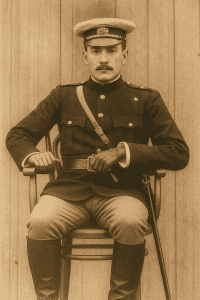
Michael Henry Connery was born in Dublin on May 8, 1856. His father, Michael Connery, was a private on the married establishment of the 96th Regiment of Foot, a precursor to the Manchester Regiment. According to his own testimony, he travelled as a very young boy with the regiment to South Africa and then India before returning to England in October 1868 when the 96th Depot was stationed at Colchester.
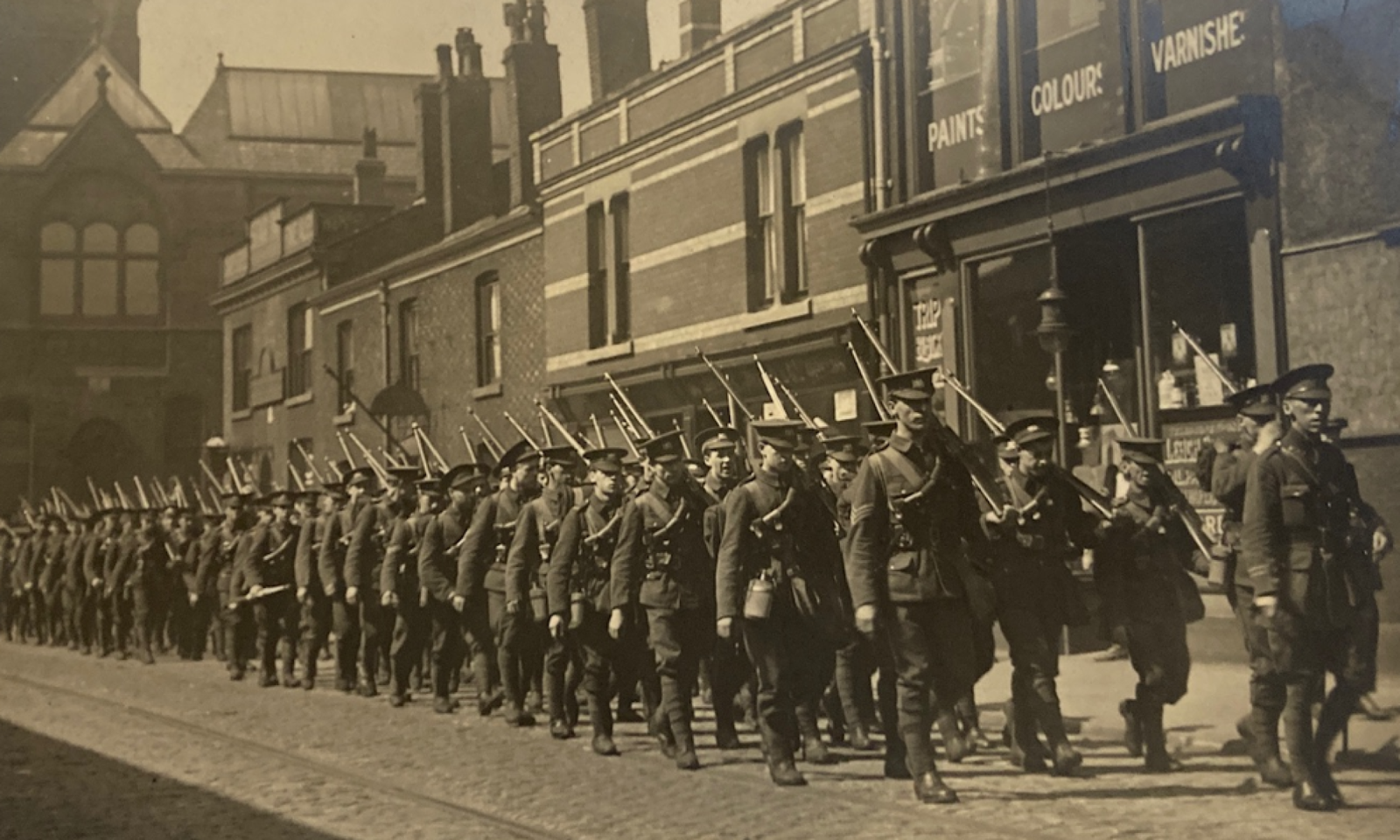
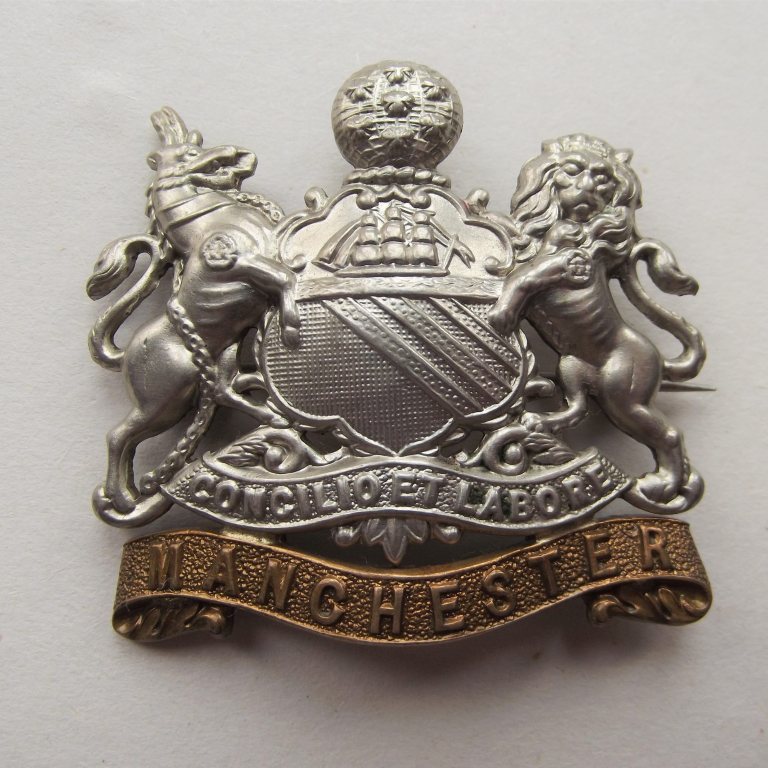
And so it was that on April 19, 1869 he too joined the 96th Regiment of Foot, at Colchester as a boy soldier, giving his age on attestation as 15 when, in fact, he was not yet 13. He was promoted rapidly and by 1873 he was a corporal and living at the barracks at Ashton-under-Lyne. Here he met and married Ellen Egan and together they had three boys. His first son, William Lawrence Connery was born in Ashton-under-Lyne on November 25, 1875. James Thomas Connery was born in Gorton on June 5, 1877 and Joseph Michael Connery on June 21, 1879. On July 1, 1881 the Childers Reforms came into effect and the 96th Regiment of Foot amalgamated with the 63rd (West Suffolk) Regiment of Foot to form the Manchester Regiment.
But in November of 1882 he discovered that his wife was committing adultery and so he petitioned for divorce and the final decree was granted on August 5, 1884. He retained custody of his three sons.
In May 1886 he married Emily Field while he was a Sergeant Quarter Master for the Manchester Regiment and still living at the Army Barracks in Ashton-under-Lyne. The following year his fourth son Arthur William Field Connery, named after his wife’s father, was born in Ashton on July 19, 1887.
On May 16, 1892 his son James Thomas Connery followed in his father’s footsteps and joined the Manchester Regiment as a 15 year old boy. His younger brother Joseph Michael Connery followed his lead and also attested on June 19, 1893 just before his 15th birthday. His oldest son William Lawrence had joined the militia but on January 10, 1894, (while still serving in the militia), he too joined the Manchester Regiment.
On July 7, 1897 Michael Henry Connery was commissioned as Honorary Lieutenant and Quartermaster for the 3rd & 4th Battalions, Manchester Regiment (since regulations only allowed one Q.M. at the barracks and both battalions shared the depot there). By March 1901 he and his wife were both still living in the Army Barracks at Ashton, their youngest son Arthur away at boarding school.
From June 17, 1901 to September 30, 1902 he served in the South African Campaign as Transport Officer of the 5th Battalion (May 1901 to April 1902) and then Transport Officer of the 6th Battalion (May 1902 to September 1902). During his time with the 5th he also served as Supply & Transport Officer for Colonel Barker’s Mobile Column, at Wynburg (October 1901 to May 1902). He was awarded the South African Queen’s Medal with 5 Clasps: Cape Colony, Orange Free State, Transvaal, South Africa 1901 and South Africa 1902. He was also mentioned in despatches (Gazetted July 29, 1902) as was his oldest son, Colour Sergeant William Lawrence Connery (Gazetted September 10, 1901). Based upon his service in the Boer War, Lieutenant Connery was promoted to honourary Captain on August 22, 1904 “for his conduct in the field.”
Since he misrepresented his age when he attested, the Army reckoned that he had reached the mandatory retirement age of 55 years on April 19, 1909, by now serving with the 4th Battalion. Although he was eligible to retire on an annual pension of £200 per year, instead he elected to join the 9th Battalion Manchester Regiment, Territorial Force as their Quarter Master. By 1911 he had been promoted to Honorary Major and Quarter Master, (Gazetted April 22, 1909), and he and his wife had moved out of the Barracks and were living at “Willow Bank” on Henrietta Street, Ashton. In June 1911 he was honored by being selected to attend King George V’s coronation in London as Quartermaster to the composite battalion sent by the East Lancs Division.
He sailed with the 1/9th to Egypt in September 1914 and in April 1915 his youngest son, Arthur William Field Connery, joined him as a freshly commissioned Second Lieutenant and serving as an infantry officer. They landed with the 9th Battalion at Gallipoli on May 9, 1915, the day after his 59th birthday. On June 14, 1915 Major Connery was slightly wounded in the left arm by shrapnel when a shell landed on his dugout but was treated at a field ambulance and remained at his post. He was again slightly wounded on July 13, this time in the right thigh, but once more remained at his post. A week earlier, his son 2/Lt. Arthur Connery had been wounded in the mouth and medically evacuated to England. On August 22 his son Hon. Lt. Joseph Michael Connery arrived to serve with him but his stay was very brief, becoming sick after 4 days and then subsequently medically evacuated to England.
He left the peninsula with the 1/9th Battalion in December 1915 and on December 29th was appointed Embarkation Officer for the 42nd Division for their move to Egypt. He continued to serve with the battalion in Egypt during the first half of 1916 until he was hospitalised for sunstroke on July 23, 1916 at El Ferdan. He was admitted to the 31st General Hospital at Port Said the following day where he was proscribed rest and then medically assessed on July 7th. They found him to be suffering from Nephritis and Granular Kidney. He was invalided home from Egypt embarking the Hospital Ship Galika and arriving at Southampton on July 18, 1916. Here he was admitted to the 4th London General Hospital, Denmark Hill where he spent a couple of nights before they confirmed the diagnosis of chronic nephritis and sent him home.
Back in Ashton he went into Manchester and was medically assessed at the 2nd Western General Hospital, Withington Street on August 3 where they noted much albumin in the urine and that his heart beat was irregular. They recommended that he come in for treatment and granted him 1 month’s leave, effective from July 20. He remained in hospital for about 2 weeks.
On October 3, 1916 the War Office informed him that he was to be “Gazetted Out”. Not a man to take things lying down he had himself independently medically examined and wrote back to the War Office respectfully requesting that he be employed, for Home Service, in any other capacity.
Bedford House
Ashton-u-Lyne
October 18, 1916
I have examined Major M.H. Connery, M.C. and find he is still suffering from Nephritis with an intermittent high tension pulse. His general condition is however very good and he expresses himself as feeling very fit.
He is anxious to do something and personally I think he is quite capable of undertaking Home Service which would not in my opinion retard his recovery.
Robert Bleasdale, M.B.
The War Office informed him that due to the amalgamation of the reserve units of the Territorial Force that no vacancies existed for Quarter Masters and he relinquished his commission due to ill-health on October 7, 1916. Later in the year he was awarded the Military Cross for his services in Gallipoli and received his medal from the King at Buckingham Palace in late December.
April 1917 was a tumultuous month for Major Connery. A vacancy appeared with the Scottish Command at a Prisoner of War Camp and he reported for duty to Stobs Military Camp, near Hawick, on April 27, 1917. The following day his wife Emily passed away and was buried at Hurst Cemetery, Ashton. He later became Adjutant & Quartermaster at the Prisoner of War Camp, Caolasnacon, a camp for German PoWs who were building the road along the southern side of Loch Leven. He was still serving here on May 8, 1919 when he was ordered to report to the 2nd Scottish General Hospital, Edinburgh for a medical assessment. They found him to be “very stout”, surely a euphemism for a man over 15st but only 5ft 8″ tall, and still suffering from an irregular heartbeat. They noted that he was short of breath with the slightest exertion but had no pain or other symptoms. As a consequence he was placed on the retired list effective July 1, 1919 and given the honorary rank of Lieutenant-Colonel for his long and distinguished service. He retired on a pension of £300 per year.
He died peacefully at home in Ashton on April 25, 1921 at 8:30pm and was buried on April 29th at Hurst Cemetery with his wife, Emily, who predeceased him. Thousands of people lined the streets of Ashton to pay their respects. His oldest son, Lt.-Col. William Lawrence Connery, M.B.E., J.P., and mayor of Ashton, was later buried in the same plot when he died in April 1944.
The Ashton Reporter carried the following article published on Saturday April 30, 1921:
DEATH OF LIEUT.-COL. M. CONNERY
Fifty Years in the Service, and Four Sons with Commissions
POPULAR QUARTER-MASTER OF TERRITORIALS
We regret to report the death of Lieut.-Col. M. H. Connery, M.C., late of the 1/9th Battalion Manchester Regiment, (T.F.), which occurred on Monday night at his residence, Willow Bank. Henrietta Street, Smallshaw. Col. Connery’s end was very peaceful. Although he had been under the care of Dr. Beasedale for some time, he had been able to go about and was out of doors on Monday. In the evening he sat reading in his favourite chair. He put his book down and said to his daughter-in-law, “I don’t think I will read any more”. His head fell on his shoulder and he passed away. He died practically in harness for he had been down to the Armoury practically daily since the Defence Corps was raised.
Col. Connery was born in Dublin 65 years ago. His father was in the old 96th foot (now the 2nd Battalion Manchester Regiment). He joined the Manchester’s as a boy of 16, and served his country for almost half a century. He rose from the ranks and was gazette quartermaster in the Manchester Regt. in July 1887. He served in the Boer War. Once he was thrown from his horse and he often was troubled with his leg as the result of the fall.
WITH THE TERRITORIALS
When he retired from the regular forces in April 1909 he accepted the post of Quartermaster with the 9th Battalion, Manchester Regiment. He needed no Army Manual to teach him the duties of a Quartermaster, he knew everything laid down in regulation and a good deal more besides.
It was his association with the Ashton Territorials that has endeared the name of Connery to Ashton. When Major Connery, (everybody knew him as Major), became the Quartermaster of the First Ninth, he soon became a prime favourite amongst the officers and men. He was no slacker, and he permitted no slacking. When the Major was in a reminiscent mood he could tell stories – tinged with an unmistakable brogue, and the point well emphasized by his slight impediment in speech – until one’s sides ached with laughing. He could conjure up rations and desirables when in camp, in a manner that was the despair and admiration of other quartermasters. He worked on a system, and if he said the transport would be ready at a given time, it was ready to the minute.
THE OUTBREAK OF WAR
When the Territorials were mobilised it was a study to watch the Major’s face when the appeal was made for overseas volunteers. How it lighted up when almost to a man the Battalion stepped forward. “I knew it”, he said, “the Ashton lads were always game!” If they were ready, so was he, and despite his age, he jumped like a schoolboy at the chance of once again taking active service. He endured the heat of Egypt and the trials, the sufferings and the horrors of Gallipoli.
In July 1916 he reluctantly returned home on sick leave after being with the Battalion since it left Ashton in August 1914. His moustache was a little greyer, and the burly figure not quite so pronounced, but his healthy sun-tanned face, with its irresistible smile, belied his years. It was easy to grasp why he was highly esteemed both by the men of the Battalion and the people at home. His warm-hearted sympathy, his cheery good humour, and his solicitude must have been like balm on a sore to the nerve-strung men – some only mere striplings – as they emerged from the firing line. There are many mothers and fathers in Ashton who have thanked God that Colonel Connery was there to cheer and comfort their sons and look after their welfare amid the trials and dangers of the war in foreign lands. He was father, counsellor, and guide to them, and whilst on the Gallipoli Peninsular he saw to it that the men wanted for nothing if he could get it for them.
AWARDED MILITARY CROSS
Whilst in Gallipoli, Colonel Connery was twice wounded and was awarded the Military Cross. The record of recommendation by Major-General Douglas, in charge of the 42nd East Lancashire Territorial Brigade was as follows: –
“For his consistent devotion to duty in the performance of his duties as quartermaster. He has been twice wounded by shrapnel in carrying out his duties but continued to carry them out. He personally saw his convoy of supplies each day to their destination, under heavy shell fire. His influence for good has had a marked effect in his battalion. He has given frequent assistance to inexperienced quartermasters of other battalions. He is one of the best quartermasters I have ever known. I cannot speak too highly of his services.”
A CHAT WITH THE KING
On Dec. 9th, 1916 Colonel Connery was presented to his Majesty the King, who pinned the Military Cross on his breast, and warmly congratulated him upon his gallant conduct.
The King greeted him with a pleasant smile as he advanced and bowed, which at once placed the gallant colonel quite at ease. Then, after pinning the Military Cross on the Colonel’s breast, his Majesty chatted pleasantly with him. The King asked Colonel Connery what length of service he had and was surprised when he was told it was 48 years.
“How old are you, Colonel?”, asked the King, adding “I see you have been wounded twice.”
“Sixty your Majesty,” replied Colonel Connery.
“Have you any sons serving?”
“Four, all bearing your Majesty’s commission,” proudly replied Colonel Connery.
“Wonderful!”, observed the King. “You have done well – very well.”
FOUR SONS WITH COMMISSIONS
Colonel Connery was justifiably proud of the fact that he and his four sons all gained commissions from the ranks. His sons are Captain and Quartermaster W. L. Connery, M.B.E., now stationed at the Ashton depot; Captain J. T. Connery, who holds an appointment at the War Office; Captain Joe Connery, now retired; and Captain Arthur Connery, M. C., who is now in the Argentine.
Colonel Connery was a man of abstemious, almost Spartan, habits. He lived simply and sparingly and was a staunch teetotaller. He has gone, but his memory will live long in the hearts of those who realized the heart of gold which throbbed under a brusque exterior. Simple in tastes, and a man who sincerely tried to do his duty for his King and country; a man who did many a good deed by stealth and blushed to find it fame. The loss of so true a man will be sincerely mourned.
The following paragraph was published in the Manchester Regiment Gazette regarding his funeral:
“The Requiem Mass took place, at St. Mary’s Church, Ashton, on Friday April 29th was attended by a large number of people. Full military honours attended the funeral. Those present included the Colonel’s relatives, a number of officers from the Depot, and a number of Territorial officers who had served with him during the war. A party of Territorials, and also another party from the Depot, marched in the rear. The interment took place at Hurst Cemetery, where, as all along the route, large numbers had assembled to pay their last tribute to an old comrade.”